
The OnlyFans funnel on social media
How mainstream platforms expose children to sexual content that mimics pornography and directs users towards paid-for sexual content on platforms like OnlyFans
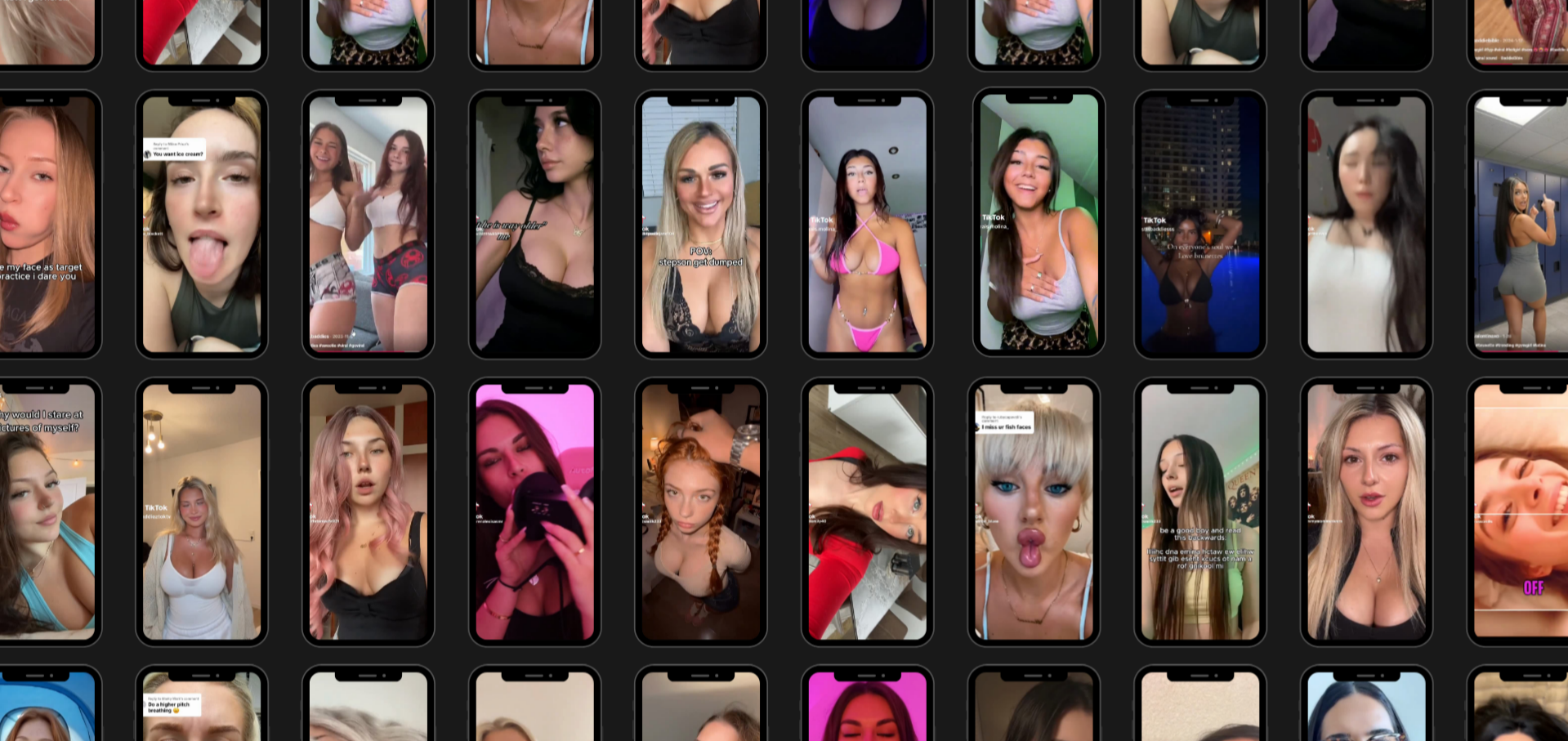
It is true that it is hard to find explicit pornography on TikTok, Instagram and YouTube. But children are able to see sexual content in which creators mimic pornography on these platforms. This includes creators pretending to perform sexual acts on the viewer, videos filmed to make it appear as though the creator is having sex with the viewer, and videos in which creators instruct viewers on how to masturbate. Examples of these videos are shown below – taken from TikTok.
When we looked more closely at the creators behind these videos, we found that many were using mainstream social media platforms as a route into paid-for sexual content elsewhere. Often, users were directed towards platforms such as OnlyFans, where creators advertised explicit material, including “sex videos”.
On the mainstream platforms themselves, the videos posted by these “funnel accounts” often appeared to stay within platform guidelines. But they still served as promotional material for more explicit paid content hosted elsewhere.
Would you be happy with your child seeing this content?
Where would you draw the line?
At Revealing Reality, we spend a lot of time examining what children and teenagers actually see online.
In our recent research, Infinite Scroll, we analysed children’s TikTok watch history data: data held by TikTok which shows every video a child has watched for up to the previous two years. Children downloaded the data themselves from TikTok, using their right to access their personal data under GDPR, and shared it with us with their consent.
14–15-year-olds saw sexual content in their TikTok feeds, which appeared to direct viewers to sites such as OnlyFans
Our analysis of one month of watch history data, from January 2026, found that multiple 14- and 15-year-olds had been shown sexualised content in their TikTok feeds.
Some of this content took the form of sexualised dancing and suggestive posts, often featuring women dancing in bikinis, leggings, or other revealing clothing, accompanied by hashtags such as #sexy, #hotgirl, #baddie, #leggings, and #babygirl. This kind of content may be familiar to people who have recently looked at teenagers’ feeds. However, some children also saw videos which appeared to more closely mimic pornographic content, like the first of the three videos below.
When we looked more closely at the accounts behind this content, we found that many of these accounts appeared to be using TikTok to direct users elsewhere.
For example, all three of the videos shown above, which were seen by 14- and 15-year-old children in our research, were posted by creators whose profiles linked to subscription sites where they were promoting their paid-for adult content.
For these three creators, the linked platforms were OnlyFans and Fanfix.
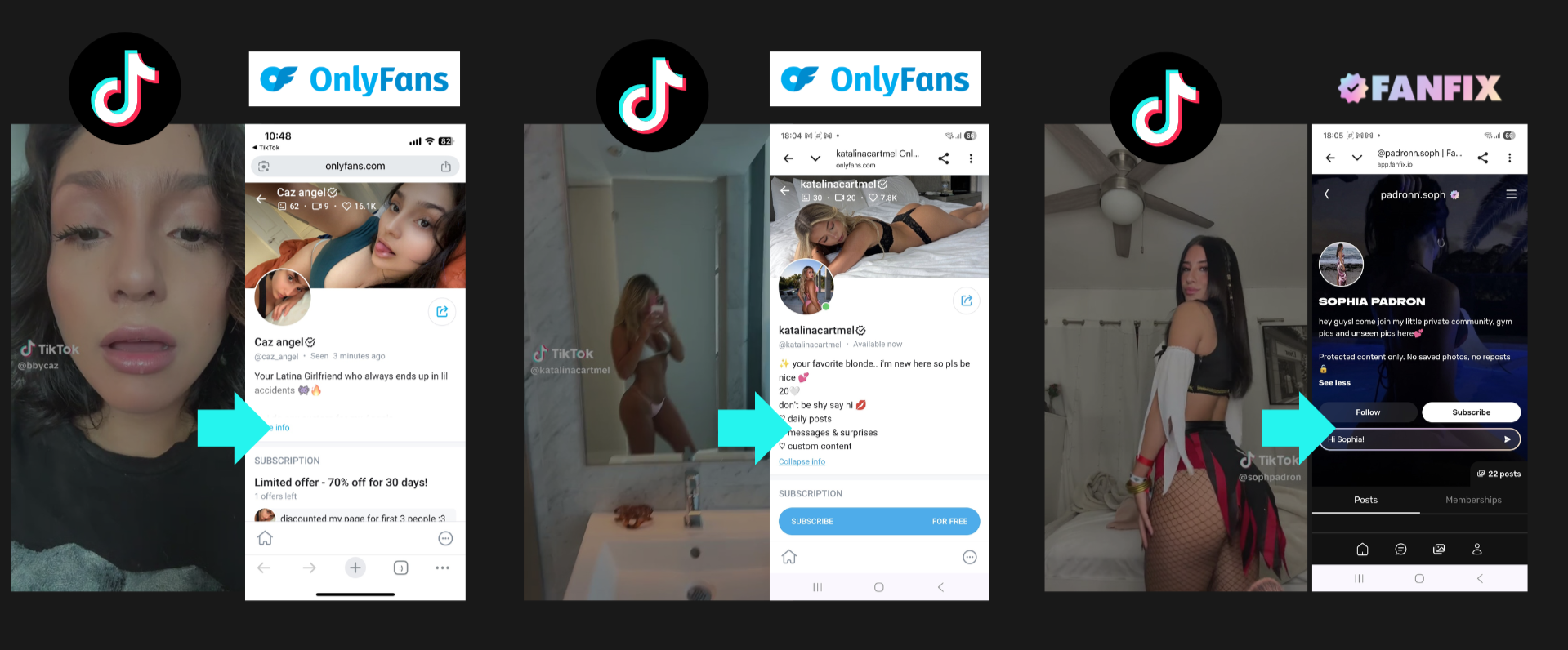
Creators were using TikTok to ‘funnel’ viewers to sites such as OnlyFans, where users can pay for adult content
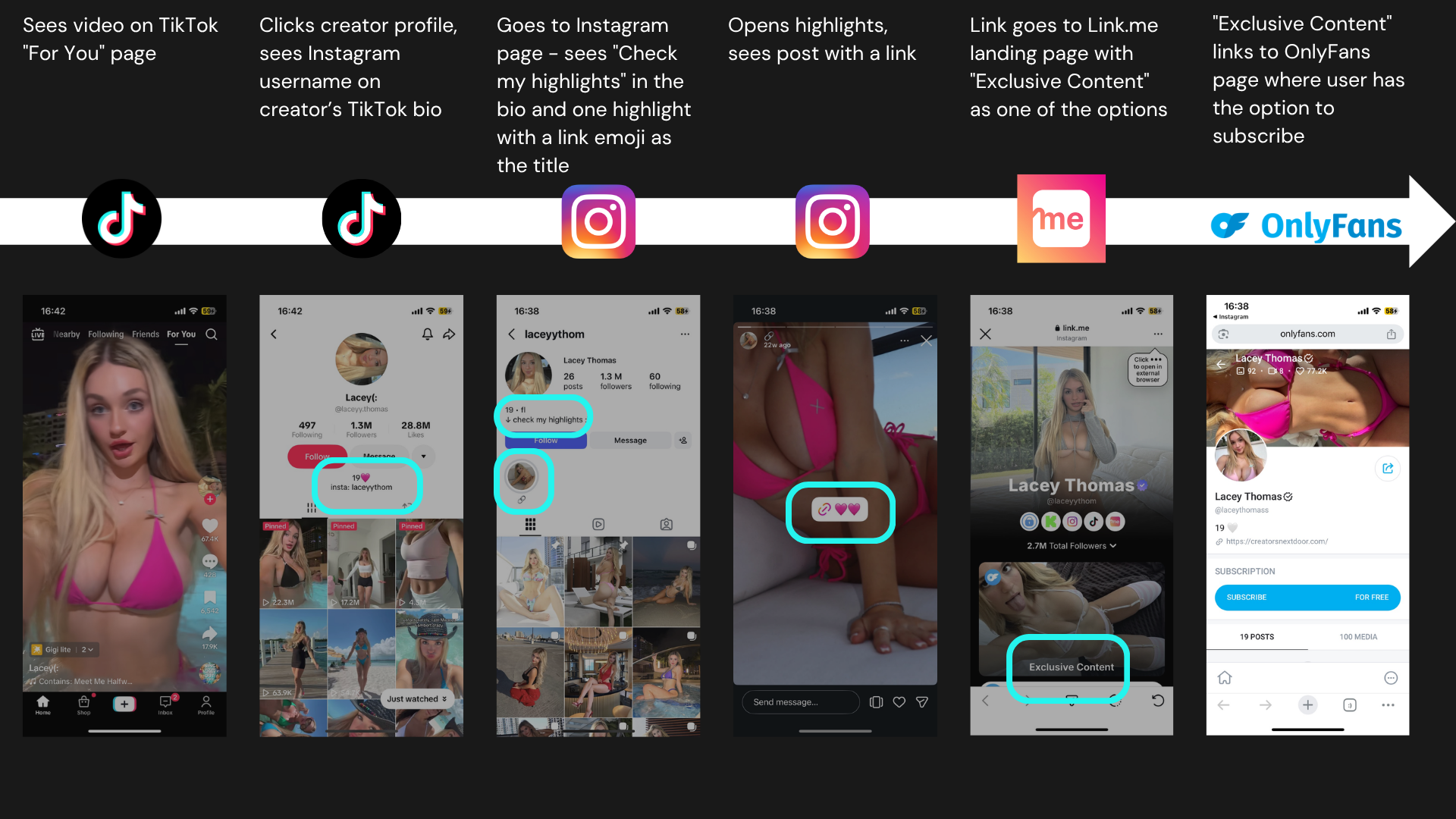
The videos themselves mostly did not include explicit links to adult content. Instead, creators used indirect routes to direct users from TikTok to other platforms. This typically involved several steps: for example, the TikTok profile links to an Instagram account in the ‘bio’, which then directs users to a ‘Link.me’ page – a customisable landing page containing multiple links, including a link to the creator’s OnlyFans page.
An example of a typical pathway from one of these ‘funnel accounts’ that we saw is illustrated below, starting on TikTok and ending on OnlyFans.
When followed, these pathways led to a number of subscription-based platforms such as OnlyFans, Fanfix, Fansly, MYM, Chaturbate or similar services, where users could pay to view explicit, sexual content from the same creator. They also led to other social media platforms such as their Snapchat accounts, Discord servers, Telegram channels and Reddit threads, all containing more sexual content.
Why so many steps?
The likely reason is that these indirect routes reduce the likelihood of content being blocked or removed. The sexualised content remains visible on the mainstream platform, while the more explicit commercial content sits elsewhere.
Customisable landing pages, using platforms such as Link.me, Linktr.ee, or Beacons.ai, create an additional step between the social media profile and platforms like OnlyFans or other subscription services containing adult content. Examples of these ‘landing pages’, with links to platforms selling adult content are shown below:
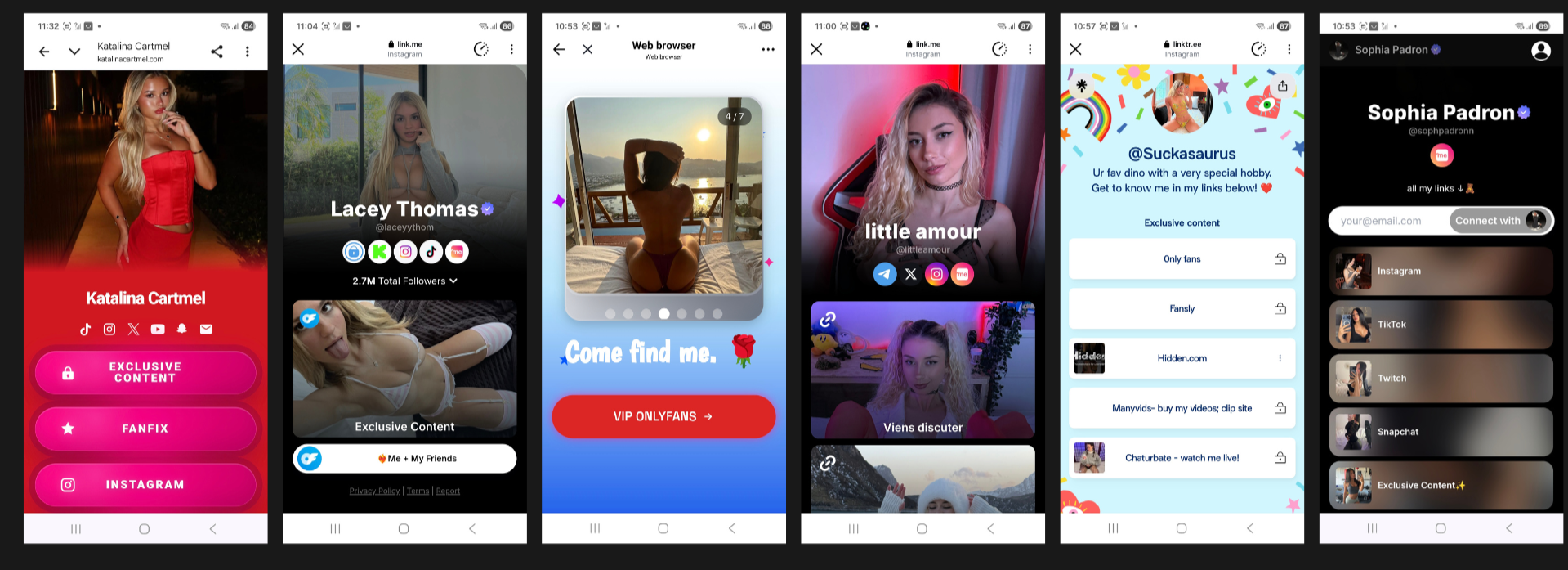
This extra step may make these accounts less likely to be identified by social media platforms as funnel accounts linking directly to 18+ content, which would be against platform guidelines.
There is a genre of sexual content that seems to be designed to mimic pornographic content, while remaining just within the boundaries of the platform’s guidelines
When we looked at accounts similar to those seen by children in Infinite Scroll shown above, we quickly found many other videos in the same genre. These videos appeared to mimic pornographic content, while staying within the boundaries of platform guidelines.
Examples of the accounts we came across are shown below:
As the examples show, this content often uses familiar techniques from pornographic or sexually intimate content without being explicit. This includes point-of-view, or POV, formats, where the creator acts out a scenario, plays a character, and casts the viewer in an assumed role, such as a sexual partner. Videos also use intimate camera angles and ASMR techniques, including visceral sensory elements such as spit and bodily sounds.
Over time, we have seen less overtly explicit material on social media platforms than might have appeared in previous years. However, sexualised content is still easy to find. Much of it appears to “sail close to the wind”: sexual enough to capture attention and engagement, but not so explicit that it would necessarily break platform guidelines or be removed.
14-year-olds in Infinite Scroll were registered on TikTok as adults, so we set up avatars to test whether accounts registered as 14 years old could see the same content
In Infinite Scroll, the children seeing this content were aged 14 or 15, but had TikTok accounts registered as being in their twenties or thirties.
To test whether this content was only available to them as a result of the age settings on their accounts, we created a TikTok avatar registered as a 14-year-old and searched for one of the content creators that children in the research had been served, a known ‘funnel’ account directing users to OnlyFans.
The result was immediate: clicking on the video and scrolling through TikTok’s suggested ‘related content’ served up a stream of similar content. The algorithm appeared to recognise this as a 'genre' and provide a consistent feed of sexualised videos. Many of these accounts also appeared to be funnel accounts, directing users to other platforms where creators monetised sexual content.
The screen recording below shows the videos that were shown to a TikTok account registered as a 14-year-old following searching for a known ‘OnlyFans funnel account’:
There were some differences between the child and adult account experiences. For example, the child TikTok account was not able to see external links in TikTok bios, and Instagram blocked access to some accounts where the user had to be 18+ to access the profile, as shown below:
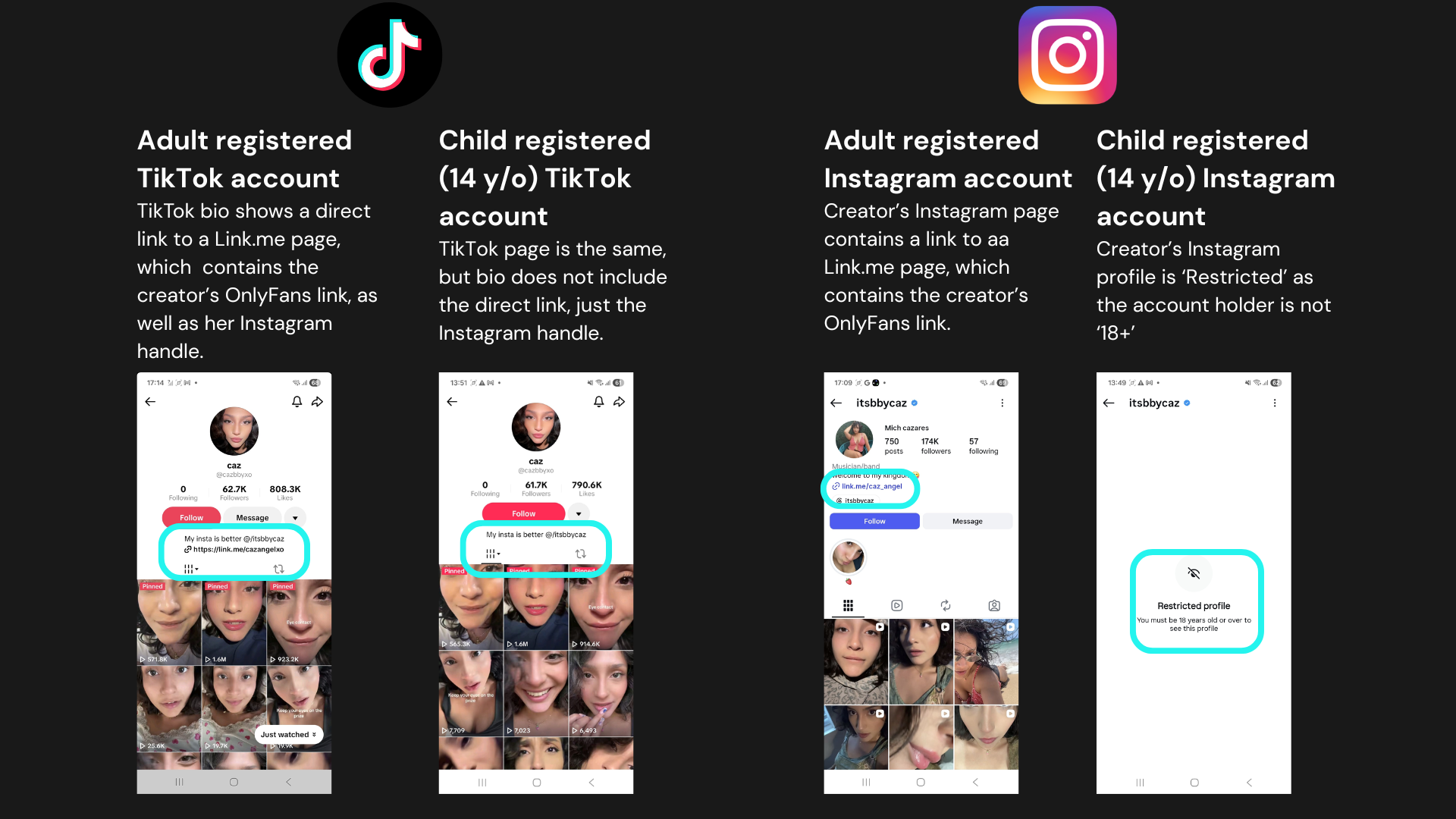
But the underlying issue remained: a 14-year-old account was still able to encounter highly sexualised content from creators who appeared commercially motivated to sell more explicit material elsewhere.
In other words, some protective measures may alter the pathway to adult content, but they do not necessarily stop children from seeing the sexualised promotional material itself.
This is not just a TikTok issue – the same content was easy to find on YouTube and Instagram
TikTok was the main focus of this strand of research because it was the platform we were studying at the time in Infinite Scroll. But the behaviours we observed are not limited to one platform.
A brief look at YouTube showed similar patterns. For example, we searched for “ASMR intimate” and clicked one of the first results titled: Encouraging Whispers ASMR | GF Roleplay. A clip from this video is shown below.
In the clip, the creator roleplays as the viewer’s girlfriend and frames the interaction around helping the viewer “release” the stress of the day.
When we looked at her YouTube profile, we found a link in her bio to a Link.me page. From there, viewers could access “exclusive content”, which — as with the examples identified on TikTok and Instagram — directed them to externally monetised sexual content on OnlyFans. On that page, a “sex video” was being advertised to subscribers.
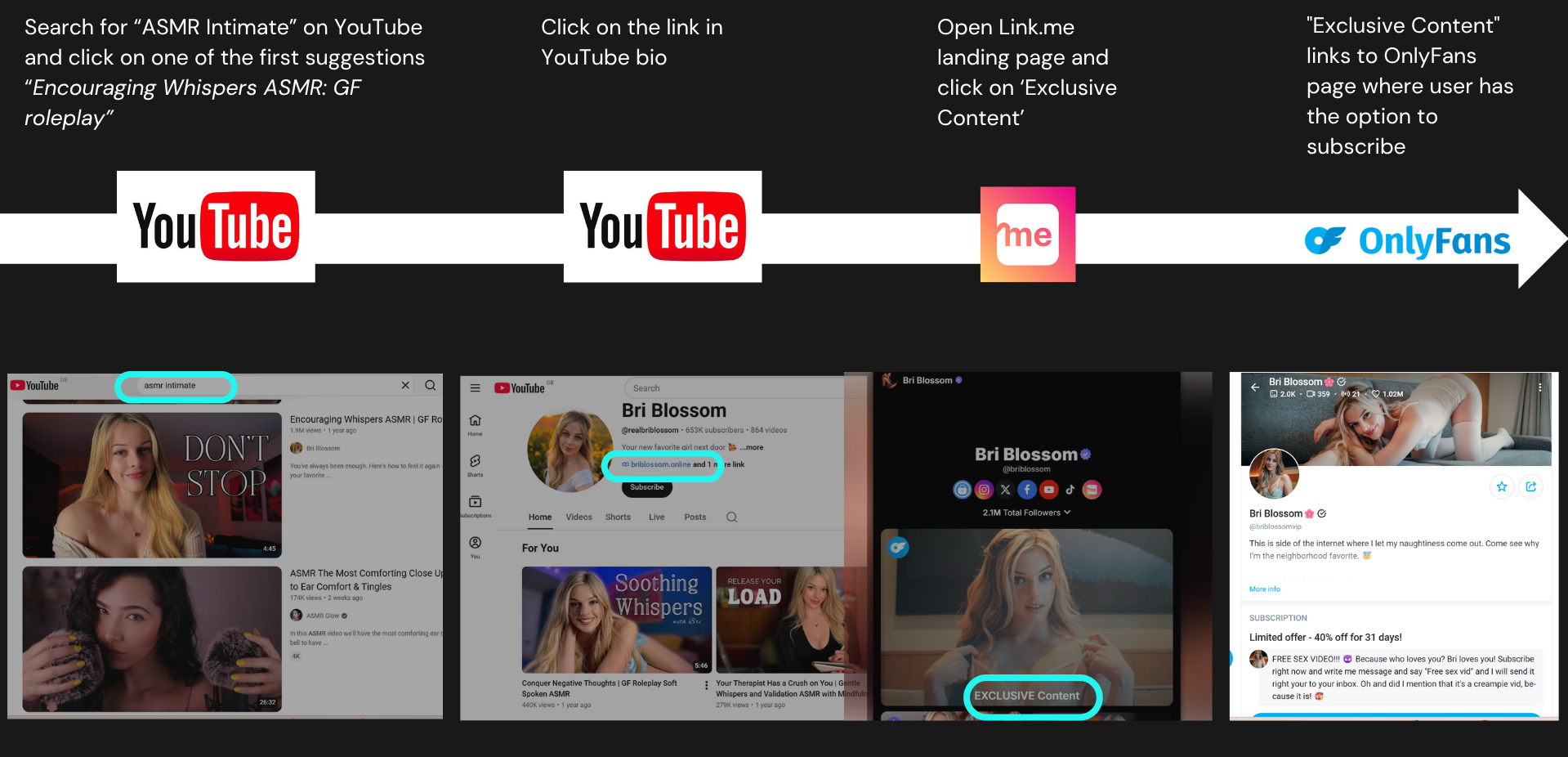
Again, it was not difficult to find content on YouTube that appeared to mimic pornographic tropes while also directing users towards OnlyFans accounts.
For example, the videos below show “mic pumping”: a form of ASMR in which creators press, squeeze, or touch a microphone to create rhythmic sounds. While this type of content may be framed as relaxing or calming, in some examples it also appears to carry clear sexual undertones.
Indeed, the first “mic pumping” video we clicked on, shown below, linked to the creator’s OnlyFans account, where they were advertising “full on sex content” to subscribers. The second example also promoted the creator’s “exclusive content” at the end of the video, alongside the line: “I want to be closer to you.”
As these examples show, the videos use many of the same techniques identified in TikTok “funnel accounts”. These include point-of-view formats in which creators roleplay as the viewer’s “girlfriend”, ASMR conventions such as whispering, and sexualised actions such as the “mic pumping” shown above.
Similar content was also found on Instagram. As noted above, creators often linked to their Instagram pages from their TikTok profiles. The content shared across both platforms was largely the same, as illustrated below.
This matters because platform-by-platform analysis can miss the wider pattern. As illustrated in our features mapping across platforms in Infinite Scroll, many platforms share the same underlying design features that can increase exposure to this kind of content.
These include algorithmically driven feeds that recommend content based on previous engagement, video-sharing functions that allow clips to travel quickly across audiences, and search and recommendation systems that can lead users from relatively ambiguous or “borderline” content towards more explicit material. They also include profile bio links and external linking mechanisms, which make it easy for creators to move viewers away from the platform and towards monetised adult content elsewhere.
Taken together, these features operate within an attention economy in which creators are incentivised to capture, retain, and monetise viewers’ attention. As a result, the issue is not confined to any single platform. Instead, similar platform designs can create similar pathways through which users are exposed to sexualised content and funnelled towards external subscription sites.
Sign up to hear more
Read Infinite Scroll
xxxx Click here
Contact the team
Feel free to contact damon.deionno@revealingreality.co.uk to speak with the research team