INFINITE
SCROLL
Growing up on TikTok
This report presents the most up-to-date, detailed portrait of a child's life on one of the most popular social media platforms among children in the UK today – TikTok. The research draws on multiple methods. Some are technical, including data from children’s phones showing exactly which apps they use, when they use them, and for how long, as well as data from TikTok itself showing every video a child was served. Some methods are simpler: watching screen recordings of children scrolling, and asking them directly what they think about their own use.
Many children are now spending a significant proportion of their childhood on social media. As researchers who have spent the past 10 years understanding and observing children's media behaviours, one of the clearest shifts we have seen is the rise in time spent scrolling through short-form video content — or, as many children call it, "doomscrolling."
This is why it's worth looking closely at one of the main platforms where we see this behaviour: TikTok. Scrolling through short-form video content is of course not limited to TikTok, with many other social media platforms adopting similar features — from Instagram Reels to YouTube Shorts.
"It's just a bit of fun."
"It's how kids connect now."
"It's how they learn about the world."
"It's how they express themselves."
But have you actually looked?
Looked at what they are doing when they are on TikTok? At what fills the feeds they scroll through? At what keeps them there for hours a day? And at what children gain in return for their time?
Because if children were spending hours a day in any other space, we would want to understand what was happening there.
If you do nothing more, spend one minute watching this video.
This video is just one minute of screen recorded data from one of our research participants, 14-year-old Charlie, showing him scrolling through his TikTok "For You" page. It's similar to many, many hours of recorded scrolling we review every year.
Charlie spends an average of three and a half hours a day doing this. It is worth taking one minute to see what that looks like.
Read on to find out more about TikTok through the eyes of a child.
About this report:
This report is based in part on data from a pilot study utilising the ConnectLive app, the development of which was co-funded by 5Rights Foundation, Together Creative, and Revealing Reality.
Throughout our longstanding partnership, 5Rights Foundation have successfully used our evidence of how the design of online platforms shape children's behaviour to drive real change for young people around the world. Here, we turn the spotlight on one of the most successful and ubiquitous design features: infinite scroll.
We recommend reading this report on a laptop or desktop rather than a phone. Phones are optimised for scrolling short form video, not reading about it.
Foreword by 5Rights Foundation
Putting paid to infinite scroll for children
By Leanda Barrington-Leach
Short-form video is taking over the internet. Powerful algorithms personalise infinite scrolls of “snackable” content across social media, e-commerce, news, education and streaming services.
This shift is often referred to as the “TikTokisation” of communication, but also of information, of politics, of learning, and even of “the world”.
TikTok’s meteoric rise testifies to the heady commercial power of the formula. YouTube Shorts quickly followed (with a much bigger child audience), along with Instagram and Facebook Reels, Snapchat Spotlights, Netflix Clips and Spotify Clips, all of which bombard children with never-ending 30-60s clips, much of it highly targeted and commercial. News websites such as the BBC and CNN have made short-form video central to their offering for young people, while EdTech platforms such as Coursera and Nibble offer bitesize video education.
That short-form infinite feeds work to keep children hooked is uncontested. Teenagers spend an average of just over 3 hours every day flicking through videos on TikTok and YouTube alone. The returns to these companies, both in immediate advertising profits as well as future markets, are enormous.
But what is the value to children? As this research shows, children are going through an average of more than 700 videos per day on TikTok alone, spending less than 5 seconds on each, with much of the activity taking place throughout the night. This “doomscrolling” of disconnected, fragmented and contextless snippets of meaningless content makes them feel tired, guilty and bad about themselves.
In drilling down into the real time and granular experience of 21 children on TikTok – our research exposes how this heady cocktail of mechanisms works to co-opt developing minds, and how it is further reinforced by functionalities including autoplay and popularity metrics, which are equally ubiquitous across many other apps. Complementing clinical research on the impact on cognition and well-being, it also reveals children’s lived experience: of compulsive use, disrupted sleep, loss of agency and brainrot.
Infinite Scroll shines a spotlight not just on the ruthless exploitation of children by social media apps, but on the risks posed by features and functionalities now commonplace across the digital ecosystem that shapes almost every aspect of children’s lives – what they think, how they behave, who they are.
It begs the question: What do we want childhood to look like? And: Understanding the mechanisms currently undermining children’s agency and development, how do we meaningfully turn the tide towards a digital future where children can thrive?
Putting paid to short-form infinite scroll for children would be a good place to start.
Introduction
TikTok is currently a big part of childhood
TikTok’s popularity exploded during the Covid-19 lockdowns and has been a constant presence in children’s online lives since. It is now one of the most popular social media apps used by children in the UK today. Of the hundreds of children we meet every year, a large proportion spend several hours a day on TikTok. That’s hundreds or even thousands of videos, every day.
TikTok is a short-form video-sharing app built around an endless, algorithmically personalised feed of videos
These features are not unique to TikTok. Over time, platforms copy each other’s most successful mechanisms.
Most social media companies make money through exposing users to advertising. They therefore design their platforms to keep users on them for as long as possible.
Features that successfully build usage habits on one platform tend to get copied by others. Streaks — a score of how many consecutive days you’ve completed certain activities on an app — were introduced by Snapchat in 2016 and have since been adopted by TikTok, Duolingo, Strava and others. Filters and beautifying tools are now near-universal, encouraging people to post more by making it easy to alter their faces and bodies. Stories — posts that disappear after 24 hours — began on Snapchat and spread to Instagram, Facebook and WhatsApp.
Scrollable feeds first appeared in 2006, when Facebook launched the ‘News Feed’. But TikTok mastered the combination of an infinite scroll feed with algorithmically selected short-form videos. These features powerfully capture and keep user attention because they tap into deeply rooted human instincts to pursue what are called ‘variable rewards’. Each swipe and scroll might bring up something funny, entertaining, shocking — or boring. The unpredictability is what makes us want to see ‘just one more’, the same mechanism behind a slot machine.
The infinite scroll proved hugely successful at keeping users online, and has been adopted widely across social media and beyond.
For a detailed breakdown of specific features across all major platforms – and a timeline of how they appeared, click below:
Children are particularly vulnerable to these techniques, but adults are far from immune.
These mechanics are effective precisely because they exploit human attention and habit formation— vulnerabilities that don't disappear when we turn eighteen. This compounds the problem for children. Growing up in a world where adults are also compulsive scrollers, children see this as normal.
It’s often assumed that children use TikTok to “connect”. But when we speak to children about how they use it – and observe their behaviour in real life – most of their time spent on the app is scrolling the “For You” page.
While TikTok includes features such as group and one-to-one messaging, children and young people more commonly use other platforms – particularly Snapchat – for direct communication.
The vast majority of time spent on TikTok is not social – it’s scrolling.
Method summary
The data in this report brings together the most detailed portrait of a child’s life on TikTok so far
This report combines data from four methods we use to explore children’s use of digital platforms (all data collected in January and February 2026). Some of these methods are more technical, others are straightforward and could be easily replicated by any researcher, policy-maker, or even a curious parent. All of them of course require clear informed consent, careful safeguarding and strong data protection.
Each method was designed to investigate how children experienced the platform, in particular documenting how design features like infinite scroll are shaping behaviour. We explored both the positive and negative impacts of TikTok in children’s lives.
You can see much more detail on how we gathered this data – the questions asked, stimulus used, analysis conducted – in the methodology annex.
23 children participated in this study overall. We are very grateful to the parents and children who took part, whose enthusiasm, collaboration and willingness to openly share their experiences of using TikTok in depth, made this work possible.
All names included in this report are pseudonyms and not the real names of the children who took part. Screenshots and screenrecordings from TikTok have been edited to remove any content that is not public, and protect the anonymity of children taking part.
ConnectLive is a research tool developed by Revealing Reality in partnership with 5Rights Foundation. Unlike other similar research tools, it combines granular passive monitoring of all app usage with the ability to automatically prompt short surveys triggered by specific app activity — enabling us to measure the in-the-moment impact on wellbeing and cognitive performance.
In this report: Data from a pilot study of ConnectLive with 23 children across the UKData donation. Any TikTok user can download their own usage data under GDPR. Within this dataset are the details of every individual video that has been watched by that user in a given time period, and at what time. From this data, we can also analyse what advertising has been served, what accounts are being most often watched, and which videos children are pausing on for longer.
In this report: Data from a subset of 7 children who took part in a pilot of data donation.Screen recording is a method we’ve used for over ten years to study what social media looks like through the eyes of a child. Most phones have an in-built screen recorder making it easy for participants to capture and share recordings. For this study, we asked children to record whilst they were scrolling TikTok (but it is easily replicated on any other platform).
In this report: Screen record samples from all 23 children who took part in the ConnectLive pilot.Ethnographic qualitative research and filming means we visit children in-home, understanding how digital technology fits into the wider picture of a child’s life.
In this report: Interviews conducted with a subset of 10 children who took part in the ConnectLive pilot study.
23 children aged 14-16 years old took part
Participants were aged 14–16 and were recruited on the basis that they used TikTok. They were not selected because they were unusually high or low users, had experienced specific harms online, or represented extreme cases.
They represent a range of backgrounds and demographics, with varying levels of self-reported TikTok use — from less than an hour a day to more than three hours daily. Their experiences align with what we see across the hundreds of other children we meet every year.
Note: Although 23 children took part in ConnectLive trial, two decided to delete TikTok before the data collection began. For this reason, findings containing TikTok usage data are based on the 21 children who were using TikTok during the research period.
There are of course limitations to what conclusions can be drawn from these small samples and larger-scale work is needed to scale the findings.
Case studies
Meet three of the children who took part in this study: Tom, 15, our heaviest TikTok user in the sample, averaging 4 hours 7 minutes a day; Emma, 14, whose average daily use was 1 hour 55 minutes, close to the sample average; and Sophia, 16 who used TikTok for an average of 57 minutes a day, less than the sample average.
Please note that some photos in this report have been edited to anonymise participants.
Chapter 1
It’s hard to stop the infinite scroll
Children are spending hours scrolling and don’t feel in control
ConnectLive data reveals how children are using their phones
ConnectLive data gives us a breakdown of when children use every single app on their phone, down to the second, 24-hours a day.
A typical pattern for children in this study is frequent and extended use of TikTok interspersed with stretches of Snapchat, plus intermitted spells on other social apps like WhatsApp, Instagram or X. Other more functional apps like Google Chrome, Maps, and Spotify also appear, as well as gaming apps, and increasingly, AI Chatbots.
The below data shows examples of children’s phone use for one of the days during the study - Thursday the 22nd of January 2026.
24-hour period of phone use for Katie (15) on Thursday 22nd January 2026
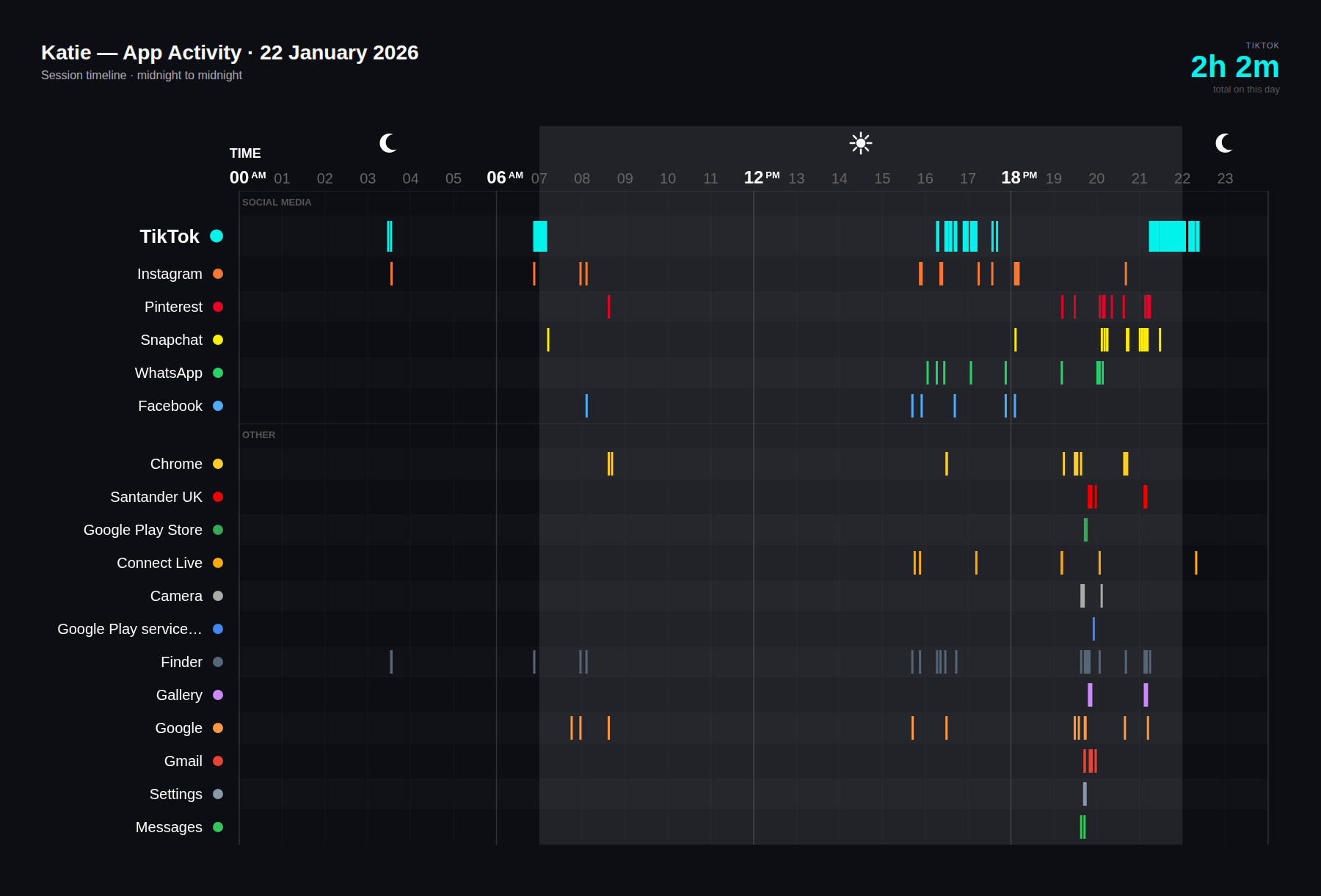
As you can see from the chart above, Katie’s TikTok use on this day was primarily after school and before bed alongside her use of other social apps including Instagram, Pinterest, Snapchat, WhatsApp and Facebook.
On this day Katie also spent a few minutes of scrolling, alongside opening Instagram, at around 3:30 in the morning.
24-hour period of phone use for Owen (15) on Thursday 22nd January 2026
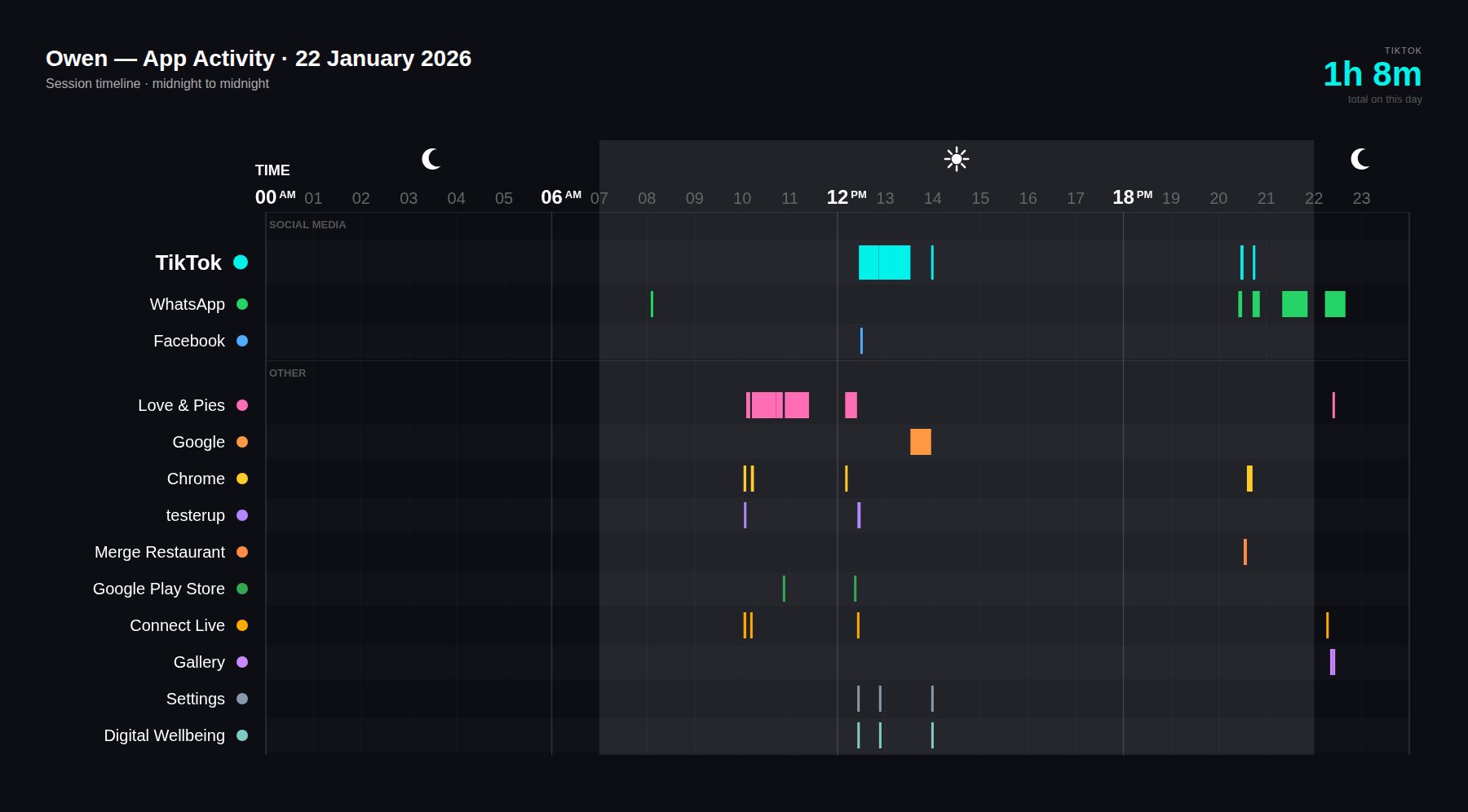
For Owen, his TikTok use appeared to occur during the school day, around lunch time, as well as some use in the evening. He also spent around an hour on a game called ‘Love and Pies’ during the morning at school.
For other children, such as Tom, TikTok was consistently used during the night.
24-hour period of phone use for Tom (15) on Thursday 22nd January 2026
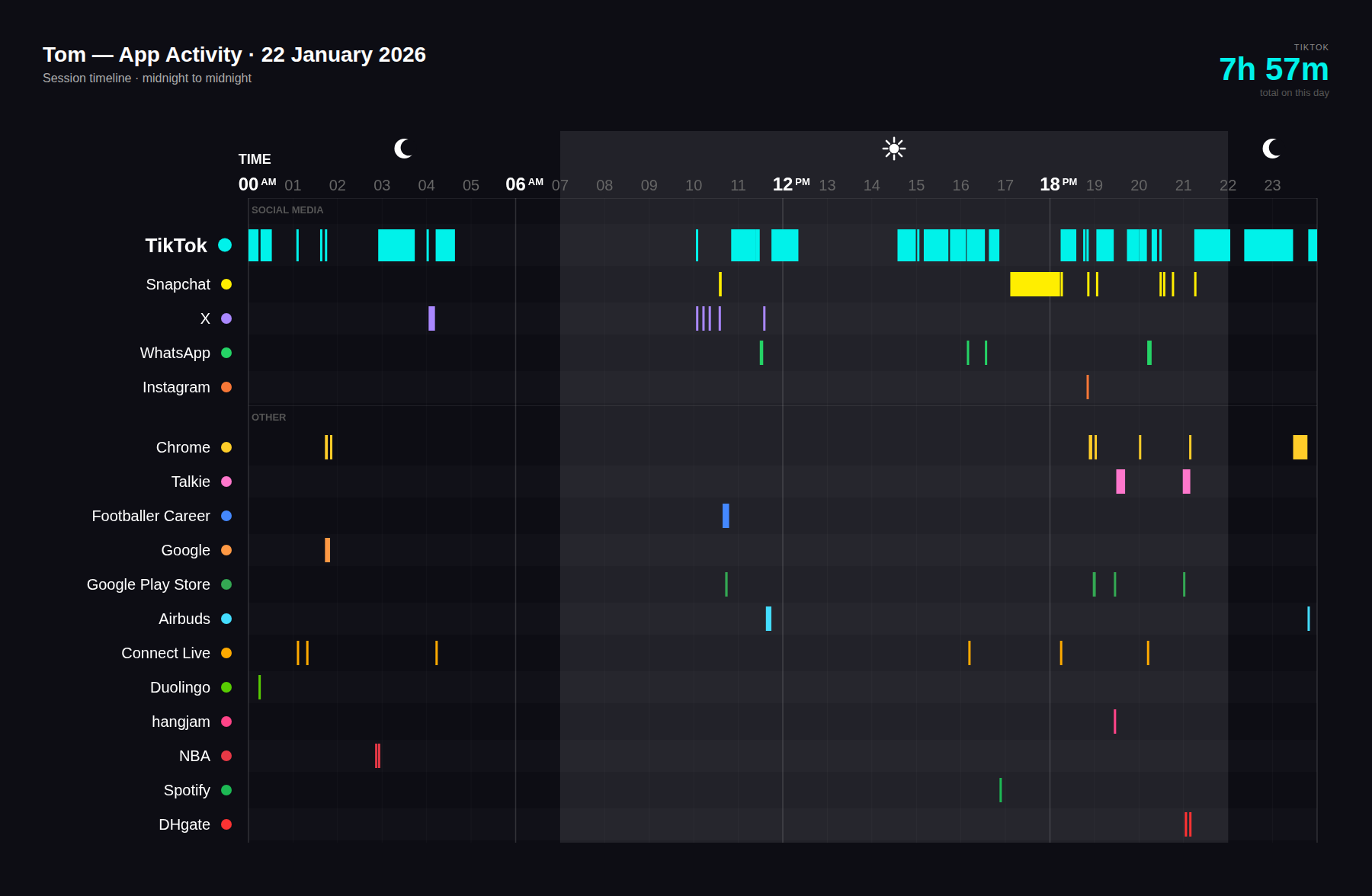
This shows Tom using TikTok late at night, first between midnight and 2am, and then again from around 3am to 4:30am.
It also shows fairly consistent use around lunchtime and after school, and throughout the evening.
We can also see that his TikTok use was broken up by around an hour on Snapchat, likely reflecting calls with friends while gaming — something Tom told us he often does. Tom also spends time on Talkie in the evening, an AI chatbot.
Children spent an average of 1h 41 on TikTok per day
Most of the 21 children used TikTok for more than 90-minutes per day on average. While a couple of children used TikTok for less than five minutes a day, several averaged more than three hours per day.
Average number of hours spent on TikTok per day
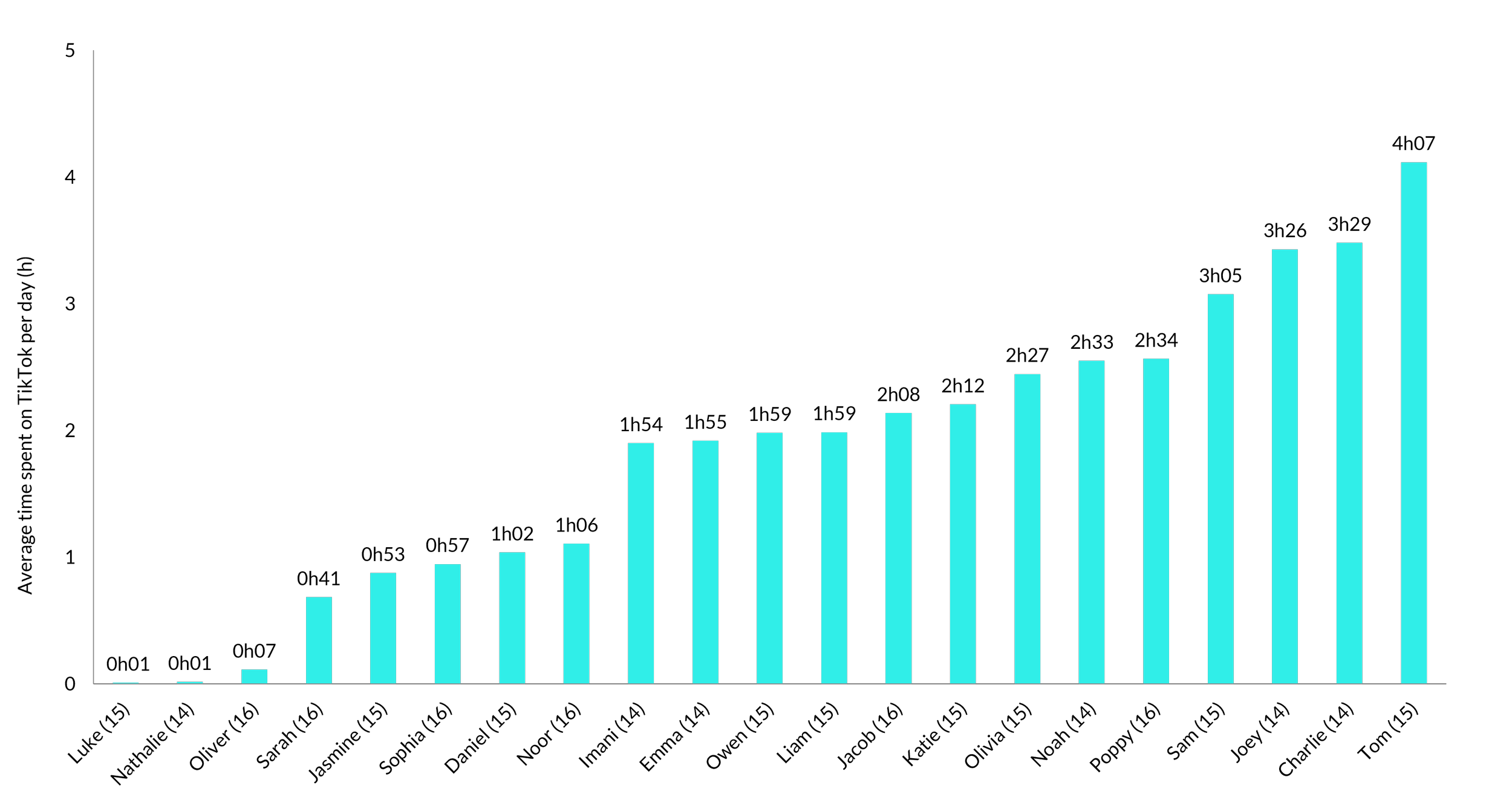
Average time spent on TikTok per day (h) for the 21 children who used TikTok. Average is based on approx. 3 weeks’ worth of ConnectLive phone usage data in January 2026
Analysis of when children use their phones revealed many were scrolling during the night, disrupting their sleep
TikTok was not the only app being used throughout the night, but it was one of the dominant ones.
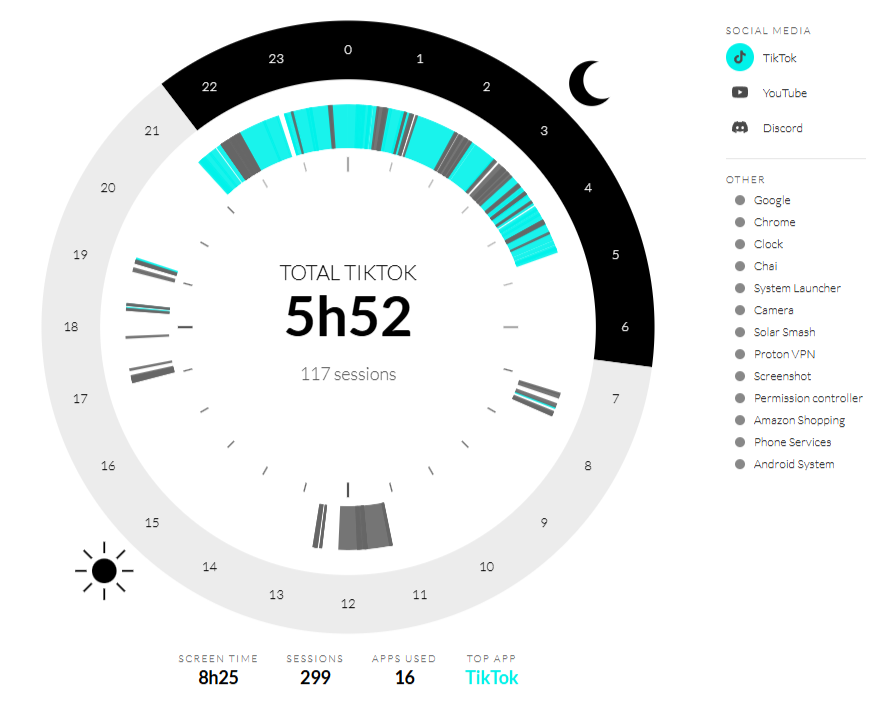
For example, the visual below shows a 24-hour period of phone usage for Joey, 14, on Thursday the 15th January 2026, a school day. While Joey was not on his phone while at school - from around 9am to 3pm - he spends a total of 3h41 on TikTok after school and late into the night.
24-hour period of phone usage for Joey (14), on Thursday the 15th January 2026
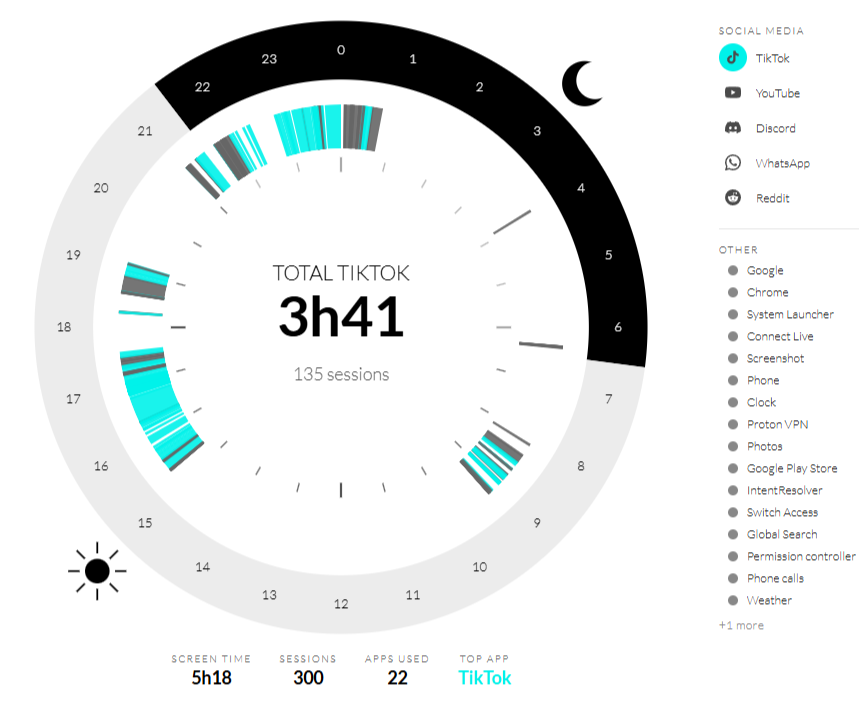
While there were many examples of late-night TikTok use on school days, this was especially common at weekends and during school holidays. The example below shows Daniel’s use on Friday 2 January 2026, during the Christmas holidays.
24-hour period of phone usage for Daniel (15), on Friday the 2nd January 2026
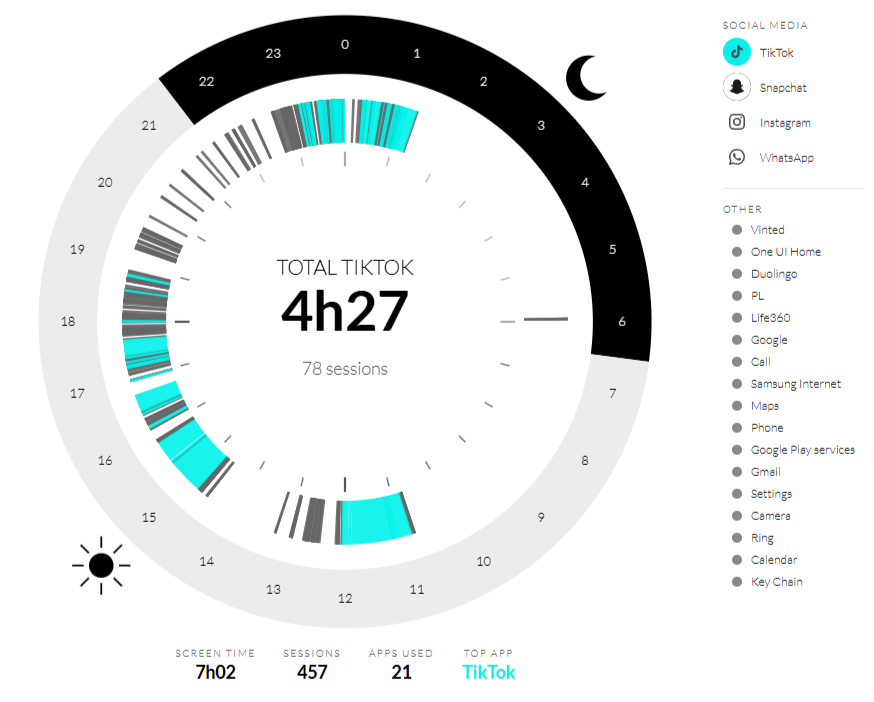
20 out of 21 children had used TikTok during the night, between the hours of 10pm and 7am. Sixteen of them used TikTok between 12am and 6am.
For some children, night-time scrolling was only a small part of their TikTok use. For others, it accounted for a substantial share of their average daily activity, as shown in the chart below.
Average proportion of daily TikTok use that took place between 10pm and 7am
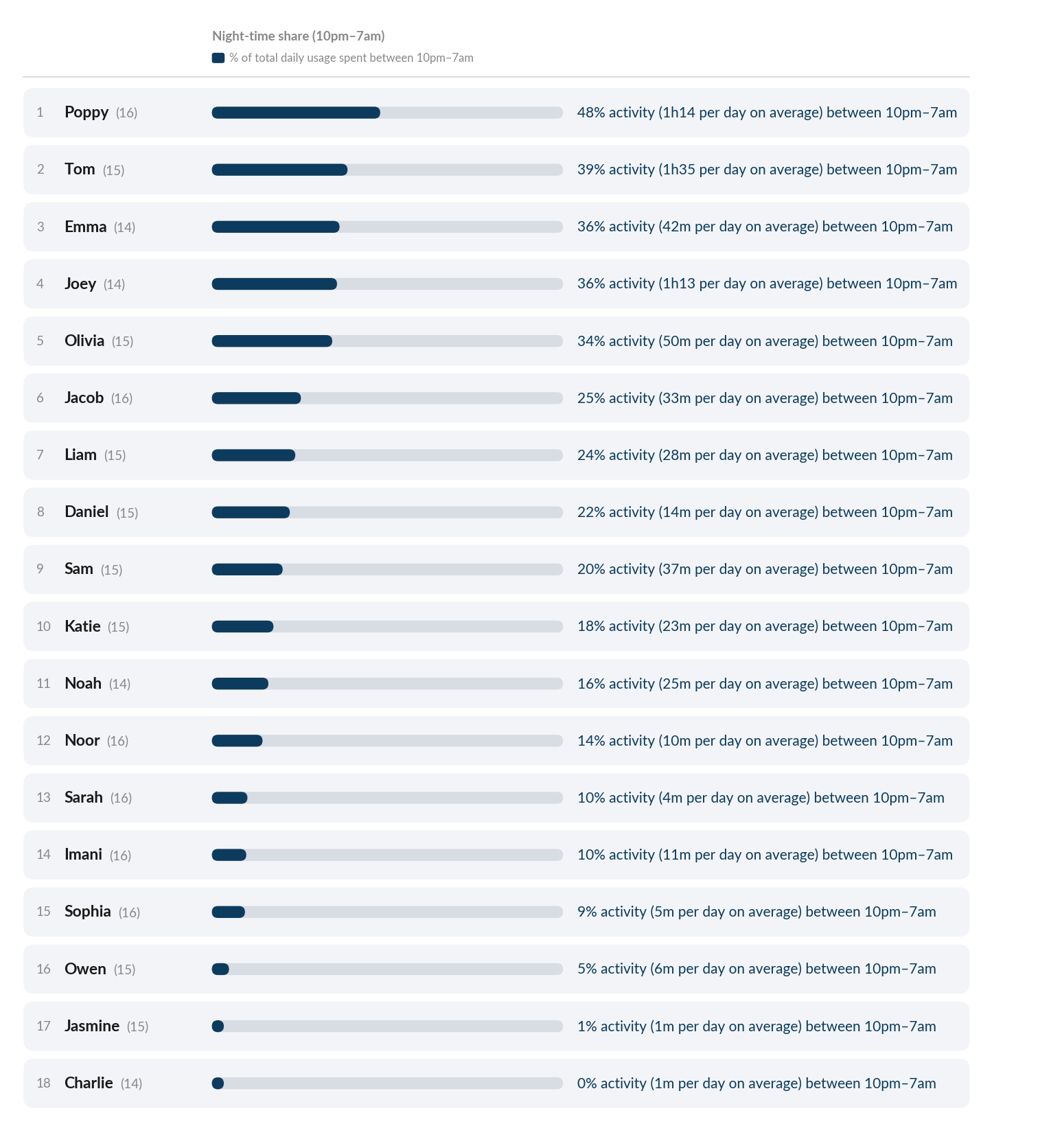
Average proportion of time spent on TikTok per day between the hours of 10pm and 7am for the 18 children who used TikTok for 30 minutes or more on average a day. Average is based on approx. 3 weeks’ worth of ConnectLive phone usage data in January 2026.
For Emma (14), 36% of her TikTok activity was between the hours of 10pm and 7am, as illustrated below in which it is possible to see Emma using TikTok between 11pm and midnight, and again between 1am and 2am.
Emma (14)’s phone use on Tuesday the 6th January 2026
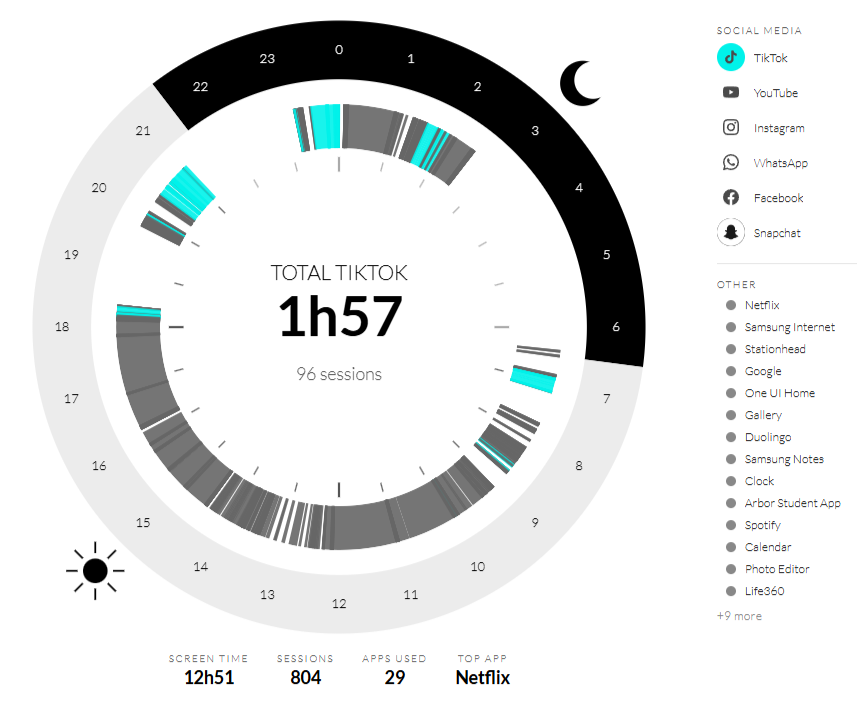
A few children, such as Joey (14) below, spent significant proportions of some nights on TikTok, such as the night shown below.
Joey (14)’s phone use on Wednesday the 28th January 2026
Most children said they found it hard to stop scrolling
Children spoke about spending more time scrolling on TikTok than they intended to.
“It's just once I'm on it [TikTok], I'm like in that world instead of a world of my own. It's just kind of… I'll watch one thing, then I want to watch another, then another, and it just keeps going on.”
Liam, 15
“It's a bit brainwashing, if you know what I mean. Because when, like, when you've been on it for so long, if you only want to go on it for 20 minutes or whatever, you could just scroll and then just forget, and then it's like 2 hours later.”
Noah, 14
Researcher: and what do you do when you’re on TikTok
Jasmine: “Just pretty much scrolling, yeah”
Researcher: and how do you feel when you’re scrolling
Jasmine: “It just feels very entertaining, and interactive, and a bit addictive, I feel like I’m on it every day just scrolling”
Jasmine, 15
Several children, unprompted by researchers, said they thought they were ‘addicted’ to scrolling TikTok
When discussing their use of social media - particularly TikTok - and how it made them feel, several children described themselves as being "addicted" without any prompting from researchers. Some of these children gave permission for us to share their comments on film. The clips that follow include both these spontaneous reflections and responses to researcher-led questions exploring how children believe social media affects them.
Three children describe how TikTok can feel “addictive”
Children described specific features of TikTok which they thought made it ‘addictive’
When asked what made TikTok feel “addictive”, some children pointed to specific features they felt kept them scrolling — including short-form videos, infinite scroll, and algorithmically driven feeds.
Short form videos - as one of the children describes in the clip shown above:
"It's the constant thing of swiping on a video, and they're not long videos, they're short videos so especially since the kids nowadays, they have a lot shorter attention spans… it's a lot easier to watch than, say, to sit down and watch a three hour movie. Whereas they can spend three hours on TikTok, but it doesn't feel like it, because they're not watching one thing."
Researcher: How do you feel about that, for yourself?
"I’ve fallen victim to it many times I won’t lie, I’ll go on TiKTok and I’ll say oh I’ll only use it for 5 minutes and I’ll be on it for an hour or an hour and 30 or something.”
Infinite scroll:
“There's obviously like so much feed that's on there, so you just scroll through it all and don't realise how, how much time you're spending on it.”
Emma, 14
Algorithmic content selection:
“I guess the videos kind of are made for you. Some of them are. So it's just nice to scroll. Like, I wouldn't scroll on my mum’s TikTok because it's so, like, boring.”
Poppy, 16
Children spoke about how this time spent scrolling could take away from other things they wanted to do
Children recognised that the time they spent scrolling often came at the expense of other activities they wanted to do, or knew would be better for them. For example, time spent with friends and family, doing their hobbies or doing school work.
“I just feel like the time I spent on my phone, I could have been riding my scooter or bike or doing homework, which would actually help me in the long run, I suppose.
Researcher: So why didn't you do those other things?
“Because it's just so much easier to pick up your phone than having to bring yourself to do homework where you've actually got to work things out and write it down. It's a lot easier to scroll compared to writing with a pen and pencil…I could be doing my homework and I'll have a notification, I'll just check it quickly and then I'll go on TikTok and forget completely about my homework.”
Liam, 15
“I feel like it's affected my hobbies because obviously instead of doing other stuff, like I said, like drawing or reading, I've been like on TikTok.”
Emma, 14
Another child, Noah (14) described how easy it is to forget about real-life activities in favour of scrolling:
"Because if people have plans but they have 20 minutes to waste and they waste 20 minutes on TikTok, but then it’s 2 hours after, they’ve just ruined all their plans… one of my mates was meant to go out with us the other day and then he said he was watching TikTok and forgot about time.”
Noah, 14
Chapter 1 key takeaways
It’s hard to stop the infinite scroll. Children are spending hours scrolling and don’t always feel in control
In summary:
Children are spending hours on TikTok each day - averaging 1h41 daily, with several spending 3+ hours a day on TikTok.
TikTok use happens at night and can disrupt sleep - 16 of the 21 children used TikTok between midnight and 6am, and children describe how it scrolling during the night impacts their sleep.
Many children do not feel in control of their TikTok use — they describe intending to scroll for a short time, then realising hours have passed. They report that this takes them away from doing other things they want to do, or know would be better for them.
Some feel “addicted” to TikTok - identifying short videos, infinite scroll and personalised feeds as features that keep them scrolling.
In conclusion:
The amount of time TikTok is taking up in many children’s lives raises serious questions — especially when TikTok is just one of many platforms they use to flick through short form videos. This feels particularly concerning because children themselves describe not feeling fully in control of the time they spend scrolling, and can identify other things they would rather be doing, or know would be better for them. And while this chapter focuses on TikTok, the features children point to — short-form videos, infinite scroll, and personalised feeds— are not unique to that platform. If these features are disrupting children’s sleep during crucial periods of brain development, crowding out other activities, and making it harder for them to choose how they spend their time, we need to ask:
How much time spent scrolling is healthy for a child?
If there were a “recommended daily allowance” for short-form content, what should it be — and who should decide?
What are children missing out on while spending hours on TikTok and other platforms?
To what extent should platforms be able to reach children during sleeping hours?
Next, Chapter 2: Low nutritional value examines what children are consuming during all this time on TikTok.
Chapter 2
Low nutritional value
Children say that meaningless content is ‘brainrot’ and that it makes them feel rubbish
Children saw an average of 708 videos on TikTok per day
Children were viewing hundreds, sometimes thousands of videos every day.
Of those who took part in the data donation method, the number of TikTok videos children watched varied widely, ranging from 359 to 1,021 per day.
Average number of TikTok videos watched per day in January 2026
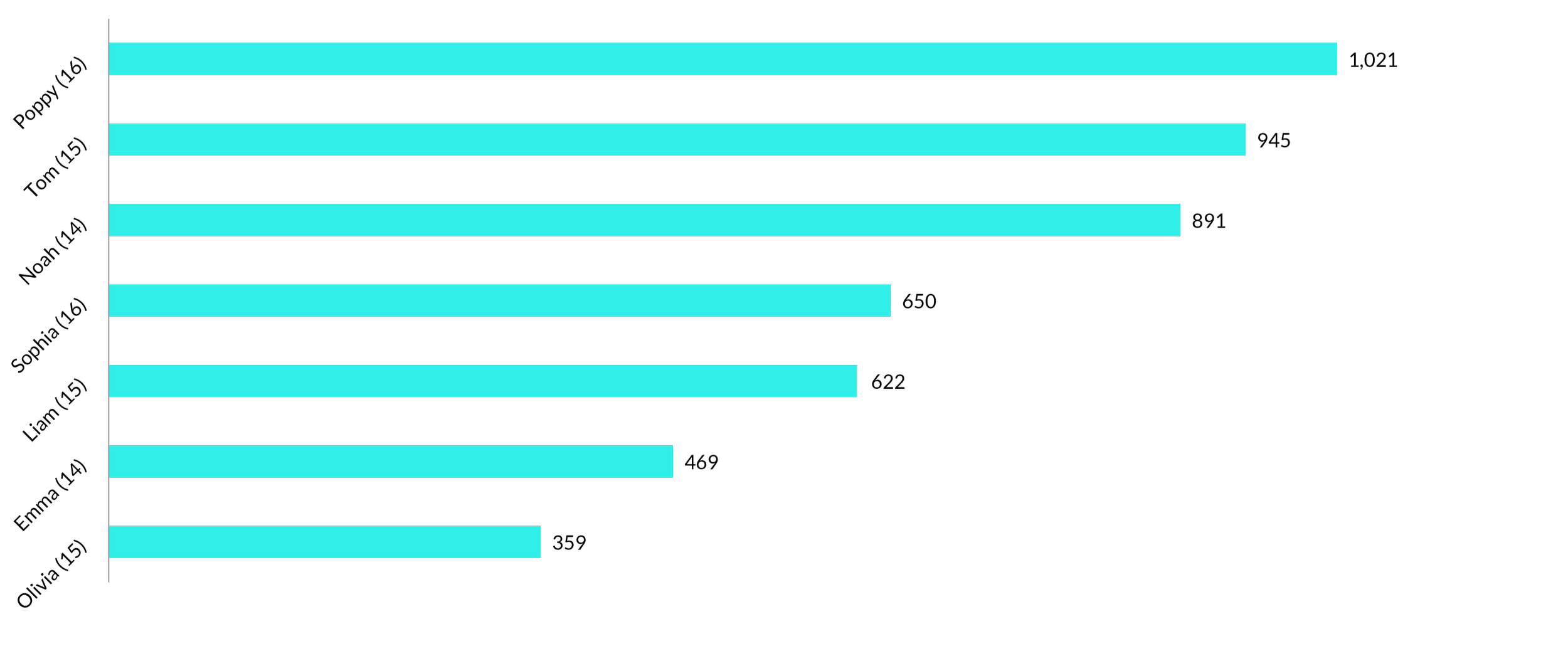
Average number of videos per day recorded in children’s TikTok watch history for the month of January 2026. Watch history is TikTok's own log of every video a user has viewed in the app, provided directly by children as part of data donation.
In January 2026 alone, all seven children saw more than 10,000 videos on TikTok, with Poppy seeing over 30,000 videos.
Number of TikTok videos watched in January 2026
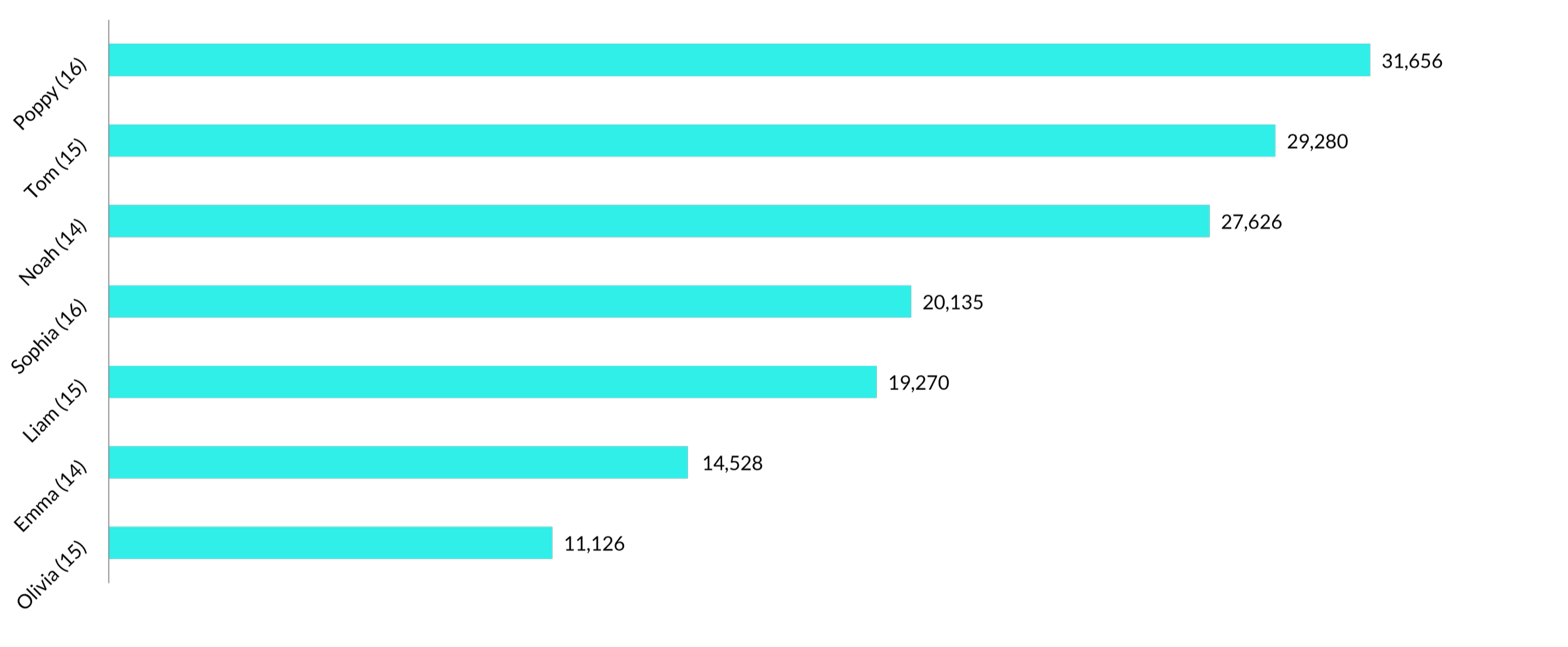
Total number of videos recorded in children’s TikTok watch history for the whole month of January 2026. Watch history is TikTok's own log of every video a user has viewed in the app, provided directly by children as part of data donation.
The number of videos children move through each day is difficult to picture — until you watch the speed and style of scrolling.
Children watched most videos for less than 5 seconds
Across the seven children who shared their TikTok watch history, around half or more of the videos they watched in January 2026 were viewed for 5 seconds or less.
Proportion of videos watched for 5 seconds or less in January 2026

For example, analysis of Poppy’s data showed that 19,519 of the 31,656 videos (62%) that she saw in January 2026 were watched for 5 seconds or less.
“With TikTok, if you get bored, you just keep scrolling”
Poppy, 16
Distribution of watch duration of videos Poppy saw in January 2026
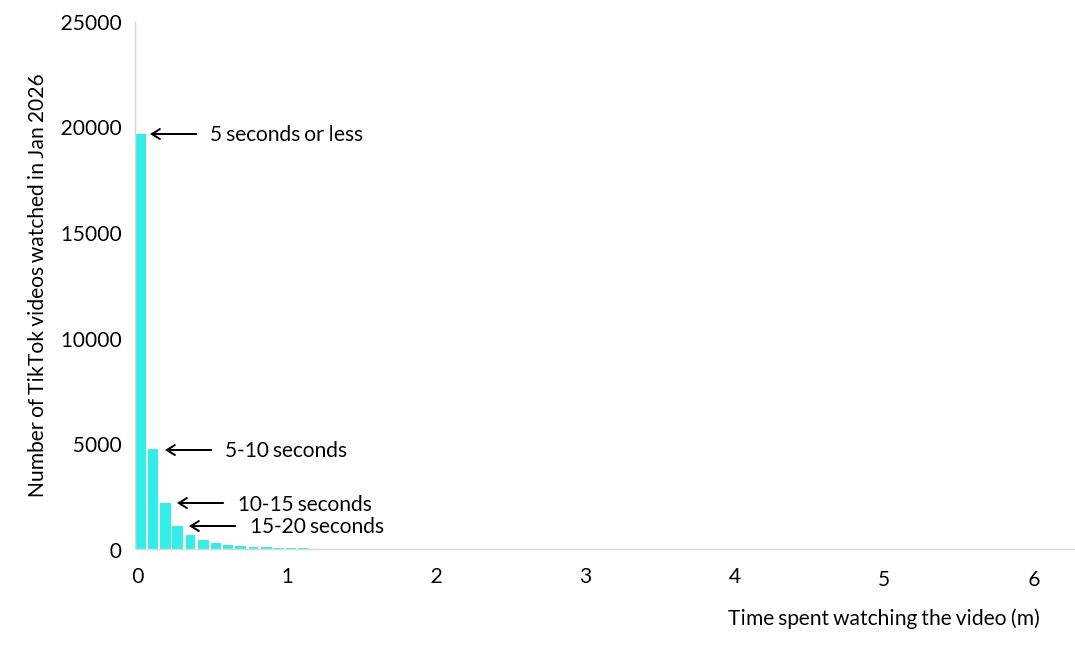
Distribution of watch duration per TikTok video for Poppy’s watch history for the month of January 2026. Watch history is TikTok's own log of every video a user has viewed in the app, provided directly by children as part of data donation. Watch duration was calculated as per the explainer below.
How video watch duration was calculated: Watch duration was calculated by working out the difference between the start times of videos watched in chronological order. Videos with a calculated watch time of over 60 minutes were excluded, as this exceeds the maximum length of any video on TikTok, suggesting these values reflect gaps in app usage, for instance where a child went off their phone or switched to a different app, rather than genuine viewing time. It is worth noting that this method of calculating watch time may still include some gaps in app usage as genuine watch times, meaning the actual proportion of videos watched for 5 seconds or less is likely even higher than reported here.
Videos form a fast-moving stream of disconnected, fragmented, contextless snippets
The result of this rapid scrolling meant that TikTok was not experienced as a sequence of meaningful videos, but as a fast-moving stream of clips.
The viewing experience was fragmented and context-light, with little continuity from one video to the next and no clear sense of story.
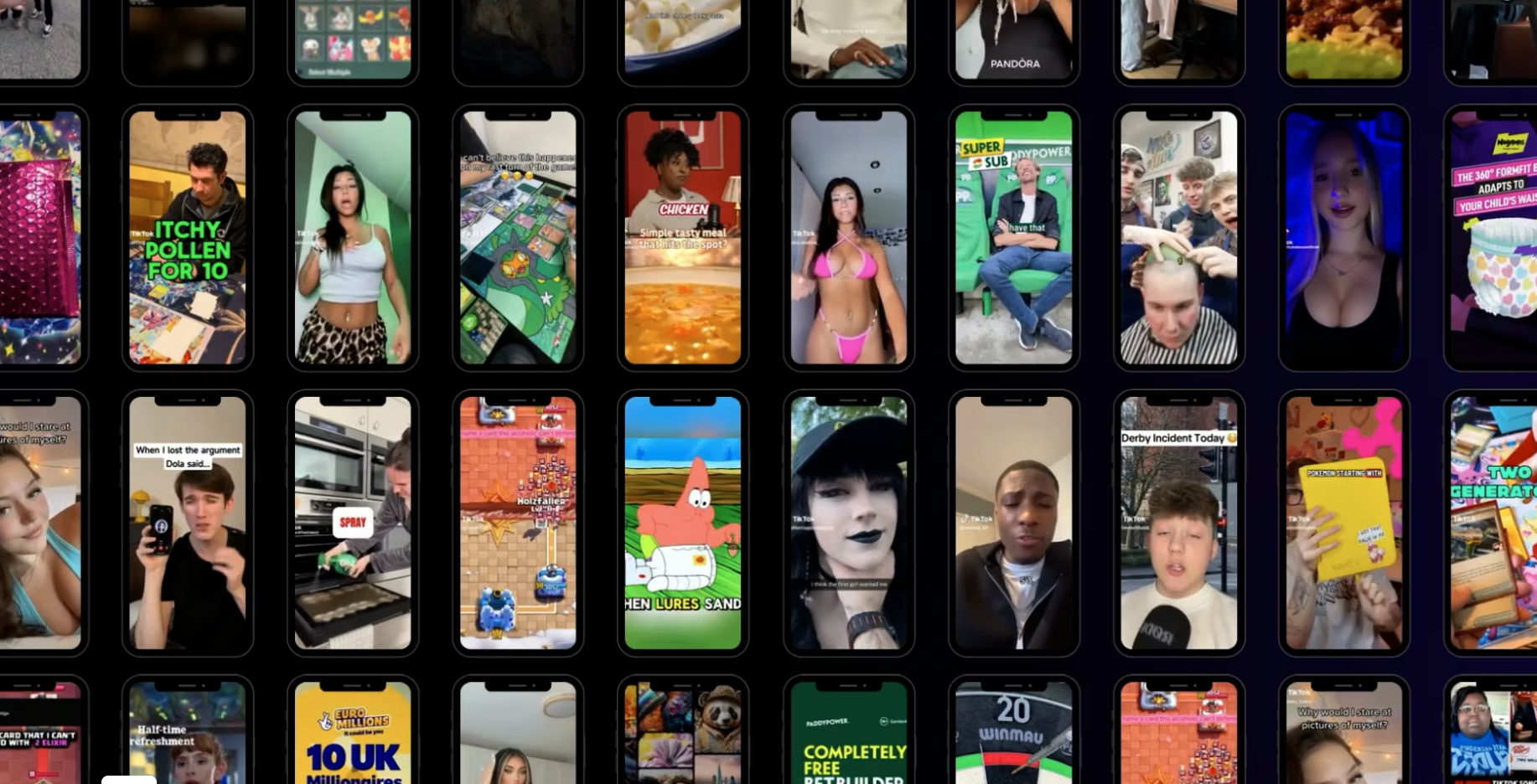
Screen recordings show children frequently skipping through content, and sometimes watching videos at double or triple speed.
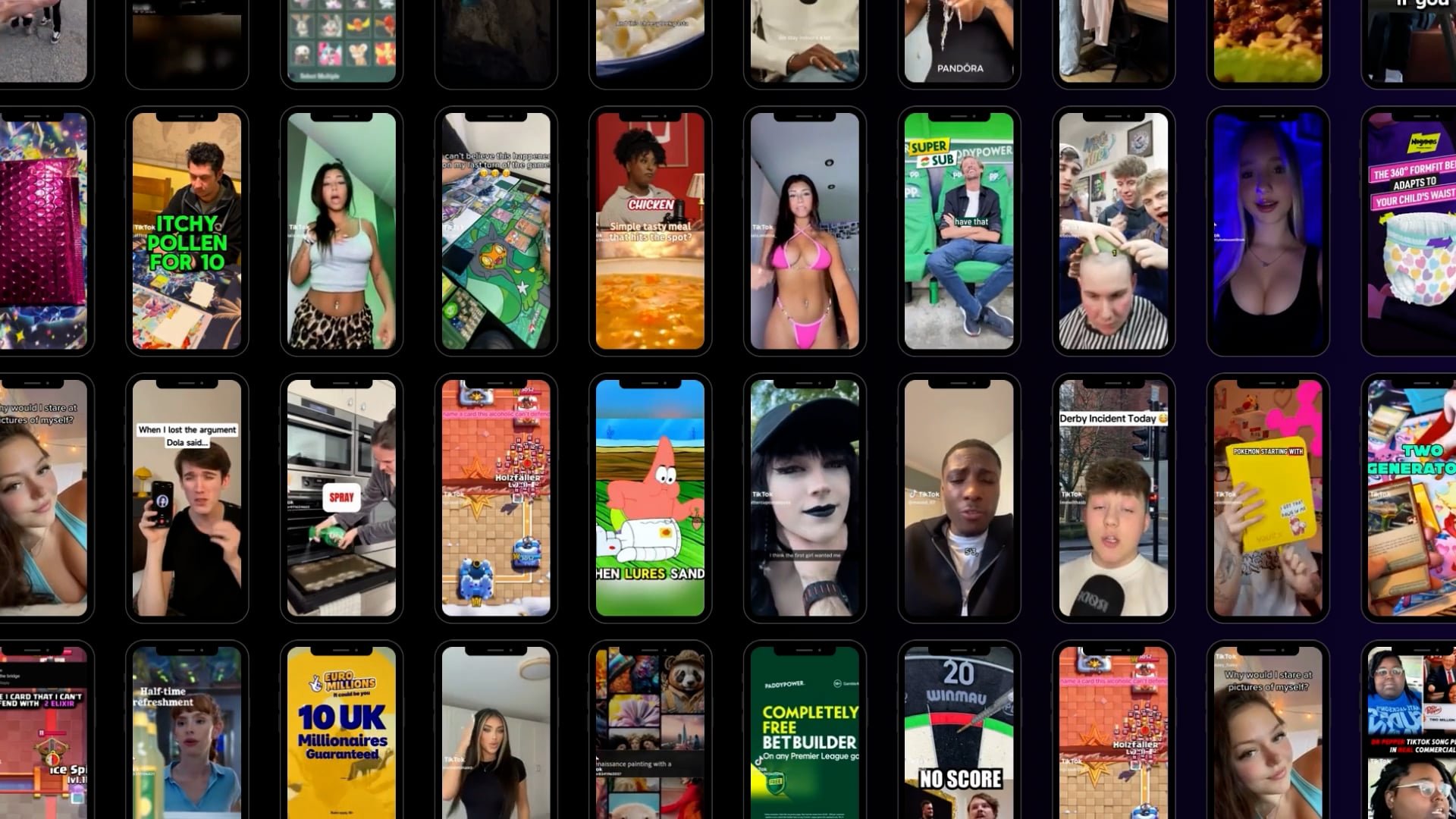
Spend 1 minute scrolling through different children’s TikTok feeds below to see what they see.
Children use the term ‘brainrot’ to describe particularly meaningless content
Children describe seeing ‘brainrot’ content on social media platforms, including TikTok. Children refer to a specific genre of chaotic, often AI generated, heavily meme-layered TikTok content, which is deliberately non-sensical with little meaning.
“Really random brainrot posts, like these random meme photos and that just in an edit, like the Italian brainrot memes and that”
Emma, 14They also describe getting ‘brainrot’ from these platforms - a feeling of mental fog or reduced cognitive abilities from spending time engaging with “useless” content, as Rishi describes below:
“If you have brainrot it’s not a good thing, it shows that you watch a lot of slop… these like AI videos do absolutely nothing for you, they just don’t do anything at all… it’s absolutely useless and it’s often associated with being like a bit lazy or a bit dumb because you’re not watching anything good”
Rishi, 14
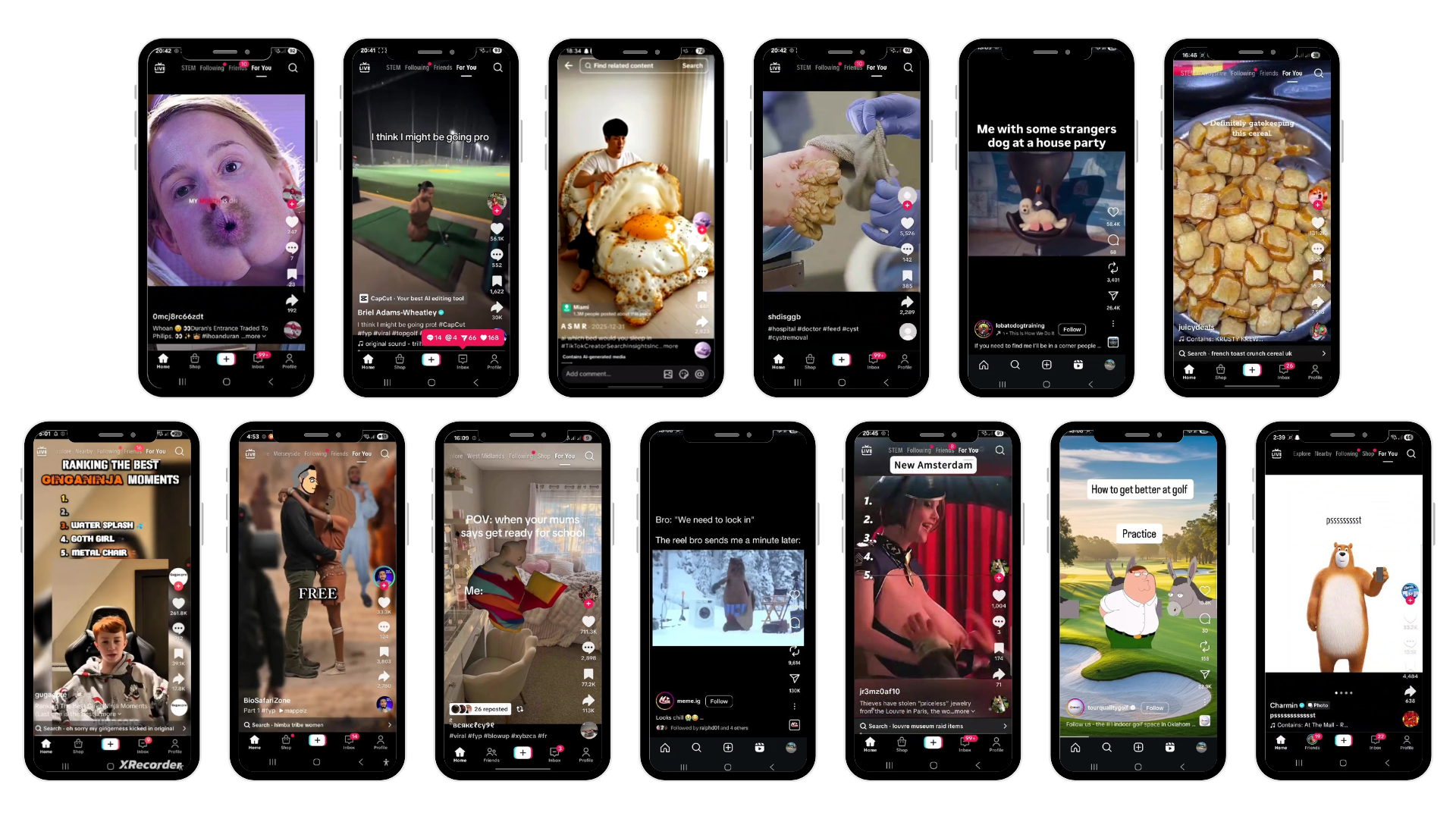
Examples of so-called ‘brainrot’ content seen by the children in this study while scrolling through TikTok are shown in the images below.
Screenshots of ‘brainrot’ content that appeared on children’s TikTok feeds
Many say they feel tired, guilty or disappointed in themselves after ‘doomscrolling’
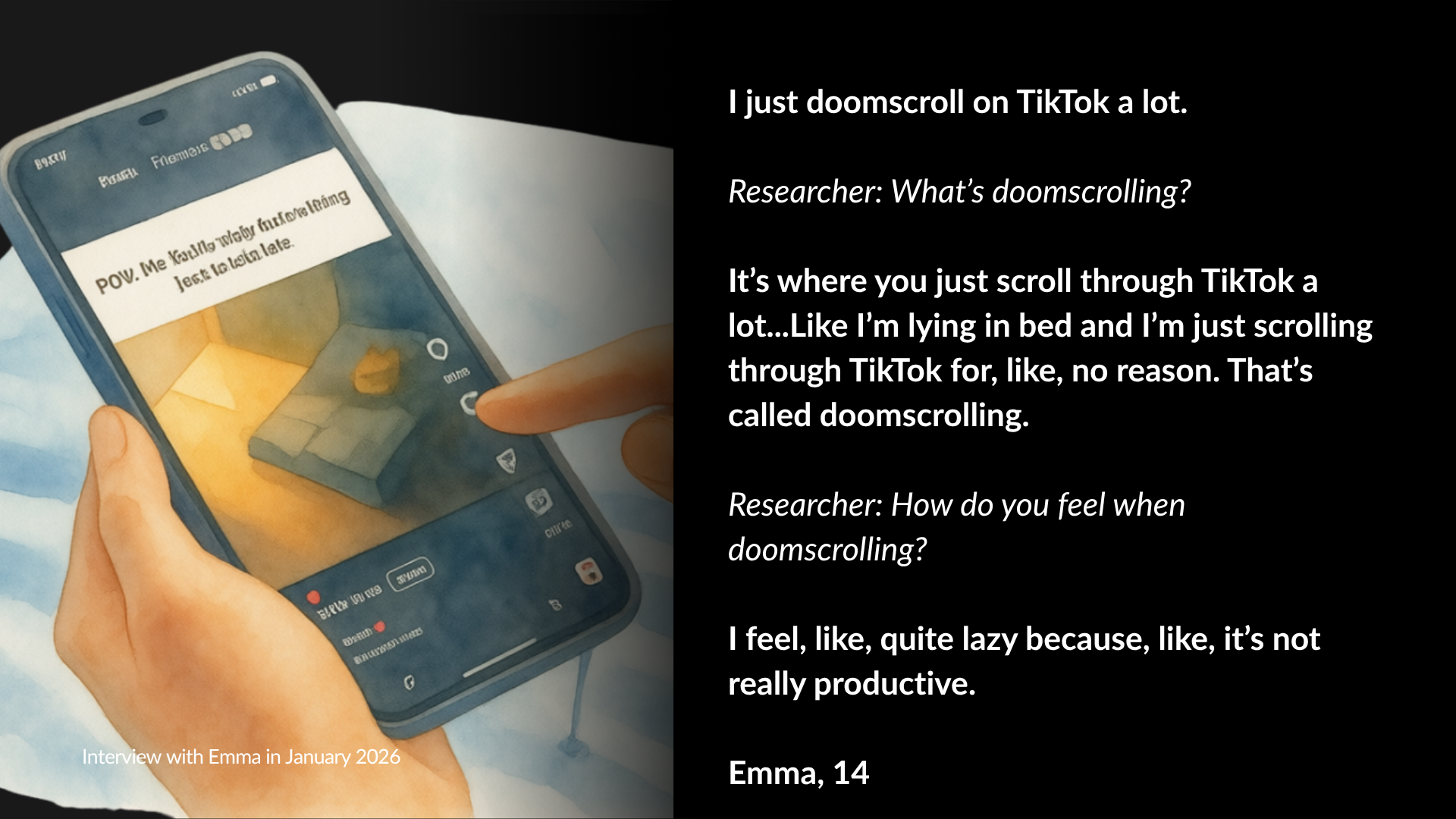
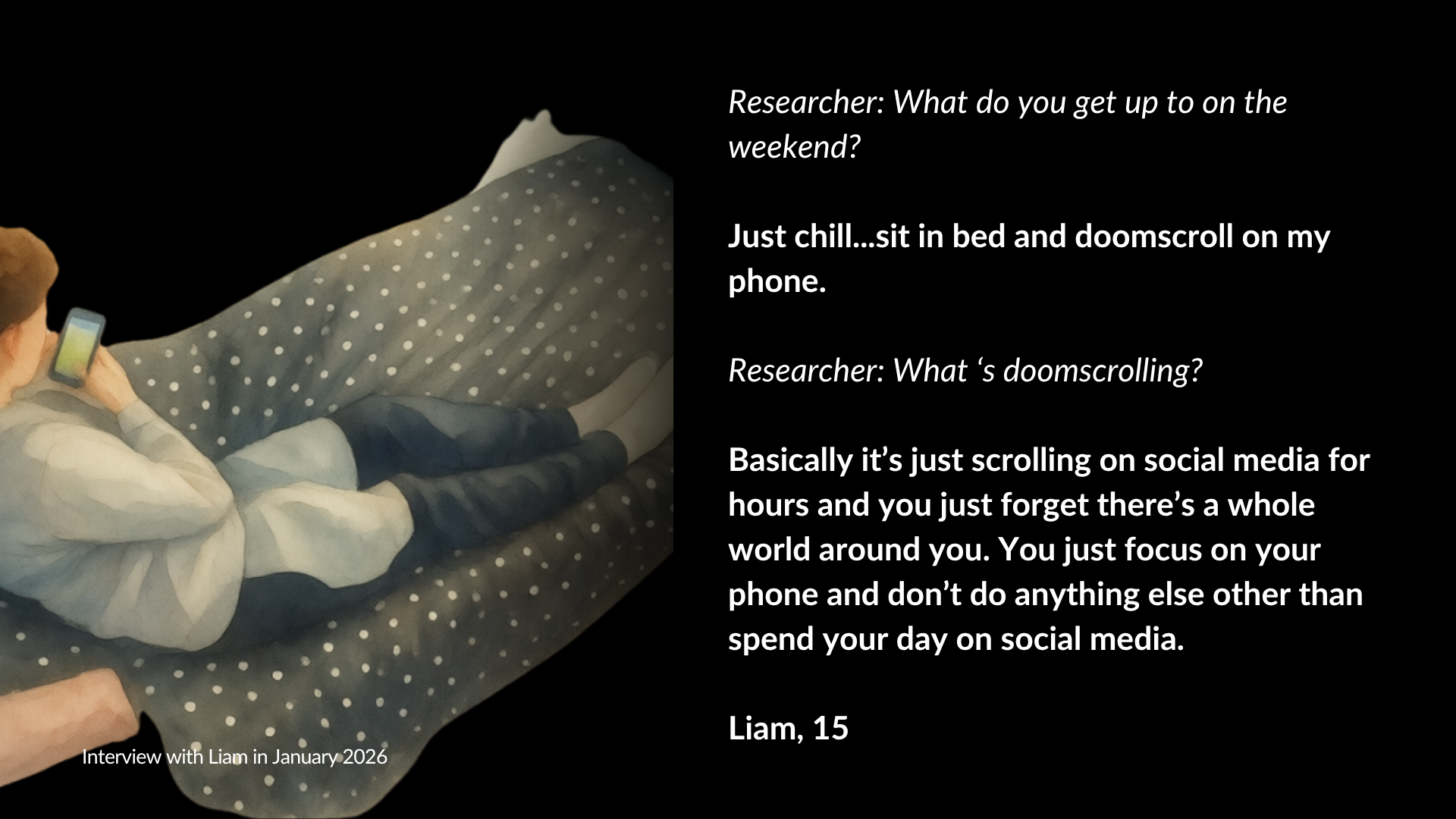
Children talk about feeling bad about the time they have spent scrolling through this content after they have had a session ‘doomscrolling’.
Early data may suggest scrolling can depress children’s mood in the moment
One of the goals of developing the ConnectLive app was to better explore the in the moment impacts of different smartphone uses on mental wellbeing and cognitive functioning. For example, does spending 2 hours scrolling through TikTok actually reduce your ability to pay attention? And how does this compare to spending 2 hours on Snapchat? Or watching YouTube videos?
ConnectLive can automatically trigger short surveys, including measures of mental wellbeing or cognitive functioning, based on specific patterns of app use.
Method: Pilot study of ConnectLive
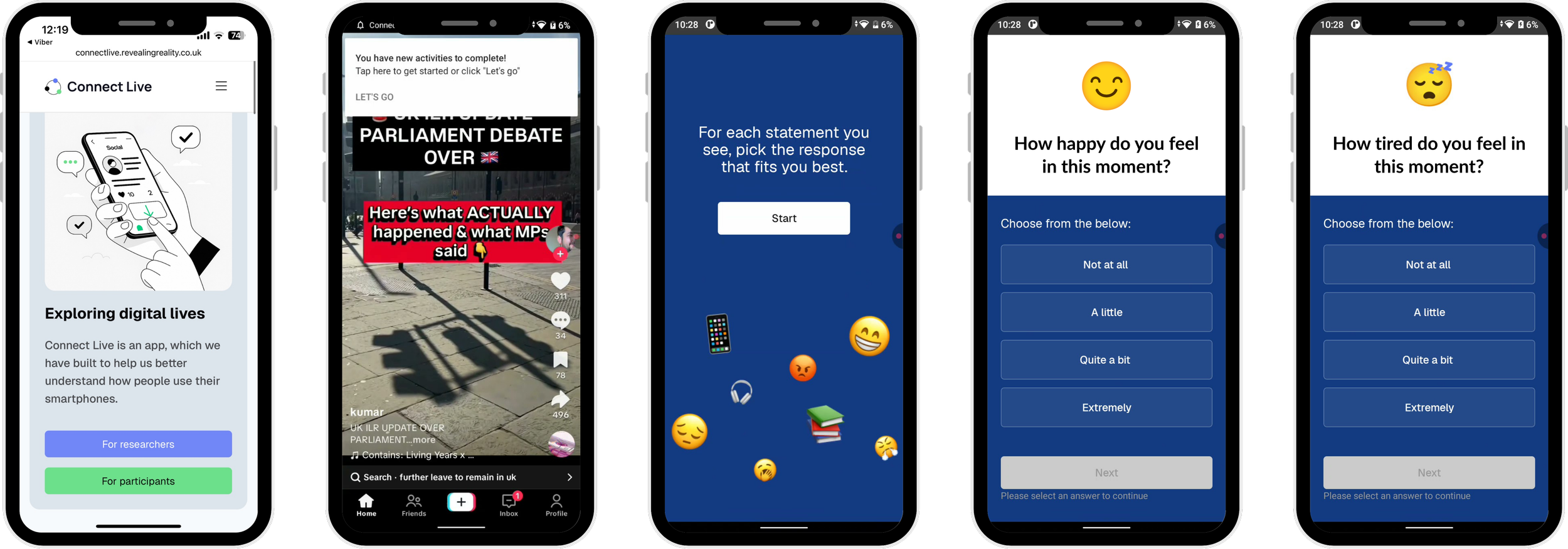
In this pilot study of the ConnectLive app, children were prompted to complete a short wellbeing survey under three conditions: after 30 minutes of TikTok scrolling within a one-hour period, after one hour of TikTok scrolling within a two-hour period, or after 30 minutes offline, with no device activity. These prompts were automatically sent to them when the condition was met, and prompts took place over a 1-week period.
The survey used was the 8-item version of the Positive and Negative Affect Schedule (PANAS), a measure of mood and affect. It asked children to answer simple questions about how they felt in that moment.
Mock up of the a prompt appearing and being completed when a condition was met
Analysis
Analysis of this data shows a small but consistent pattern: positive mood tends to decrease following TikTok sessions, while negative mood increases, compared with periods when participants were not using their phones.
Estimated marginal means for positive affect from the Linear Mixed Model, by prompt type
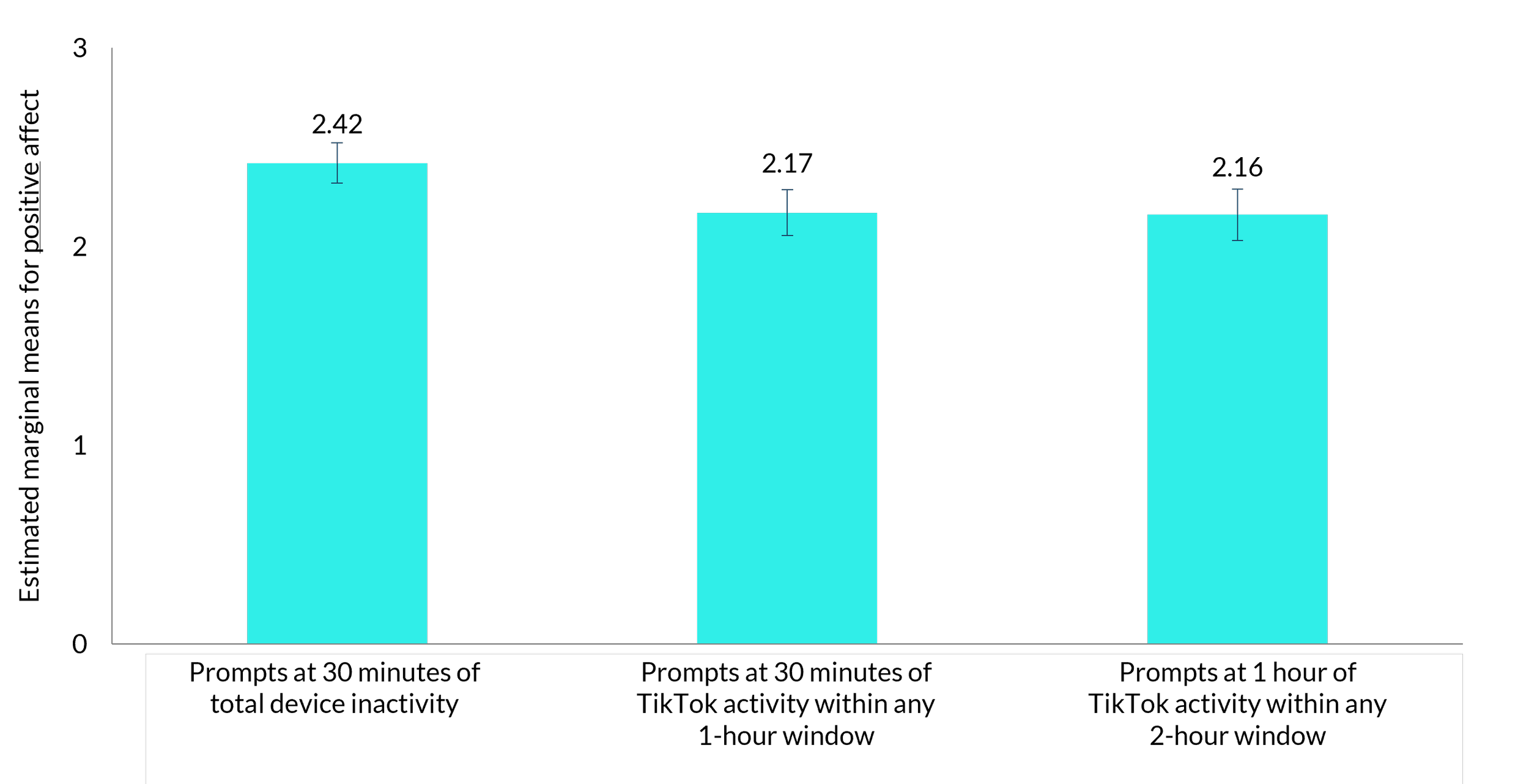
Mean scores for positive affect (PANAS) estimated from the Linear Mixed Model exploring mood by prompt type. Error bars represent 95% confidence intervals. The effect of prompt type on positive affect was not significant at the 95% confidence interval (F=2.483, p=0.09). Base for device inactivity n=48 prompts, base for 30mins TikTok activity n=29, base for 1hr TikTok activity n=16.
Estimated marginal means for negative affect from the Linear Mixed Model, by prompt type
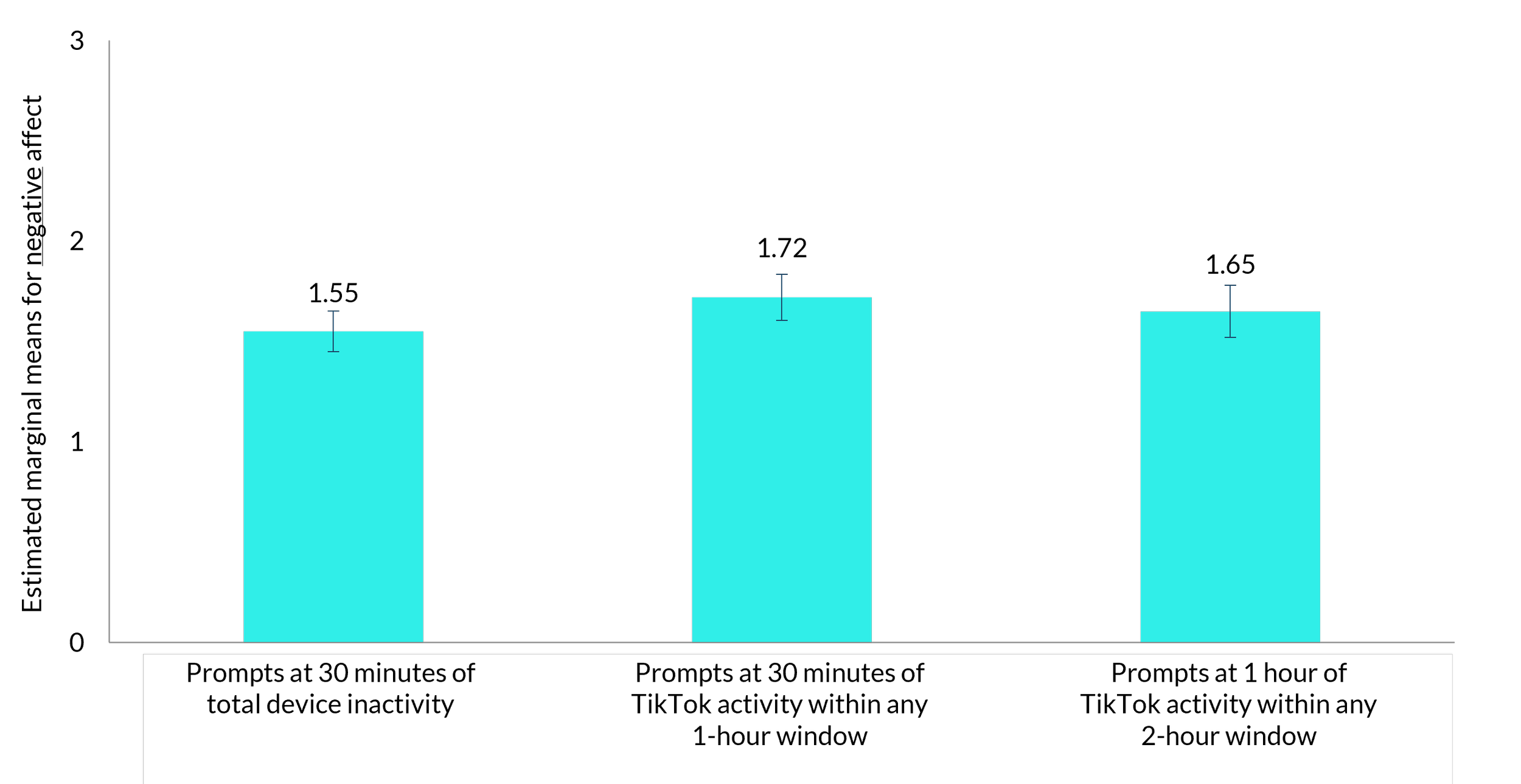
Mean scores for negative affect (PANAS) estimated from the Linear Mixed Model exploring mood by prompt type. Error bars represent 95% confidence intervals. The effect of prompt type on negative affect was not significant at the 95% confidence interval (F=1.958, p=0.148). Base for device inactivity n=48 prompts, base for 30mins TikTok activity n=29, base for 1hr TikTok activity n=16.
*This data should be interpreted cautiously due to the small sample size. The results did not meet the standard 5% statistical significance threshold commonly used in academic research: the probability that the finding could be due to chance was 9% for positive affect and 15% for negative affect.
Without further research it’s not yet possible to know if this is a reliable, repeatable finding or that it is linked specifically to TikTok use, or phone use generally.
Without pre and post measures, we also can’t be sure whether scrolling TikTok causes children to feel worse, or they feel drawn to TikTok when their mood is low.
Even so, the consistency of the pattern suggests it’s worth exploring further with larger-scale research that can clarify these questions.
Chapter 2 key takeaways
Low nutritional value: Children say that meaningless content is ‘brainrot’ and that it makes them feel rubbish
In summary:
Children see high volumes of content on TikTok each day —among the seven children who shared their watch history, children saw an average of 708 videos per day, with some seeing more than 1,000 videos a day.
Much of this content is consumed extremely quickly —across the seven children, around half or more of the videos they watched were viewed for five seconds or less. This creates a stream of context-less, fragmented snippets.
Children use the term ‘brainrot’ to describe particularly meaningless content —including chaotic, often AI-generated, heavily meme-layered videos that feel nonsensical, useless or low-value.
Many children say they feel worse after scrolling — describing feeling tired, guilty, disappointed in themselves, or as though they have wasted time after “doomscrolling”. Analysis of ConnectLive prompt data on in-the-moment mood suggests this is an important area for further large-scale research.
In conclusion:
Screen recordings of children scrolling through their TikTok feeds are often painful to watch. Not because children often encounter explicitly harmful content — in fact, we have seen less of this on children’s feeds over time — but because of the speed and volume of what they consume: resulting in a stream of fragmented snippets of content with little coherence, story or meaning. Children themselves often describe finishing a scrolling session feeling that they have wasted their time and taken very little from it — a feeling many adults are likely to recognise too.
What real value do algorithmic feeds of short-form content provide to children?
Is that value proportionate to the amount of time children spend on them?
To what extent is this type of content, and this format for consuming it, likely to have a positive impact on their development?
Next, Chapter 3: Everything has a price examines the commercial content that frequently appears on children’s feeds, and who benefits from children spending time on the platform.
Chapter 3
Everything has a price
TikTok feeds are commercially driven, selling products and people
You don’t have to spend long looking at children’s feeds to notice how much commercial content is shown to them. For example, in the one minute of screen recorded footage that Jasmine (15) shared with us of her scrolling through her TikTok “For You” page, she saw five adverts and one post containing an affiliate link (which lets a creator earn money when someone buys a product after clicking their link).
Posts labelled as ‘ad’ or ‘commission paid’ shown in 1 minute of Jasmine (15) scrolling her “For You” page
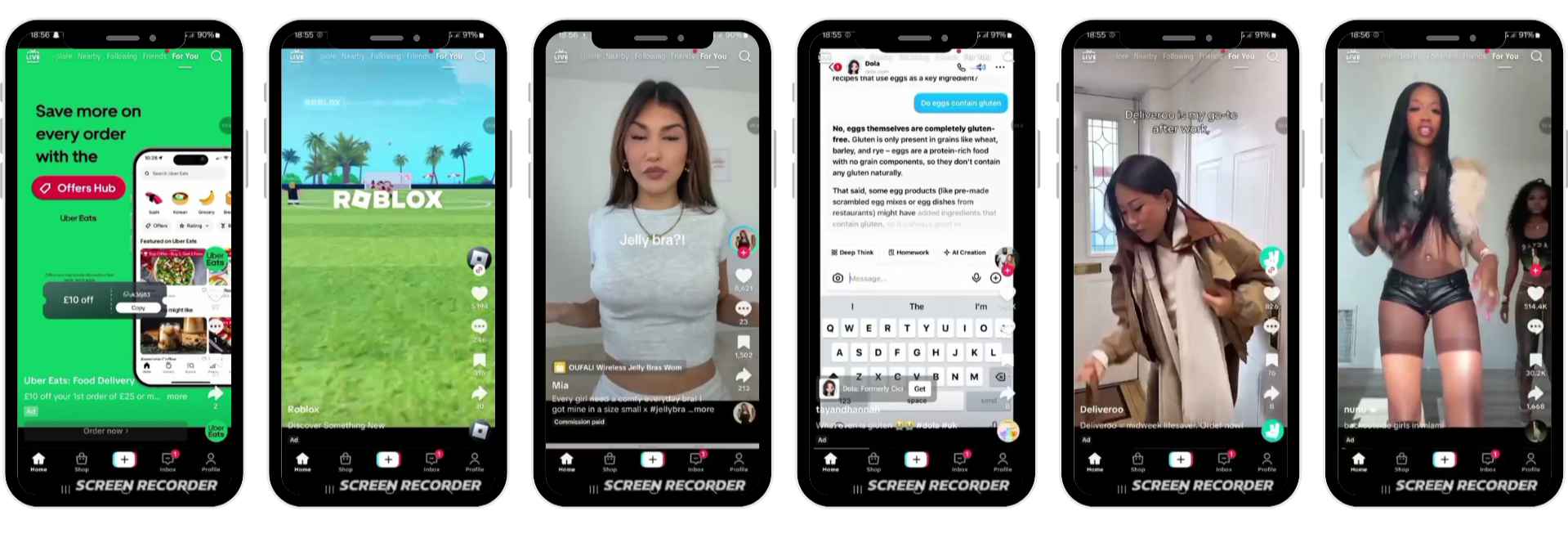
As you can see above, these posts came from Uber Eats, Roblox, a lingerie brand, Dola (an AI chatbot), Deliveroo, and an individual content creator promoting their page.
Similarly, in one minute of Noah (14) scrolling TikTok, he saw seven adverts.
Post labelled as ‘ad’ shown in 1 minute of Noah (14) scrolling his “For You” page
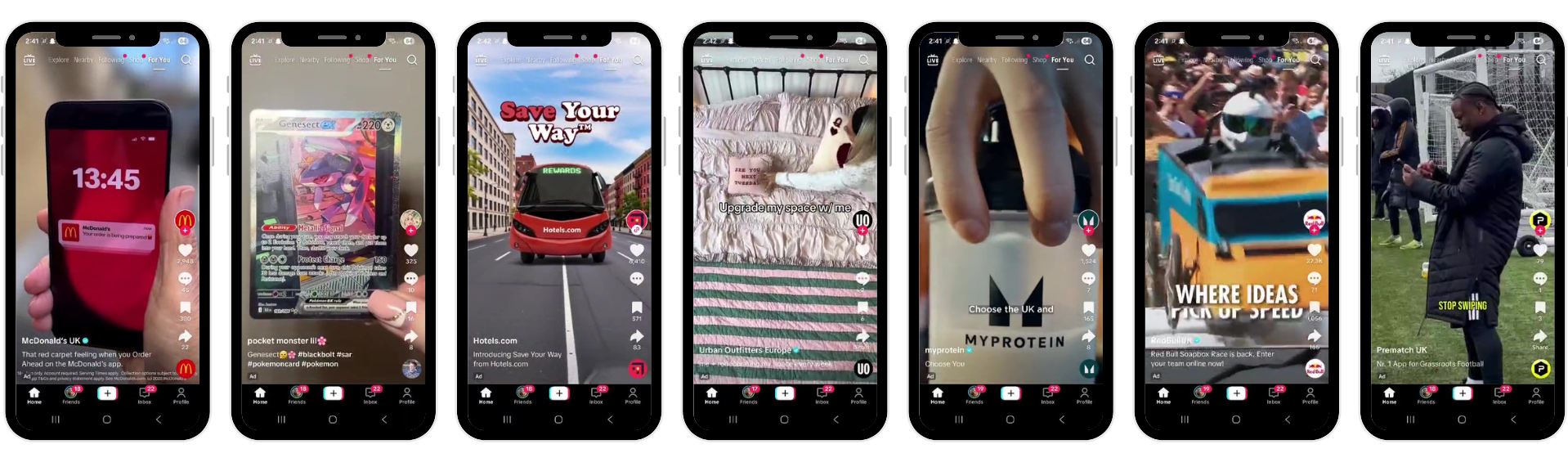
The adverts shown to Noah (14) in this one minute of scrolling were for McDonald’s, a content creator promoting their Pokemon card trading account, Hotels.com, Urban Outfitters, MyProtein, RedBull and Prematch (a football statistics app).
Some children complained about how much advertising there was on their feeds.
“There's always like ads, like a HelloFresh ad that I don't need to watch… I'd say like every like few videos [are an ad].”
Poppy, 16
“There’s a lot of promotion videos for Chatbots on TikTok - you can talk to an AI, I don’t really see the point”
Charlie, 14
TikTok ads appeared as often as every 1 in 5 videos
For the seven children who shared their full TikTok watch-history data, it was possible to objectively identify all of the adverts they had seen — videos labelled by TikTok as a paid advertisement in which a brand or business directly paid TikTok to promote their content.
In January 2026, the proportion of videos shown to children that were adverts ranged from 1 in every 25 videos for two children (4%) to as many as 1 in every 5 videos for another child (20%).
Proportion of videos shown to children in January 2026 that were paid adverts, including examples of the adverts they were shown
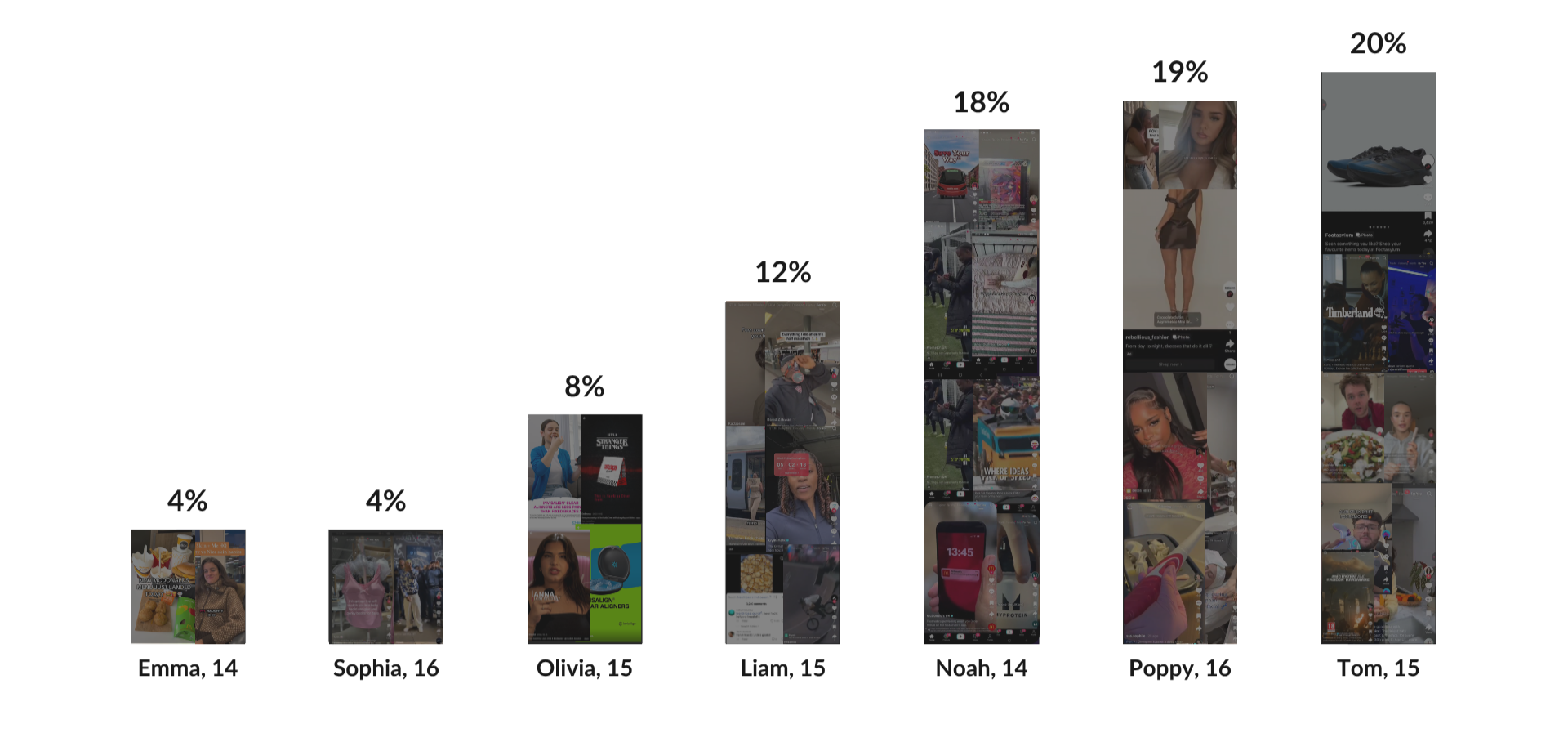
Proportion of videos shown to children during January 2026 on TikTok that were flagged as paid advertisments in TikTok’s metadata. Base size of videos ranged from n=8,401-25,120. This includes the total number of videos watched by each child in January 2026 that were still available for analysis – i.e. had not been removed or the account made private – in April/May 2026 at the time of the analysis.
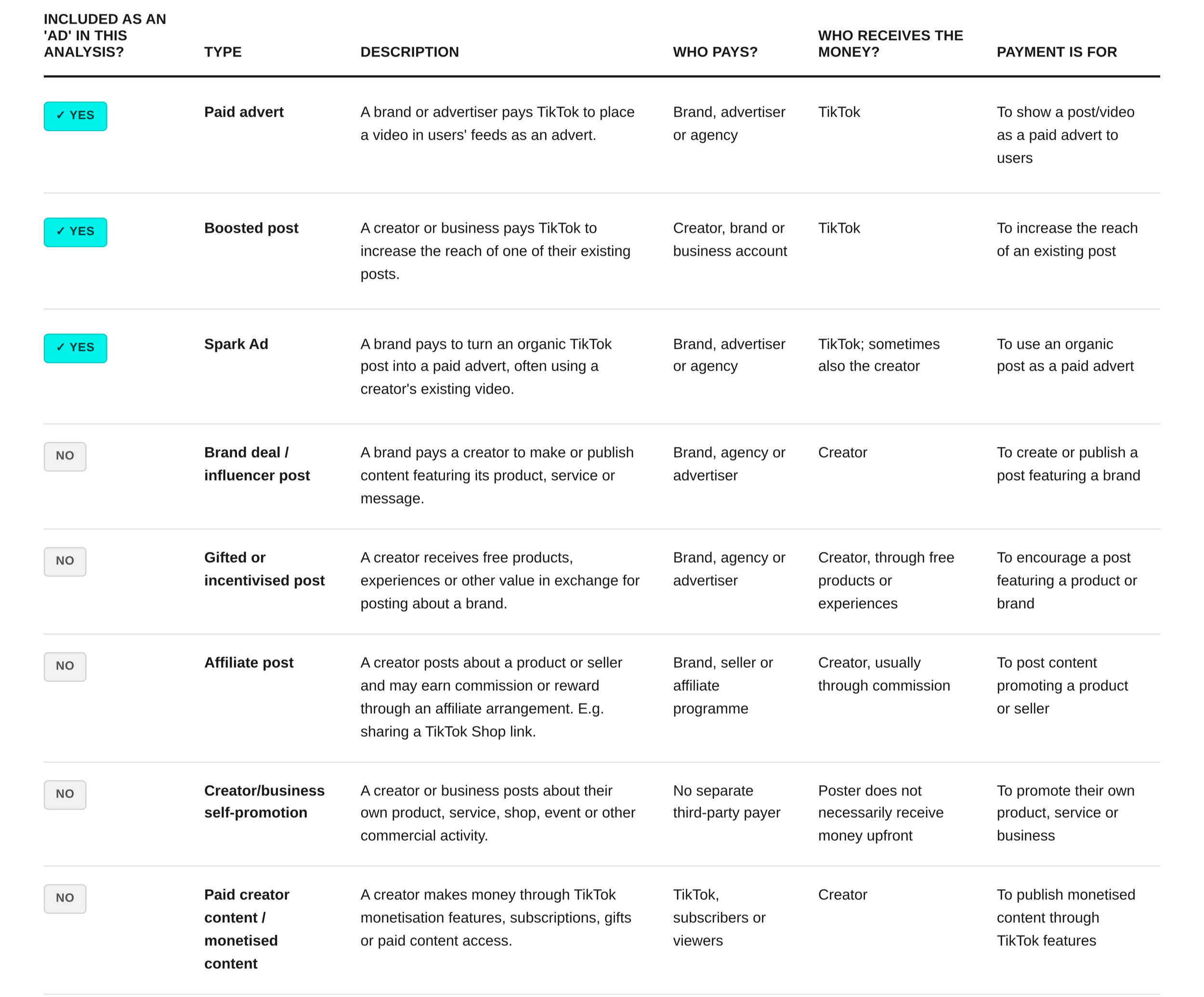
What we mean by "TikTok Ad": In this report, "TikTok Ad" refers exclusively to paid commercial advertisements. These are videos where a brand paid TikTok directly to boost the video's reach to a targeted audience.
There are a range of other ways in which creators can monetise their content, shown in the table below.
The analysis above only includes paid adverts labelled by TikTok. It does not capture the wider range of commercial content that children see on the platform.
This includes content where creators have been paid by a brand to promote a product, earn commission through product links, promote their own business or brand, or post about products they have received for free.
As a result, the overall proportion of commercially driven content children are exposed to is likely to be substantially higher than the figures shown here.
Table showing different types of commercial content that a user may see on TikTok
Children saw adverts for gambling and alcohol brands
The data children shared with us from TikTok made it possible to see exactly which adverts had been served to them, when and how many times.
This analysis found that three of the children had been shown multiple adverts for gambling and alcohol brands.
A selection of these adverts, served to children in January 2026, is shown below.
Adverts shown to children in January 2026 from gambling and alcohol brands
Most obviously, this raises concerns about children aged 14–16 being served adverts that appear unsuitable for their age. It also raises a secondary issue for brands, who are currently paying to reach audiences who are inappropriate for, and unlikely to benefit from, their campaigns.
Advertising these products to children is explicitly prohibited according to TikTok’s own policies.
So how is this happening?
TikTok accounts did not reflect children’s real ages
All three children who had seen adverts for gambling and alcohol had TikTok accounts registered as over 18. Noah, aged 14, was registered as 36; Liam, aged 15, as 32; and Tom, aged 15, as 20.
In our wider work, we regularly see children using social media accounts registered with an age that does not reflect their real age. This happens for a range of reasons: some created accounts when they were under 13 and too young to sign up with their real date of birth; some accounts were set up by parents using their own date of birth, often because they believed this was safer; and others appear to have entered a random year simply to move quickly through the sign-up process.
The result is that age-based protections — on advertising and on content more broadly — are effectively void.
Multiple children saw sexualised content on TikTok, including OnlyFans ‘funnel’ accounts
Although children rarely mentioned this type of content in interviews, and tended to skip past it quickly when observed scrolling, watch-history analysis shows that sexualised content appeared regularly in some children’s TikTok feeds.
This often appeared as women dancing suggestively in bikinis or revealing clothing — often accompanied with hashtags such as #sexy #hotgirl #baddie #leggings #babygirl.
Examples of sexualised content that children in this study saw
It also included posts from accounts that appeared to direct users towards adult sites or OnlyFans, acting as ‘funnel accounts’
Funnel accounts on TikTok: A funnel account is a TikTok account that appears to use TikTok to attract people towards paid adult content hosted elsewhere. The account may post suggestive but non-explicit videos that do not appear to break TikTok’s guidelines, in order to gain views, click-throughs and followers. It then directs users to another platform or subscription site where paid adult content is promoted or sold. This can happen through several steps: for example, the TikTok profile may link to an Instagram account, which then links to an OnlyFans page.
An example of an OnlyFans funnel account - directing users from their TikTok, to their Instagram, to their OnlyFans, is shown below. This account appeared multiple times in one child’s TikTok feed; examples of the videos they were shown from the account are included below. Click play to watch these videos.
Posts shown to one child from an OnlyFans funnel account on TikTok
Most of what children saw on TikTok, whether advertising or not, appeared to be commercially driven
Official adverts are only part of the commercial picture. Across the screen recordings and watch-history data we reviewed, it’s very difficult to establish a clear dividing line between commercial and non-commercial content. Most of the content children encountered beyond labelled advertisements appeared to be commercially motivated in some way.
Many videos spotlight or promote specific products without being labelled as adverts: a creator reviewing a supplement, a teenager showing off a new outfit, a recipe that happens to feature a branded ingredient. Others are oriented toward building a following, going viral, or replicating trends that have proven monetisable.
Very little content appearing on children’s feeds was produced by their peers or friends.
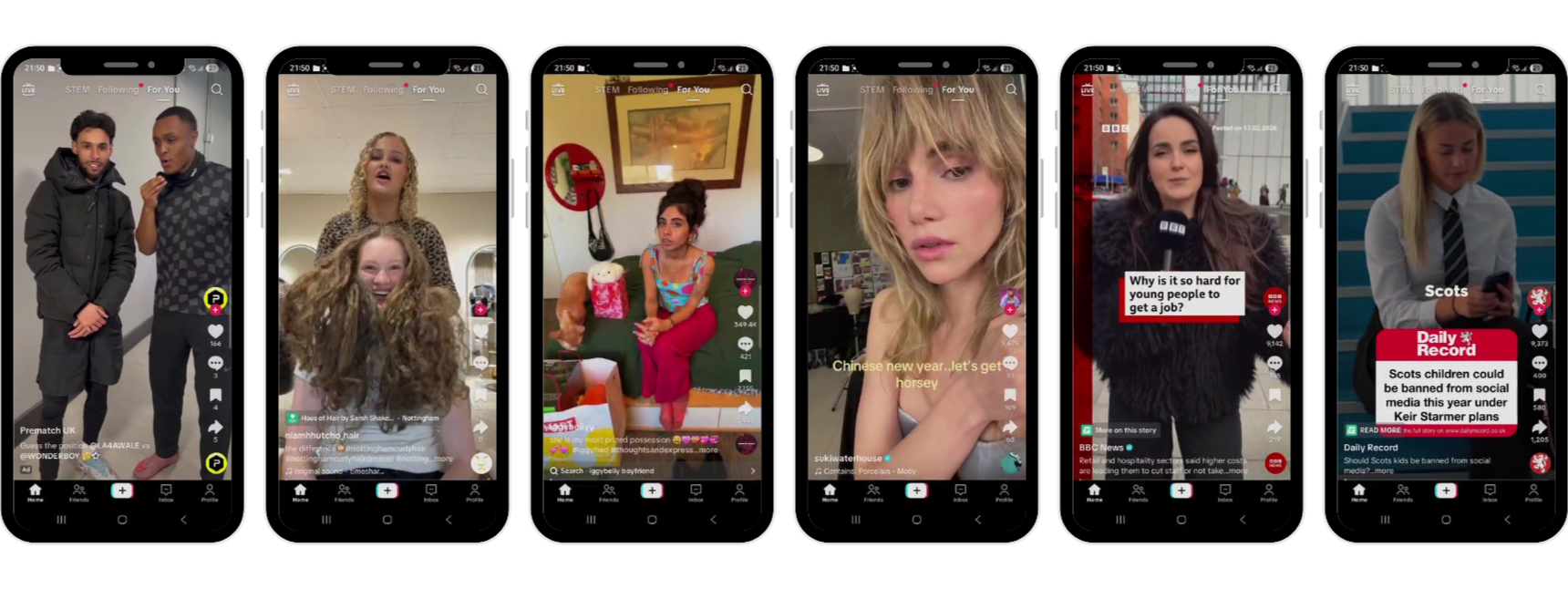
Below you can see six consecutively served videos from a randomly selected stretch of Sophia’s TikTok screen record. The first is a post promoting “Prematch”, a football app. The second is a promotional video from a hair salon. Third is a post from infleuncer iggybellyy, with over 3 million followers, who regularly promotes skincare products and clothing brands. Fourth is a post by actress, singer and model Suki Waterhouse. Fifth and sixth are promoted posts from news brands, BBC and the Daily Record. All are, in different ways, promoting people, products, brands or businesses.
Screenshots of six consecutive videos viewed within four seconds of Sophia’s screen record
Chapter 3 key takeaways
Everything has a price: TikTok feeds are commercially driven, selling products and people
In summary:
Children encounter significant volumes of advertising on TikTok — among the seven children who shared their watch history, the proportion of videos that were paid adverts ranged from 1 in every 25 to 1 in every 5 videos in January 2026.
Three children were served multiple adverts for gambling and alcohol brands — products that TikTok's own policies explicitly prohibit advertising to children. This happened because all three children had TikTok accounts registered as over 18.
Multiple children encountered sexualised content in their feeds — including from accounts that appeared to funnel users toward paid adult content on other platforms.
Beyond labelled advertising, much of the content children see on TikTok appears commercially driven — oriented toward product promotion, audience growth, or replicating monetisable trends.
In conclusion:
TikTok presents itself as a platform for entertainment and self-expression. But children's feeds tell a different story — one that is primarily commercial, selling to them directly through advertising, indirectly through creator-driven promotion, and structurally through a feed designed to maximise engagement for commercial return.
The failures of age-based protection uncovered here amount to a scam – both for children, who did not knowingly sign up for adult advertising, and for brands – who presumably don’t want their advertising spend directed at the wrong age group. TikTok profits from the revenue regardless. When a 14-year-old is registered as a 36-year-old, every protection built around age fails simultaneously.
In an environment designed purely for commercial purposes with ineffective regulation, it shouldn’t be a surprise that sexual services are also being sold to children.
With this in mind, we need to ask:
How much commercial content it is acceptable for a child to see while online?
If platforms cannot reliably identify the age of their users, what does age-based commercial regulation actually achieve?
In an environment where almost everything is selling something, what value is there likely to be for children?
Just because sexual content stays just beneath the threshold of TikTok's own guidelines, does that make it acceptable to serve to children?
Next, Chapter 4: The value of TikTok examines who benefits from children spending time on the platform.
Chapter 4
The value of TikTok
Children are not sure TikTok is worth the return on investment
Children see things they like on TikTok – that they find entertaining, funny, or interesting
“Um, there's a big variety of things to watch. Like, I can easily go from watching things to do with scooter and
BMX, into football or darts… I've used it [TikTok] before to find the best temperatures and lengths to cook like chicken or 'How to cook bacon in the air fryer.' I've done that before, and actually they teach me how to do it”
Liam, 15“I usually use it [TikTok] for comedic relief if I'm bored, so I think most time it's quite joyous or entertaining.”
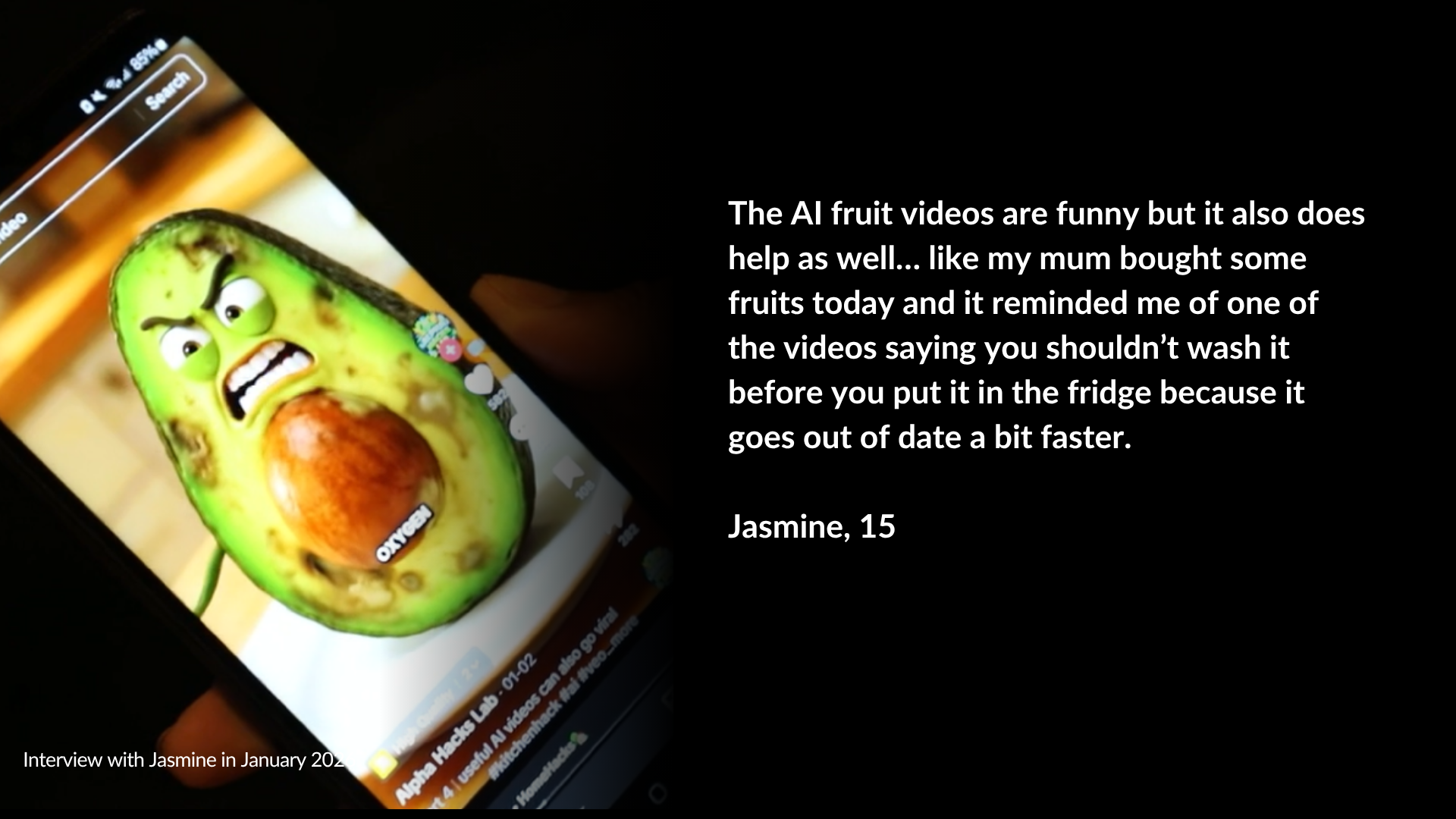
Olivia, 15Jasmine said that TikTok can be ‘educational’ and teach you things. When we asked Jasmine for an example of something she had learnt on TikTok she spoke about seeing AI videos of fruit describing how they should be stored.
Children say they use it to relieve boredom and to chill out
Relieving periods of boredom and ‘relaxing’ was one of the most common reasons children gave for using TikTok.
“It's very like easy if you're bored, you just go on that [TikTok] and you're not really bored anymore because it's obviously — entertainment.”
Charlie, 14
“I mainly use TikTok for, well, Just entertainment, or when I'm bored and I've got nothing else to do”
Tom, 15
“I feel like it feels like, you know, when you're like bored and you don't know what to do, it just like fills that gap of time”
Emma, 14
There is social currency attached to sharing videos with friends on TikTok
Sharing videos, reacting to trends, and tagging friends in content are all ways children maintain and signal their social connections on TikTok.
“Certain mutuals [mutual friends] I have, like I may not necessarily speak to you on Snapchat, but it's sometimes nice to just talk on TikTok every once in a while, and then like just like connecting each other, whether it's like making jokes or memes or videos.”
Olivia, 16
Conversations accounted for a small proportion of the time children spent on the platform, and were sometimes very surface-level
Some children do use TikTok to speak to their friends, but this often accounts for only a very small proportion of the hours they spend on the platform.
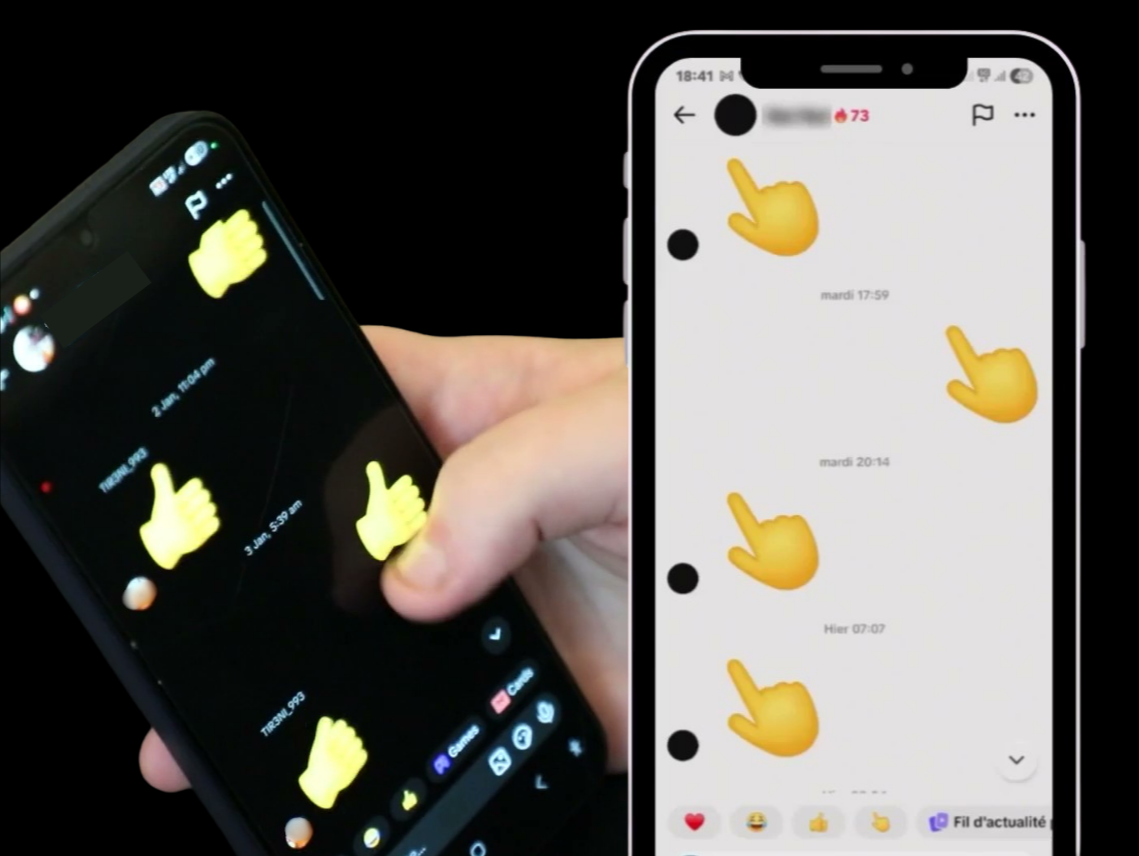
When interactions do happen, they tend to be fairly surface-level. A few children, for example, talked about using TikTok’s “streaks” function, which encourages users to share a video or a message via the chat function every day in order to maintain or build their streak. The images below show examples from two children using the streaks function, where interaction consisted of sending a daily emoji to keep the streak going. Features like streaks reward daily exchanges between friends, while creating an incentive for children to open and use TikTok every day.
Two children sending daily emojis to their friends in order to maintain their “streak” on TikTok
Despite this, most children wished they spent less time on TikTok
Most children wish they spent less time on TikTok, and when asked how they would feel if they did not have access to the platform, some said that they thought it might be a good thing.
Researcher: and how do you feel when you’ve finished using TikTok?
“I feel a bit relieved because I am doing something else other than just scrolling on my phone for very long”
Jasmine, 15
Researcher: And is there anything else you would rather be doing instead of scrolling on TikTok?
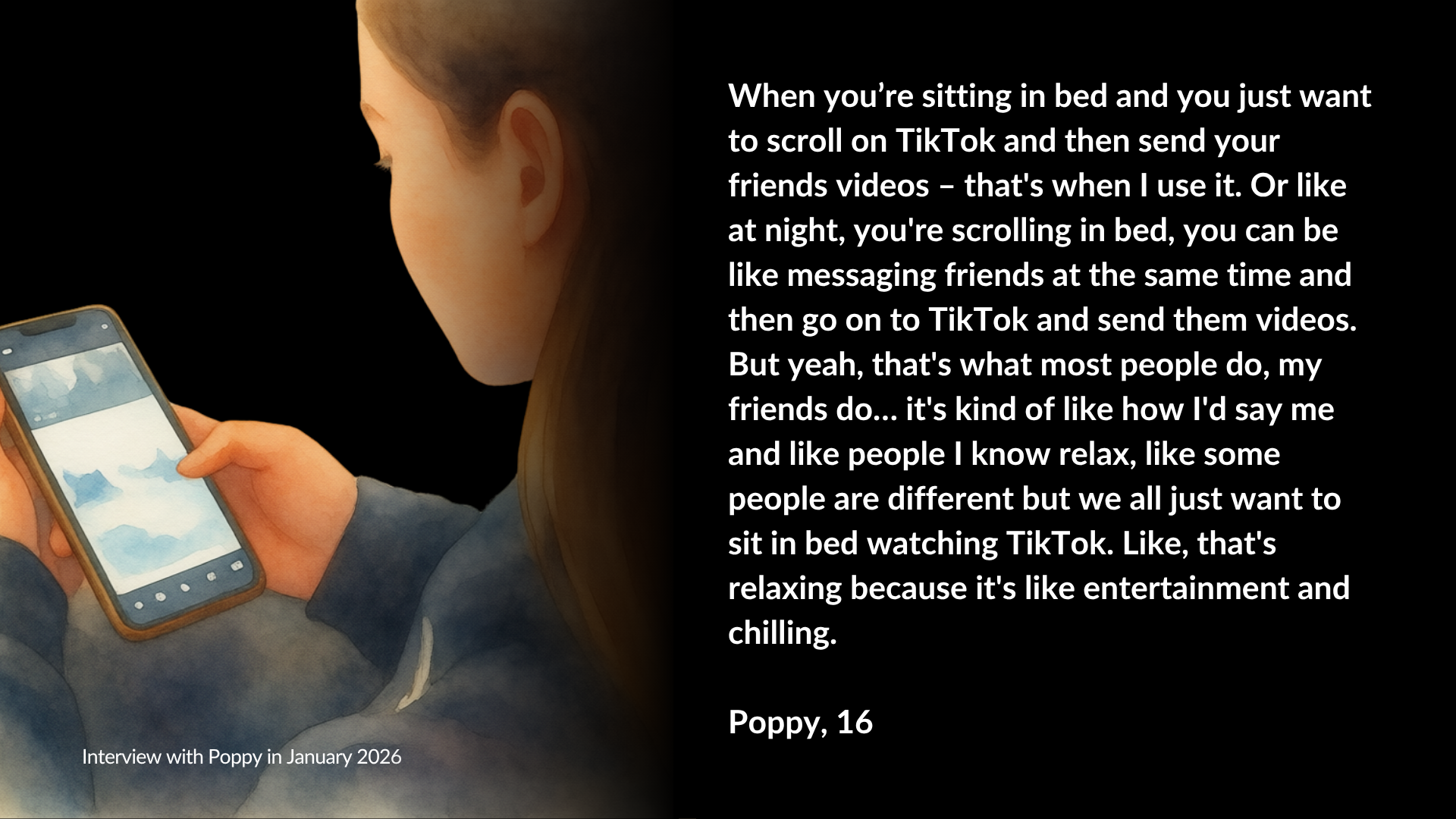
“To be fair, I'd rather, like, hang out with my friends. But obviously when you get back from school, you don't really want to go out. Everyone just kind of wants to sit in bed, so that's why everyone messages each other. So maybe hang out with them or, like go out.”
Poppy, 16
Researcher: What do you think you would do if TikTok was banned?
“I think I'd get on with my life and live, to be fair. I think it do a lot of people good in a way.”
Tom, 15
Sophia, one of the 16-year-olds, described how she wasn’t sure she got much from the time spent on TikTok.
“Sometimes when I think about TikTok it makes me feel really weird cos it’s like why, there just feels like there’s no point of it like I’m not getting anything out of it, but I think it can be really addicting definitely, sometimes it’s nice to learn about other people’s lives and see what’s out there but then other times it’s like what is the point of it?”
Sophia, 16
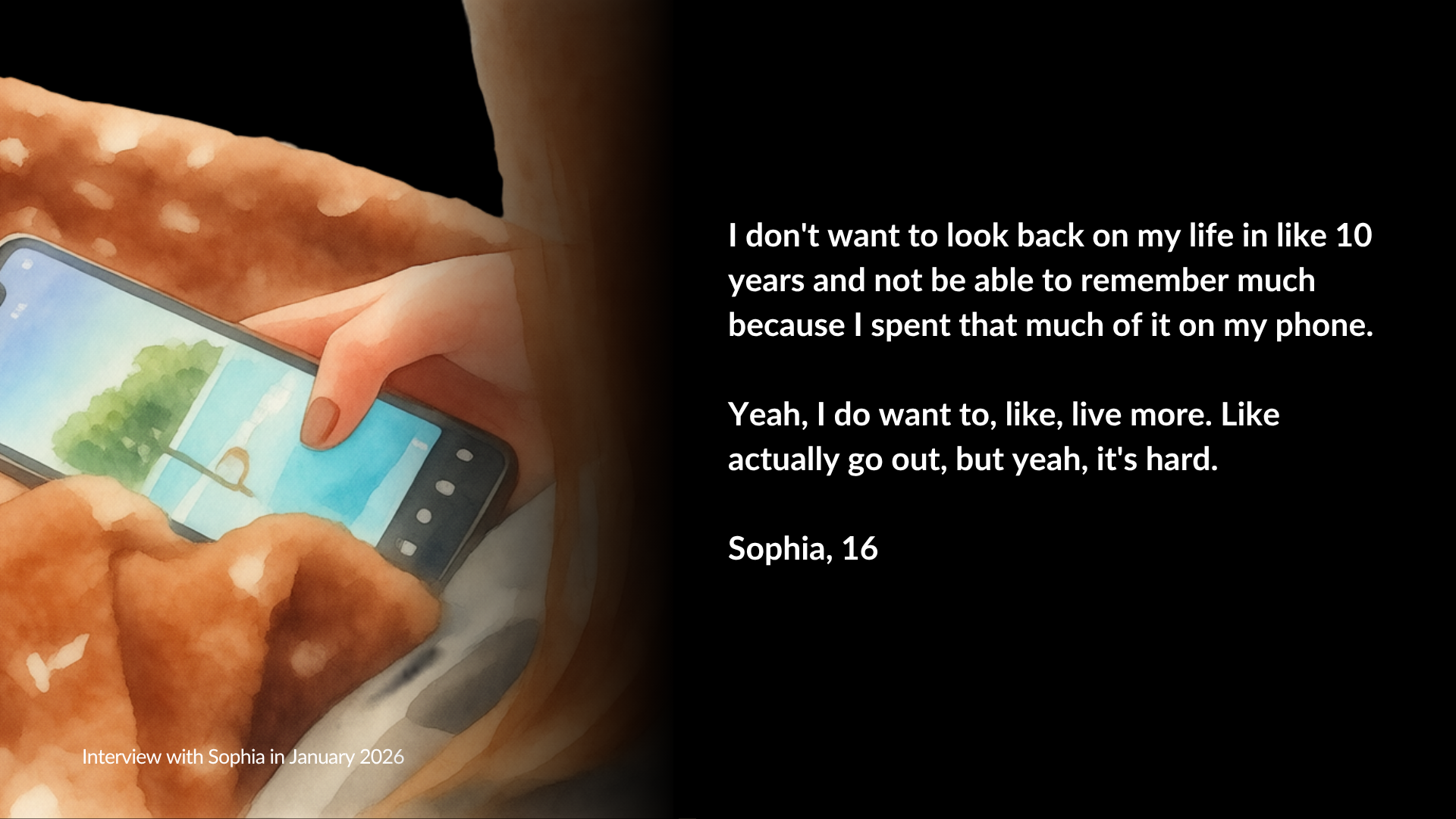
She reflected that she did not want to look back on her teens and young adulthood and regret the time she had spent on her phone:
Chapter 4 key takeaways
The value of TikTok: Children are not sure TikTok is worth the return on investment
In summary:
Children see things they like on TikTok - they describe seeing entertaining, funny, interesting and sometimes useful or educational content on TikTok. However when you ask children to share examples of this, it is often hard for them to remember or identify examples.
Children often use TikTok to relieve boredom or ‘chill’ out - several described it as something easy to turn to when they have nothing else to do, or when they want to fill a gap in time.
Sharing videos with friends gives TikTok social value, but direct conversations often account for a small amount of the time that children spend on TikTok, and the conversations are often fairly surface-level, such as sending daily emojis to maintain a “streak” on TikTok.
Despite this, most children wished they spent less time on TikTok— some said they felt relieved when they stopped scrolling, or thought not having access to TikTok might be good for them.
Some children questioned whether TikTok was really giving them much back — describing a sense that there was “no point” to the time spent scrolling, and recognising that the platform could feel addictive.
In conclusion:
The value children get from TikTok appears mixed. Children can clearly identify things they enjoy about the platform: it entertains them, gives them something to do when they are bored, and offers small moments of social connection with friends. But these benefits sit alongside children’s own doubts about the amount of time TikTok takes from them, and whether that time feels worthwhile. This feels particularly concerning because the return children describe is often quite thin: a funny video, a momentary distraction, a daily emoji, a passing sense of connection. If children are spending hours on a platform that they themselves are not sure is giving them enough back, and is even taking away from other things they think would benefit them more, we need to ask:
What value are children really getting from the time they spend on TikTok?
How should we weigh short-term enjoyment against children’s own sense that they would rather spend less time scrolling?
If children feel relieved when they stop using TikTok, what does that tell us about the experience of using it?
Are features like streaks creating meaningful social connection, or simply giving children another reason to open the app every day?
Conclusion
We opened this report by posing the question: Is TikTok ‘just a bit of fun’? Is it really how children relax, connect, and learn about the world?
Now you’ve looked, what do you think?
Is TikTok harmful? It’s true that for most children, we see a lot less explicitly harmful content on feeds nowadays. Fewer self-harm scars, less violence, minimal explicit nudity. But we still need to ask: is it good for children?
In this report, we show that on TikTok, children spend almost all their time passively scrolling and consuming. It’s rare for a post by a friend to pop up in the feed. Interaction with people they actually know makes up only a small proportion of time spent on the platform — and even then, it is often limited to lightweight exchanges, such as sending thumbs-up emojis to maintain ‘streaks’.
Children are learning about the world on TikTok. This report shows what world they’re seeing: feeds are made up of a targeted reflection of what commercial actors think will capture their attention. That includes posts about sports they’re interested in or bands they like. It also includes gambling adverts, OnlyFans actors promoting their channels, beauty influencers selling weight-loss supplements.
As for a bit of fun, for many children in this research it’s hours a day, thousands of videos a week, it’s during the school day and it’s at 3am. The teens in this study are scrolling TikTok for an average of 10% of their waking hours, with some closer to a quarter (this assumes they sleep for eight hours, which many don’t, because they’re scrolling).
Children say it’s entertaining and good for filling time when they’re bored. But many also say they feel tired, guilty or disappointed in themselves afterwards. Children use phrases like “doomscrolling” and “brainrot” to explain what it feels like. They regularly report feeling out of control, spending longer than they meant to, or even describe themselves as “addicted”.
Children told us about the activities they worried TikTok was taking them away from – hobbies, time with their friends, homework, sleep. These are not small losses; they’re part of growing up.
TikTok is where most children go to scroll – but the features that make it so captivating are common across many platforms. YouTube, Instagram, Snapchat – even Netflix, Spotify and Roblox are recognising the commercial value of the infinite scroll.
We have allowed a significant portion of childhood to move into a space that we have barely looked at, shaped by powerful behaviour changing technologies that are quickly becoming ubiquitous.
Setting TikTok aside, is super-short form video ever a good idea for children? What value can it provide to developing brains when it precludes meaningful stories, narrative, context? Is an infinite scroll ever likely to be a mechanism by which children can benefit? If it is – we can’t see it.
Methodology annex
Four ways to look at children’s lives on TikTok
Further detail about the four methodologies used in this study are detailed below - ConnectLive, data donation, screen record and in-home filmed interviews.
Note that for all methods, informed consent was obtained from both the parent and child.
ConnectLive
Measuring when children use which apps, and what the impact can be
What is ConnectLive?
ConnectLive is a research tool developed by Revealing Reality and 5Rights to capture objective, passive data on how children use their phones. Unlike self-report surveys – which rely on children or parents to recall and honestly disclose their behaviour – ConnectLive records what children actually do: every app opened, every session, timestamped to the millisecond.
ConnectLive also has the ability to trigger short in-app surveys based on observed behaviour. The tool can detect when a participant has spent, say, thirty minutes scrolling on TikTok or thirty minutes away from their phone, and prompt a survey immediately afterwards. This makes it possible to measure the effect of specific types of phone use on mood, on attention, on cognitive performance – in close to real time, rather than asking children to reflect on how they felt at the end of the day.
Who took part?
ConnectLive was developed and refined through several rounds of internal testing before being piloted with real participants.
For this pilot study, 23 young people aged 14 to 16 were recruited, sampled to reflect a range of backgrounds: roughly equal numbers of girls and boys, with a spread across all four UK nations, school types, social grades, and ethnic backgrounds. All participants owned an Android phone and, crucially, all had their own TikTok account. Children were recruited to ensure a mix of heavier and lighter phone users, as well as varying levels of TikTok use. Self-reported TikTok usage collected during the recruitment ranged from those who reported spending under two hours a day on the app, to those spending two to three hours, and those spending three hours or more.
What taking part involved
Sharing usage data: All children shared passive data about the phone usage as part of the study. Data was available from an average of 26.5 days per participant, drawing on both activity recorded during the study period and the historic app usage data captured when children first downloaded the ConnectLive app. The total period spanned 30th December to 2nd February across the sample, though the window varied by participant (ranging from 18 to 33 days of data which was available for different children), reflecting differences in how much historic data was retrievable at the point of the initial data draw. It should be noted that for some children, this period spans the Christmas holiday, meaning that a few days of the data reflects behaviour during school holidays rather than term time. Dates are included where specific days are visualised in this report, to help distinguish between weekdays, weekends and school holiday periods. To ensure only complete days of data were included, the first and last days were excluded from analysis for each participant.
It should be noted that two participants had decided to stop using TikTok altogether in the time between being recruited and the data collection completing on the ConnectLive pilot. Therefore, data shown in this report includes 21 children who used TikTok throughout the trial period.
Completing prompts: In the second week of the pilot, prompts were triggered by phone and app activity, whenever one of three conditions was met:
1. 30 minutes of device inactivity: if a participant had not used their phone for 30 consecutive minutes
2. 30 minutes of TikTok activity: if a participant had spent 30 minutes on TikTok within a one-hour window
3. 60 minutes of TikTok activity: if a participant had spent one hour on TikTok within a two-hour window
Each type of prompt was sent at most once per day, to avoid overburdening participants.
The prompts that were sent contained the same survey, but each with response options randomised to minimise order effects and maintain engagement. Prompts contained an 8-item version of the Positive and Negative Affect Schedule (PANAS), a measure of mood and affect, adapted to capture how participants were feeling in that moment, rather than across a period of two weeks.
To ensure that responses were reflective of the condition that triggered them, the data was cleaned. For device inactivity and TikTok activity prompts, responses were invalidated if a participant had proceeded to use any app other than ConnectLive for more than one minute from the point the prompt was sent.
What the data covers
ConnectLive generates a comprehensive record of app usage on each participant's Android smartphone for the duration of the study, logging every app used with exact timestamps and session durations recorded to the millisecond. This passive data record covers all apps used on each device.
Uniquely, ConnectLive also captures a period of historical app usage data at the point of download – providing two to three weeks of behavioural data prior to the study period itself. This means the dataset does not simply reflect how participants behave while they knew they were being studied, but also offers a window into their ordinary, unobserved phone use before the research began. Throughout the study period, data was synced each time the participant opened the app.
Alongside this, the child’s responses to the prompted surveys used in this pilot were collected.
This pilot demonstrates that ConnectLive is capable of generating objective, real-time data on device and app activity and linking it to in-the-moment measures of wellbeing and cognitive function. A larger study will be needed to replicate the research findings at greater scale, but the methodology has been proven to be capable of collecting both usage data and in the moment survey data via automatic prompts sent to the child’s phone based on their usage.
Data donation
Examining what TikTok's algorithm actually serves to children
What is data donation?
Every TikTok user has the legal right, under UK GDPR, to request a full export of their account data. This includes data such as search history, watch history, comments, purchases on TikTok shop, profile information, and videos shared.
Data donation is the process of asking research participants – in this case, children and their parents – to make that request and share the resulting file with researchers. It requires no specialist software, no access to platform systems, and no cooperation from TikTok. It does require careful consideration of research ethics, informed consent and strong data security.
What makes this method particularly powerful is that the data comes from TikTok itself. It is not a sample, not an estimate, and not self-report. It is a complete, platform-generated record of everything a child has been served and seen.
Who took part and what did taking part involve?
A subset of seven children (four girls and three boys) from the ConnectLive pilot took part in a subsequent phase of research to explore the potential for using data donation from TikTok in research.
Participating children, with parental consent, were guided through TikTok's own privacy settings to submit a formal data request via the app. Once the export was ready – typically within one to four days – the file was shared with the research team directly.
What the data covers
The exported data includes each participant's watch history, search history, and following list, with timestamps recorded for each entry. For the pilot, direct messages and comments were explicitly excluded from the request.
The research team then analysed the watch history data as the primary data source. Using a custom-built script, each video in the watch history was processed to extract a range of variables – including TikTok's own classification of paid advertisements, the handle of the user that posted the content, and the video description provided by the uploader.
On average, 22% of videos in the dataset were unavailable at the time of retrieval – meaning the URL no longer returned the original video, typically because it had subsequently been deleted or originated from a private account. This figure ranged from 13% to 33% across the seven participants. The data presented from this analysis is based on the sample of videos that were successfully retrieved.
The watch history data also made it possible to estimate watch duration. Watch duration was calculated by working out the difference between the start times of videos watched in chronological order. Videos with a calculated watch time of over 60 minutes were excluded, as this exceeds the maximum length of any video on TikTok, suggesting these values reflect gaps in app usage, for instance where a child went off their phone or switched to a different app, rather than genuine viewing time. It is worth noting that this method of calculating watch time may still include some gaps in app usage as genuine watch times, meaning the actual proportion of videos watched for 5 seconds or less is likely even higher than reported in this report.
Screen record
Seeing TikTok through a child’s eyes
What is screen recording?
Screen recording uses the built-in recorder available on all modern smartphones to capture a first-person, real-time record of exactly what a child sees as they scroll through TikTok – every video, every swipe, every pause and skip, in sequence.
We have used this method for over a decade to study what social media actually looks like through a child's eyes. It requires no specialist software, no platform cooperation, and no technical expertise. It does require informed consent, very strong data protection and careful consideration given to safeguarding procedures should the data reveal safety concerns for participants.
What it produces is a direct, unmediated visual record of the TikTok experience as a child lives it. No method is without its limitations, and screen recording is no exception. Children who know they are being recorded will sometimes modify their behaviour – skipping past content they might otherwise have watched, or spending slightly longer on something they want to be seen engaging with. In our experience this effect is real but modest, and it runs in one direction: if anything, recordings show a slightly more considered version of a child's TikTok use than the unobserved reality.
Who took part?
As part of the ConnectLive pilot, all 23 participants were asked to share short screen recording clips – between three and five minutes in length – of themselves using the apps they spent the most time on, including (or as well as) TikTok.
What the data covers
Participants were asked to turn on their phone's built-in screen recorder and capture a three to five minute clip of themselves using the apps they spent the most time on, at a time of their choosing. No instructions were given about how to behave during the recording - the aim was to capture naturalistic behaviour, not a curated or self-conscious performance, though clearly, children were aware they were recording.
After recording had finished children then shared these clips with researchers, giving them a chance to review the clips prior to sending. Consent was obtained from both children and their parents before any recordings took place. Children knew their recordings would be seen by the research team.
In-home interviews
Speaking to children about their TikTok use
What are in-depth interviews?
Our in-depth interviews involve spending time in the physical environments where children live, helping us understand the wider context of their lives, families, hobbies and routines.
Through in-home interviews, we explore not only what children say they do, but what they are actually doing in practice. This includes observing their digital use and, where appropriate, capturing screen recordings of phone use to understand how technology fits into their everyday lives.
Our researchers are trained in photography and film, enabling them to capture rich visual assets that bring children’s experiences, environments and behaviours to life.
Who took part
Ten of the 23 children took part in an in-home interview. Children were selected based on their willingness to take part in the interviews, while also ensuring a diverse range of profiles, including variation in overall levels of phone and TikTok use. The final interview sample comprised five girls and five boys, aged between 14 and 16, drawn from locations across England and reflecting a spread of social grades and ethnic backgrounds.
What the data covers
The in-depth interviews took place a few weeks after the ConnectLive app trial. Interviews captured audio, video, and photography, with screen recordings captured during the sections where participants showed the researchers how they used different apps. Researchers, where possible, also spoke to participant’s parent or guardian. Four broad areas were covered during the interviews:
1. Children’s day-to-day life, routines, and relationships – providing context for the data on phone use collected during the study
2. A detailed walkthrough of their phone use, with researchers exploring specific apps and patterns of usage identified from each participant's ConnectLive data ahead of the session
3. A dedicated focus on TikTok, including how they used it, what they watched and how they felt about their use of it
4. Reflections on taking part in the ConnectLive pilot itself
Neutral ways to explore children’s TikTok use
The interviews explored participants’ experiences of TikTok use through a semi-structured discussion guide designed to remain neutral and enable exploration of both positive and negative impacts. For each prompt relating to potential harms or negative experiences, corresponding prompts were included to explore positive experiences and perceived benefits.
This approach was intended to avoid framing TikTok, social media use, and phone use more broadly in predominantly positive or negative terms and to allow participants to describe their experiences in their own words.
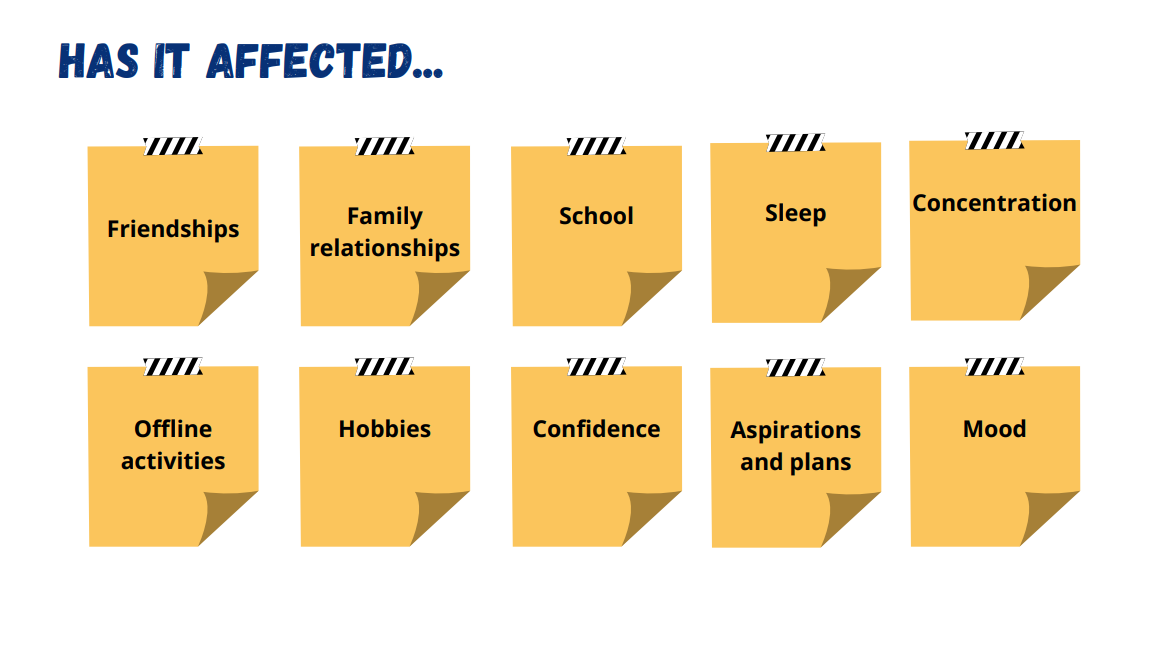
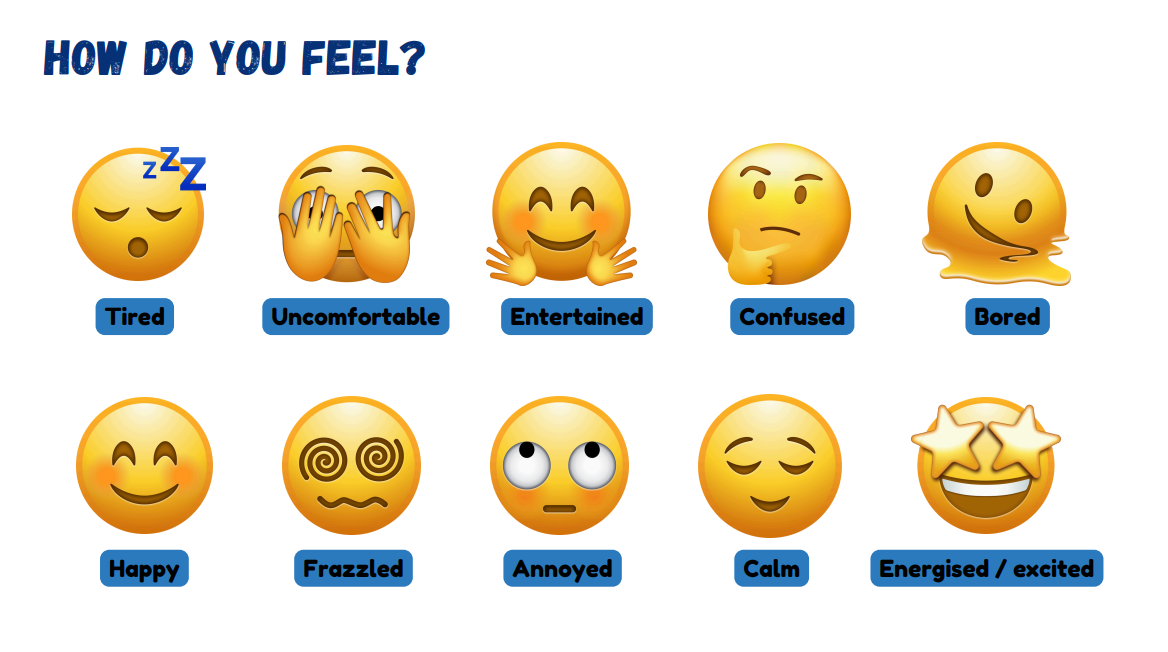
Researchers used the interview guide to identify and explore these themes throughout the discussion. After an initial period of open-ended questioning, towards the end of the interviews, children were prompted to consider whether and how different social media platforms they used affected different areas of their lives. The stimulus used in the interviews is shown below.
Impacts stimulus: Children were shown a series of prompts relating to different areas of life (e.g. friendships, sleep, concentration, hobbies, mood) and asked to reflect on whether TikTok had affected these areas at all, in positive, negative, or mixed ways.
Mood and feelings stimulus: Participants were presented with a range of emotion prompts and asked how each social media platform they used made them feel in the moment while using them.
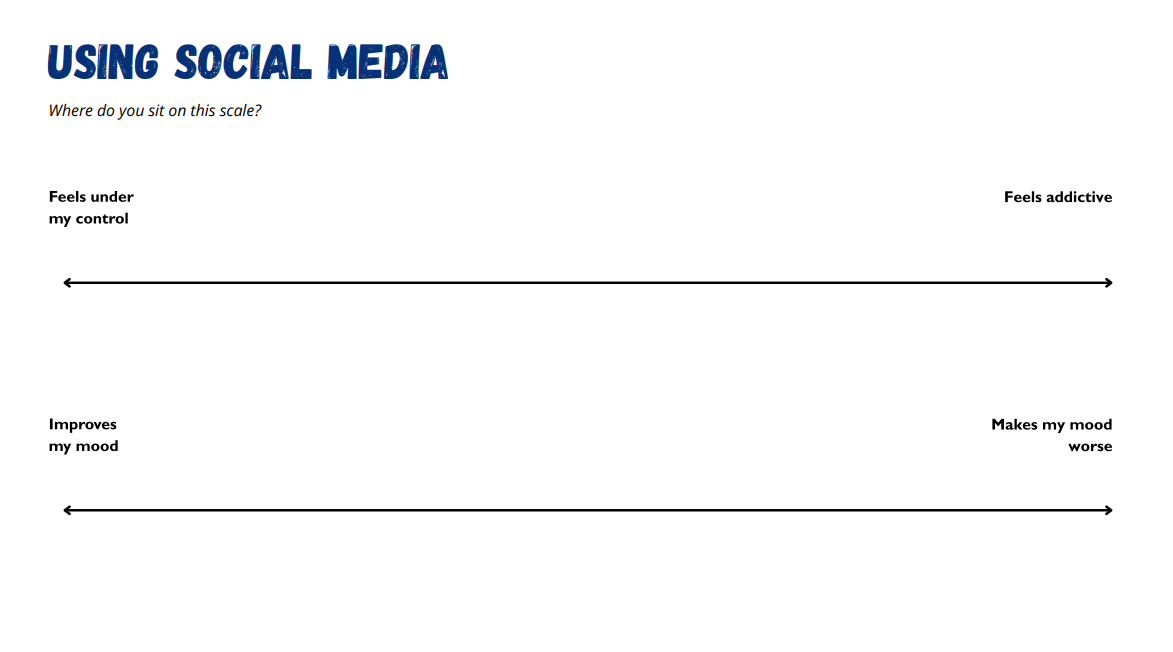
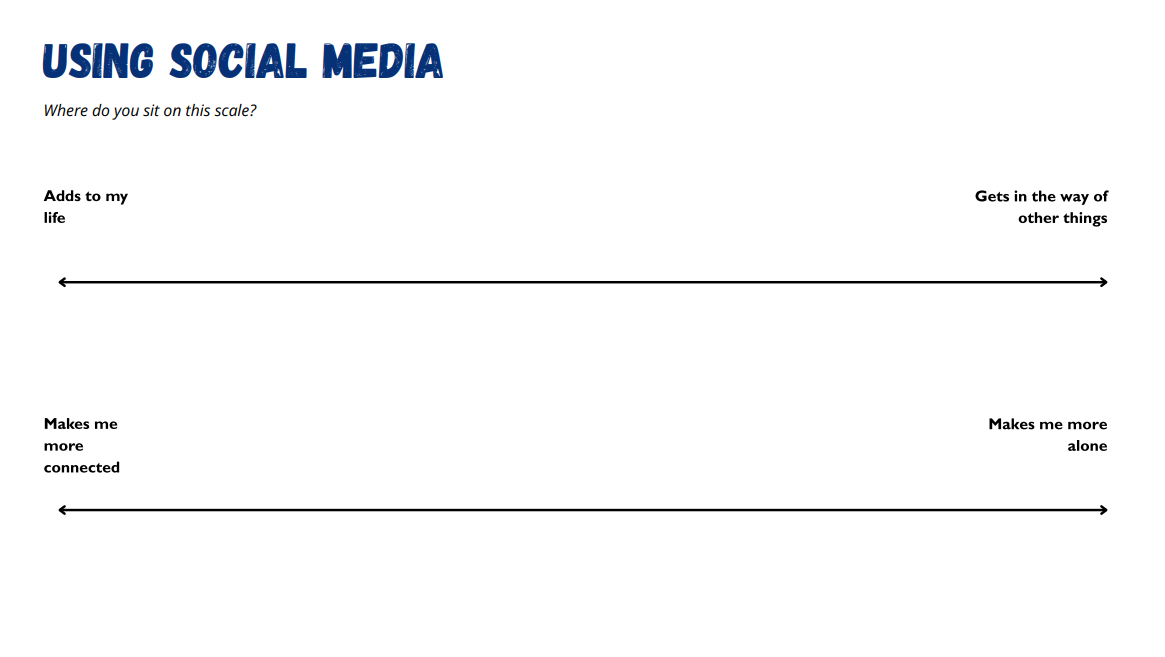
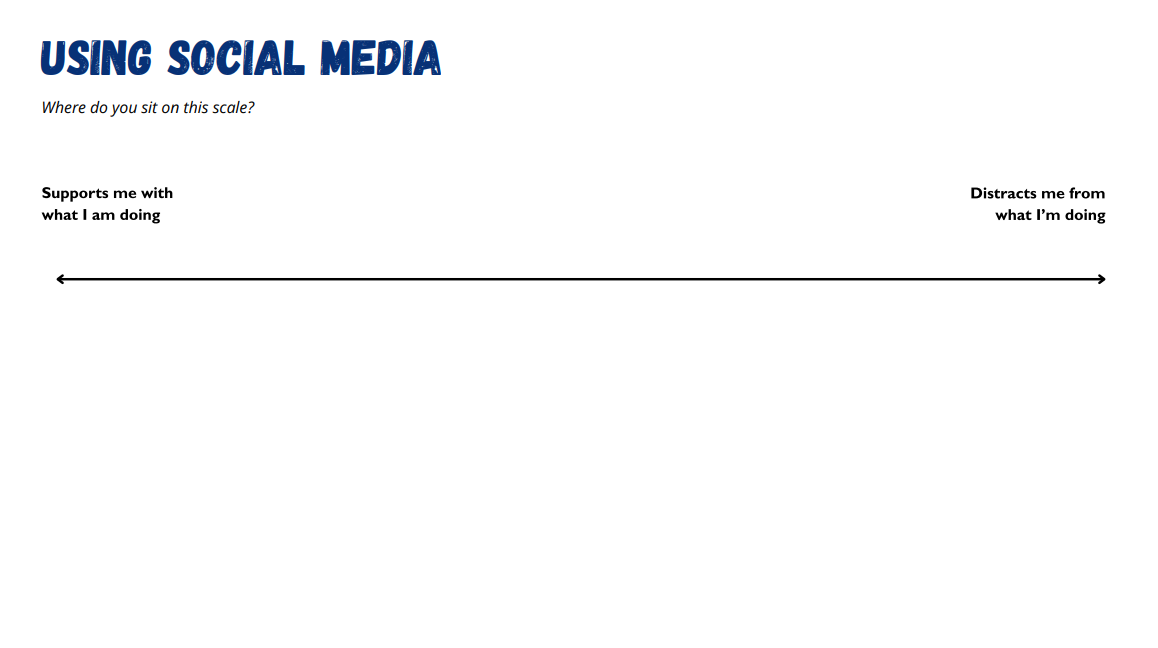
Spectrum exercise: Participants were asked to position themselves along a series of scales (e.g. “feels under my control” to “feels addictive”) to indicate how they perceived the impact of social media overall, after which researchers probed for platform-specific experiences and examples.