
Children’s media lives must be seen to be believed
22/04/24
A decade of Children’s Media Lives
For the past 10 years, we've conducted the Children’s Media Lives research for Ofcom. This longitudinal project follows children from age eight to 18, exploring how they use media and its impact on their lives. Doing this work is a privilege – it gives us a unique window onto what children see online. We've witnessed massive change over the decade, as we’ve evolved the project to capture not just what children say, but what they actually see.
Our findings come from talking to children about their thoughts, feelings, and experiences, and then seeing it for ourselves. Each year, we watch hours of ‘screen recordings’ shared by children in the project. We observe their tap-by-tap journeys through platforms like TikTok and Instagram – we see what they scroll, like, comment on, and repost. We note what holds their attention and what doesn't.
If you haven’t seen it yourself, kids' social media experiences can be difficult to imagine. And they’re hard to put into words (though we do our best!). We find it makes a huge difference when we can simply show people. We think this is often what is missing from more abstract discussions about screentime, and children’s use of smartphones and social media.
Three minutes through the eyes of a child
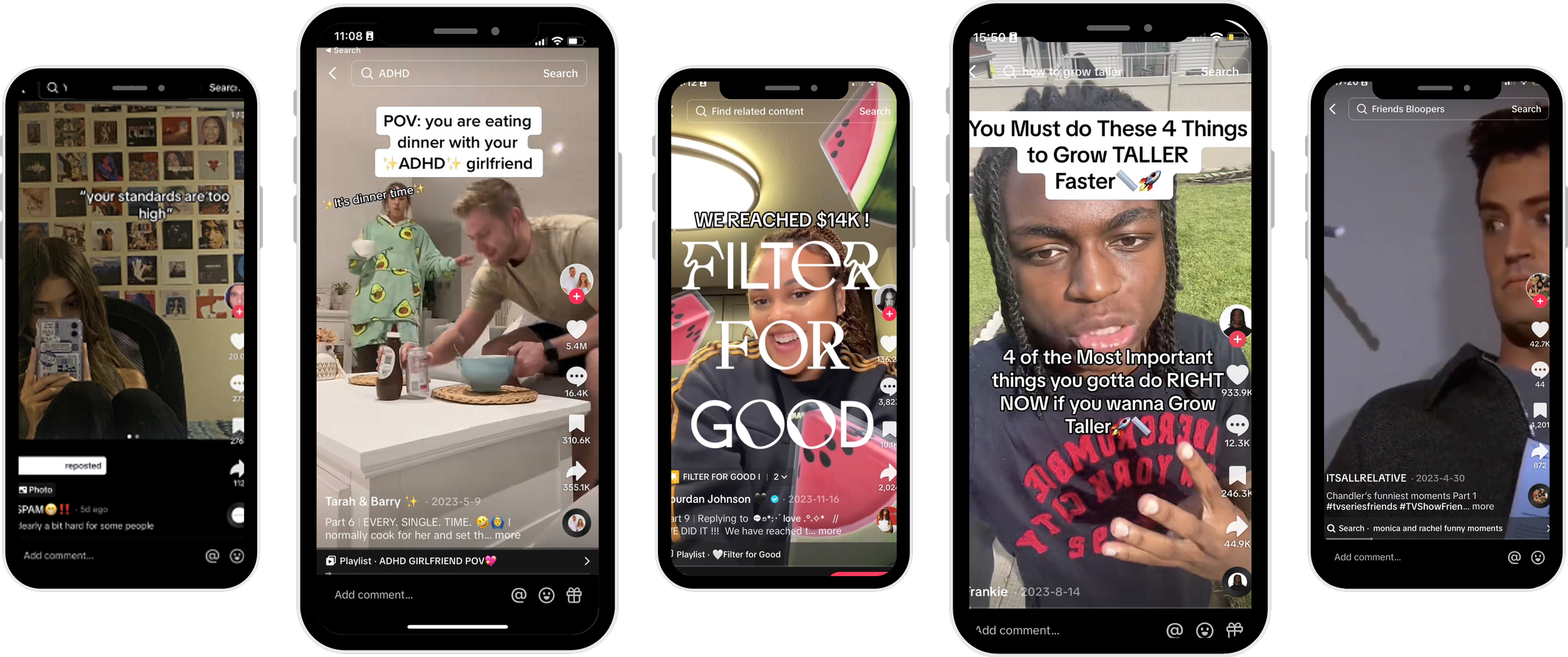
While we can't share these screen-recordings publicly, we've created realistic mock-ups of four children's TikTok ‘For You’ feeds. These videos feature content creators whose work appears in these kids' actual feeds. We've tried to mimic the way they scroll, pause, and swipe.

Amber (11) spends one to two hours on TikTok on a school day. Amber’s screen recording is particularly diverse and seemingly random, which we’ve tried to replicate here. You’ll see disconnected clips of TV shows are interspersed with satisfying ‘slime’ or ‘ASMR’ videos, ‘get ready with me’ montages, Roblox tutorials, dances, jokes, drama and gossip.
At one point you’ll see a popular format of video - the ‘split screen’, playing two unrelated videos simultaneously.
Zak (13) averages around seven hours of screen time daily, with close to three on TikTok.
You’ll see that the algorithm has clocked him as a Taylor Swift fan, and his screen recording also includes a mix of challenges, Roblox tutorials and influencer ‘behind the scenes’ gossip.
Taylor (15) is in her GCSE year and trying to limit how much time she spends online. She uses Snapchat for two to three hours daily and spends over an hour on TikTok.
Her feed shows her advice and motivational content related to routines, exams, careers, and lifestyle.
You’ll see that Taylor often switches to ‘fast forward’ mode on TikTok, watching longer videos at double speed.
Ben (16) averages six hours daily on his phone, and over four on TikTok.
His feed includes sports gossip, gaming commentary, motivational montages, and life/fitness advice (including videos on "how to grow taller").
Ben also watches some videos at double speed.
The changes we’ve seen in children’s media 2014 to 2024:
Seeing children join the project age eight and graduate out at 18 has been hugely rewarding. We've witnessed major changes over the past decade – trends emerging, evolving, and sometimes vanishing. The same children, year after year, adapting to a shifting media landscape. The amount of time children spend on screens has ballooned, and the time spent doing anything else has dwindled.
But the most eye-opening aspect has been seeing how the content on those screens has evolved. This year’s report illustrates trends towards hyper-stimulation, tactility, and heightened intimacy in videos. The stark difference between a relatable ‘Get Ready With Me’ video watched by girls in the study in 2014, and an “ASMR Doing Your Makeup In The Back Of Class” role-play video watched by girls of the same age in Children’s Media Lives 2024 – is hard to describe: it has to be seen.
We've done our best to convey how much the content has changed in these videos, but really anyone can look for themselves. Spend a few minutes skipping through TikTok Lives, or see if you can sit through a whole MrBeast video.
Screen recording and social media avatars offer rigorous research tools, but the truth is just a few clicks away for anyone who’s interested.
Sign up to hear more
Read the full report
Click here to read the full research report for wave 10
Contact the team
Feel free to contact ruby.wootton@revealingreality.co.uk to speak with the research team