
The value of childhood
The commercialisation of play, entertainment and learning in children’s lives
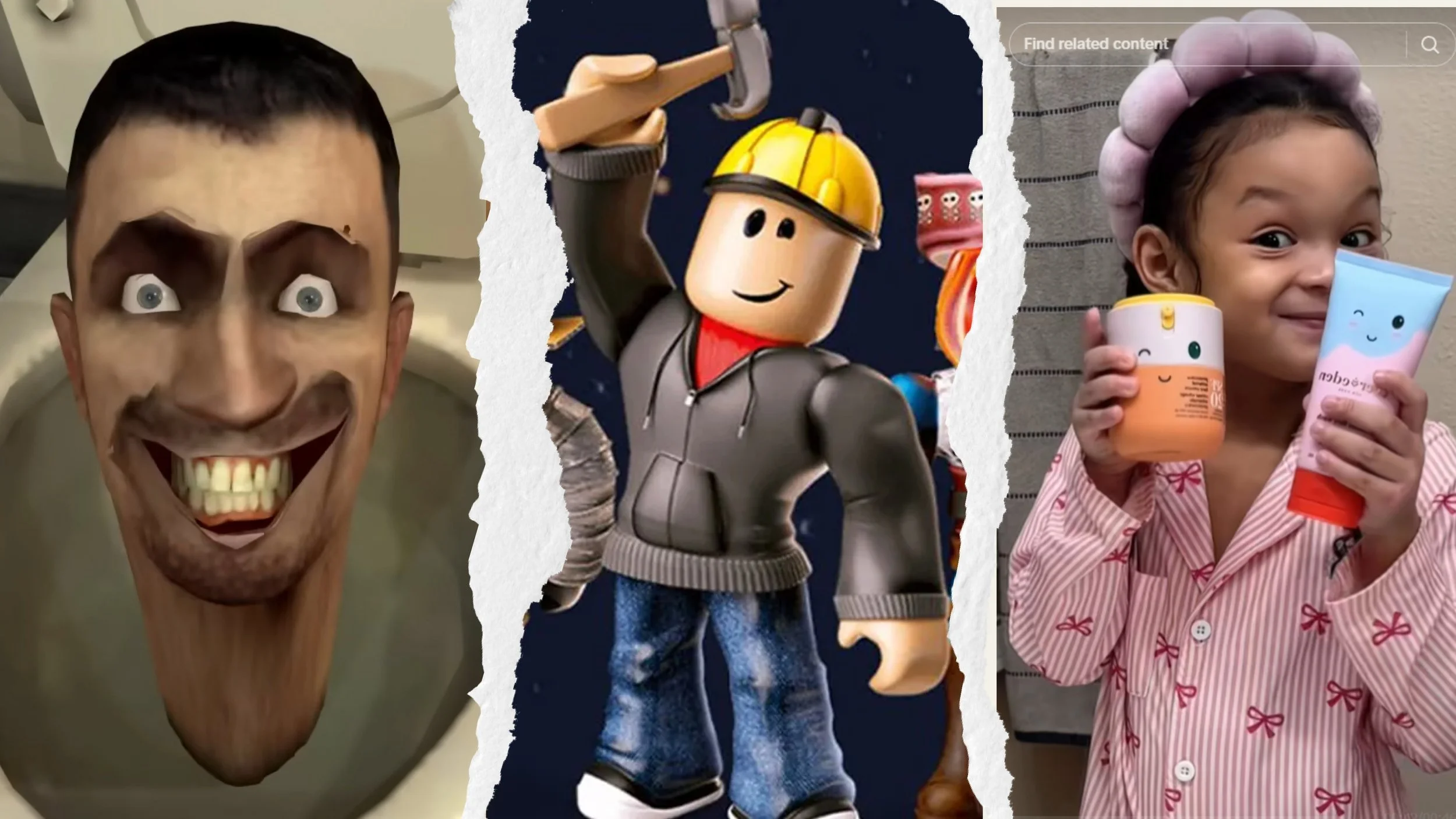
Left to right: Skibidi Toilet, Roblox, Evereden TikTok
Throughout history there have been constant and sometimes monumental shifts in the way we raise children.
There were once few qualms about putting children to work and using them for commercial gain – in the late 18th century an 8-year-old sent down a mine wouldn’t have raised an eyebrow.
Over the course of the 19th and 20th century, in the UK and many other parts of the world, more attention began to be paid to what a ‘good’ childhood should look like. Child-labour was largely eliminated, educational attendance became compulsory, services were set up to monitor and protect children, and what it meant to be a parent changed – a far more hands-on approach became the norm.
But there seems to be a sense now that we’ve taken a step backward. Increasing numbers of young people are reporting higher levels of mental health difficulties, missing school and spending far less time outdoors playing with their friends.
At Revealing Reality, we have had the privilege of spending over a decade researching childhood, conducting ethnographic research with hundreds of children and their families.
We were commissioned by the Ada Lovelace Institute to draw on this experience to share the most significant shifts we have seen in childhood and what the impact of those changes might be.
The commercialisation of childhood
We’ve witnessed childhood entering a fundamentally different phase – one we seem to have sleep-walked into without deliberate choice or public debate. Childhood has become dominated by digital experiences, shaping how children play, learn, and are entertained. Platforms, apps, and devices are the environments within which they spend most of their spare time, and are consequently playing a significant role in their behaviour and development.
These digital environments operate within a commercial framework – an ‘attention economy’ – the currency? Attention and user data.
Platforms and online games generate revenue through multiple channels, with user data driving the whole system: attention spans, preferences, scroll habits, locations, plus names, contact details, and uploaded images power the personalisation of feeds, targeted ads, and feature design, creating a feedback loop. The content shown shapes engagement, generating preference data that, in turn, shapes future content alongside increasingly precise marketing.
Take Suzy for example (participant from Children’s Media Lives, 2025 Ofcom). Suzy, 12, spends an average of seven hours a day on her phone, with TikTok as her most-used app. She describes scrolling before bed as "going down a rabbit hole" – frustrated about the time spent but drawn to the content.
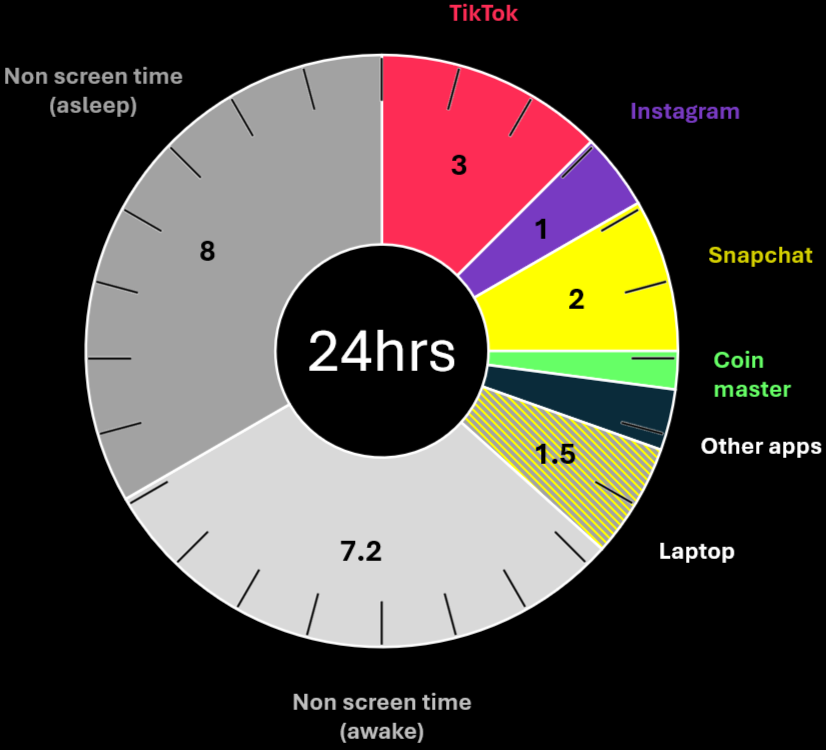
Suzy’s screen time
On TikTok, she watches lifestyle and fashion content. Recently, she bought a £60 Adanola jumper after seeing it in an influencer's sponsored post. She also sees videos of young children, "Sephora kids" as she calls them, marketing skincare products: "wee girls that want to be grown up. Wee girls using retinol, wee girls buying Drunk Elephant."
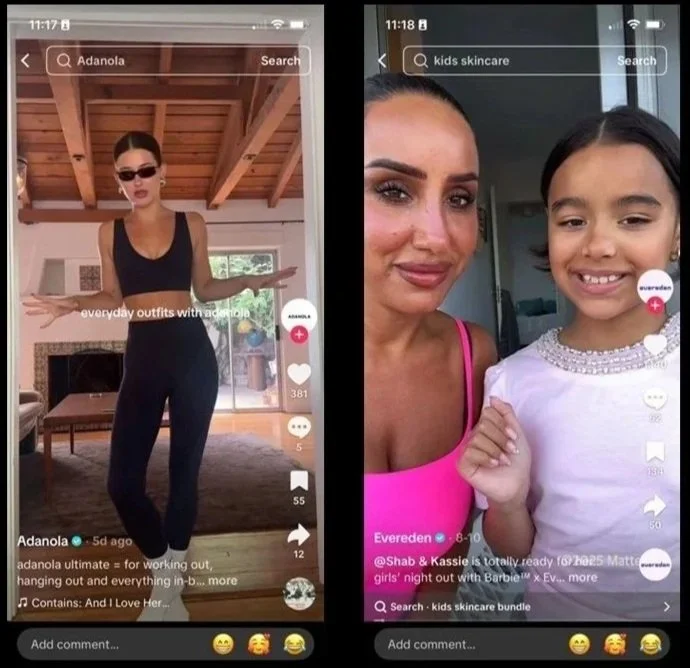
Left to right: Adanola, Evereden TikTok
The constant short-form content has affected how she watches other media: "I find it really hard to watch movies. […] I just go on my phone and I don't even realise it, I'm just scrolling on TikTok then I look at the time and I'm like, 'what the hell'."
Suzy’s experiences aren’t unusual. In the UK, 66% of children aged 3-17 use social media with 51% of under 13’s having their own profile.
While children may no longer be forced to work to survive, they are once again being used for commercial gain. And although children do receive something in return – entertainment, convenience – the question is whether this represents a fair exchange – and what opportunities are being lost in the process.
In this article we explore the aspects of children’s lives that commercial digital environments now dominate: play, entertainment and learning.

Entertainment: from embedded values to embedded marketing
The online entertainment platforms most popular with children – TikTok, YouTube Instagram – have been designed to keep users engaged to drive revenue.
Parents struggle to monitor highly personalised feeds, while regulators focus primarily on removing harmful content rather than ensuring what remains benefits children.
This creates a regulatory gap where platforms operate with minimal oversight regarding the developmental impact of their content, leaving children navigating digital environments designed primarily for engagement and profit rather than their wellbeing.
Children’s entertainment has shifted from shared stories with moral purpose to fragmented content designed for clicks
A cause and effect of platforms’ business model has been a shift in the subject of children's entertainment: from stories, often with some sort of moral message, to fragmented content designed for clicks.
Prior to the introduction of Freeview and the transition to digital television, five main Public Service Broadcasting (PSB) channels dominated UK TV viewing. Children mainly consumed content that had been approved as suitable for them. Children’s PSB TV content was – and still is – designed to entertain, educate and protect, with post-watershed content also having to uphold commitments to quality in terms of editorial integrity. PSBs are required to operate within a set of values which prioritise public good, including what is deemed to be beneficial and appropriate for children.
Commercial media products like books, newspapers and films were incentivised to be child-appropriate and often carried moral messages aiming to explore themes of right and wrong. While there was not always consensus about what was appropriate, crucially, parents and guardians could easily track what children were exposed to and make active choices about what they felt was suitable.
In the first few years of Children’s Media Lives – a longitudinal ethnographic research project tracking a cohort of children since 2014 – family TV viewing was common. As the years went by this became far more unusual and in 2018 we reported that consuming content had become more of a solo activity. If creators strayed too far from the values parents expected to see upheld, many children wouldn't be taken to view the film, be bought the book, or the TV would be turned off.
Stories, in books and film, while being influenced by societies’ values, also had a role in shaping them. The Iliad, The Lord of the Rings trilogy, among countless other stories have been widely known and shared throughout history. Many of these stories explored questions of right and wrong, and their messages stay with us, providing common cultural references. For many people, a book or film they encountered in childhood became a lasting influence on how they think and act.
The rise of individual content consumption on personal devices and tailored feeds means we are losing those shared cultural references. But it has also become much harder to have oversight of what exactly a child is watching and reading – parents and gatekeepers can no longer easily monitor or curate what children see. Most platforms set their minimum age at 13, a threshold that sits well below the age when young people can legally consent to many other decisions affecting their lives.
This loss of shared, editorially accountable content extends beyond entertainment and into news. Whereas previous generations might have absorbed news indirectly through family viewing of programmes like News at Ten, or by encountering editorially curated newspapers designed around shared standards of truth and accountability, children today are largely missing out on that collective news experience. The “news” they come across online often arrives in the form of short, decontextualised clips or influencer commentary, detached from any clear editorial process or public oversight. Much of it appears without recognisable branding, making it difficult to tell who produced it or what agenda may sit behind it. Pieces are often stripped of context, background reporting or even timestamps, blurring the line between current and outdated information. Increasingly, the rise of AI-generated content adds a further layer of uncertainty, making it harder still to know what is genuine or true. It is not that children are turning to social media for news, but rather that it is woven into the same feeds that serve their entertainment – content surfaced for engagement rather than accuracy. In losing these shared, regulated sources of information, children are also losing a common framework for understanding and questioning the world, and with it, an important element of media literacy and civic trust.
By year seven of Children’s Media Lives, in 2021, group viewing round a TV set was far more unusual “I don’t even know the last time I watched live TV […] I prefer to watch movies or Netflix or play on my Xbox.” Ben, 13 (2021). There is now little incentive for creators to consider societal values or develop meaningful stories with moral lessons.
Entertainment has primarily turned into children alone in their room, glued to short-form video platforms like TikTok and YouTube Shorts. On them they are served endless feeds of clips, often just seconds long, frequently splicing together unrelated videos, with the content rapidly tailored to whatever keeps them most engaged.
Deep dive: TikTok
Among the older children in Children’s Media Lives, TikTok is one of the most popular short form video platforms. When we ask children about their TikTok feeds, they often describe them as “random” – content with no plot, made-up words, and little meaning beyond social media.
Children themselves recognise this as problematic. The rise of the term “brain rot” among young people reflects a growing awareness that much of what they consume online lacks substance or value.
In our research, children frequently tell us they regret the time spent watching such content as soon as they put their devices down. When asked to reflect on what they've seen, they struggle to remember specifics, acknowledging that the content “doesn't mean anything” to them and serves no purpose beyond momentarily filling time.
It’s a long way from the carefully curated world of PSBs or the children’s books that once shaped childhood, with the move towards solo consumption making it more difficult for parents to have any oversight of the media their children consume.
In a notable change, this type of social media does not feature dedicated and well-defined ad breaks, as on broadcast TV. Instead, content creators tend to seamlessly embed selling into entertainment via sponsorships, brand endorsements, and product placement
In some cases, children themselves become financially-motivated creators, earning an income from live streaming – with the platforms taking a cut.
Entertainment has become indistinguishable from marketing
Unlike the dedicated ad breaks on TV, selling is embedded into the entertainment content on platforms.
Children struggle to distinguish between entertainment and marketing when the boundaries are deliberately blurred, with influencers positioned as trusted friends whose product recommendations feel like personal advice rather than paid promotion.
During one interview, Keeley, 8, a Children's Media Lives participant, showed researchers a 'Beyond Family' YouTube video testing Amazon products, clearly enjoying it. Yet when a separate Amazon pop-up interrupted viewing, she exclaimed, ‘I hate ads!’ This indicates the blurred line between clearly labelled marketing content (i.e. a pop-up advert) and more subtle forms of marketing (i.e. sponsored videos).
One of the biggest drivers of commercial success for platforms now is selling products, without any need to uphold the values that used to be essential for keeping parents onside. The result? A fragmented media diet filled with commercial messages that children absorb uncritically.
Who profits from children’s entertainment?
The commercialisation extends beyond products sold directly on platforms – children’s data itself has become a valuable currency. Yet many young people don’t fully grasp what's happening to their information. In Children's Data Lives, our longitudinal ethnographic project for the ICO examining what children understand about data collection and use by social media platforms, we’ve found that even older teenagers have limited understanding of how their personal information is collected and monetised.
“I don't know if I've ever agreed to a contract online, but I’ve definitely agreed to a contract in real life.” (Jamie, 16)
“You normally have to accept [cookies] to be able to make an account…I don’t really know what they are, but you always get them on apps, if they can have access or something like that on websites.” (Orla,16)
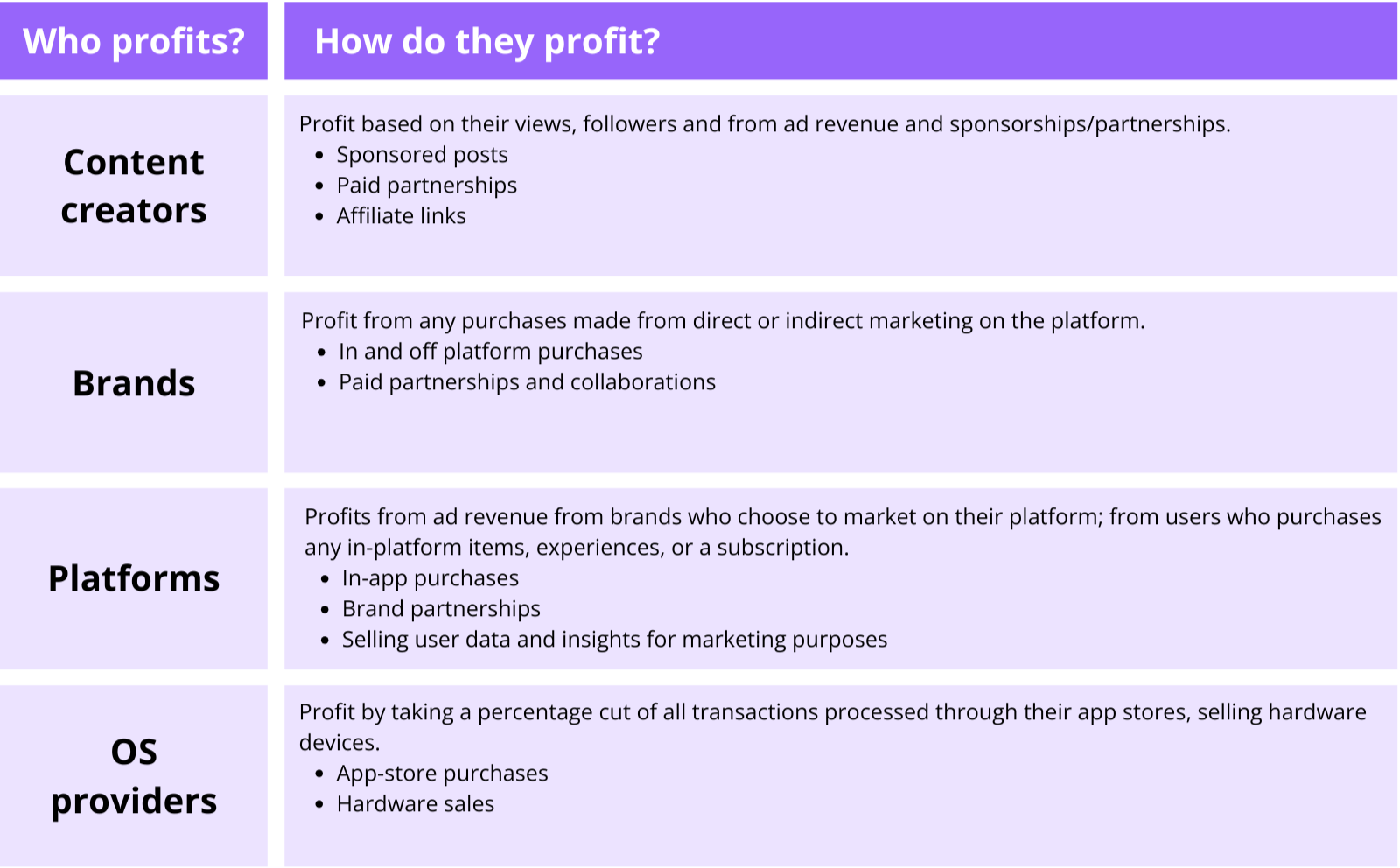
Children are unknowingly participating in a system where their profiles, viewing habits, and preferences are packaged and sold to brands, who then use these same platforms to target them with increasingly sophisticated marketing.
What might this mean for childhood?
If children are no longer encountering stories that explore good and evil, moral dilemmas, or overcoming adversity, where are they begin to learn how to navigate life’s challenges? How do they develop resilience and problem-solving skills without narratives that model these processes?
What are the long-term effects of growing up in environments where advertising and commercial messages are seamlessly woven into every piece of content they consume? How does this constant exposure to marketing shape their ability to think critically about consumption, authenticity, and their own desires?
How will today’s children feel as adults when they realise the extent to which their childhood entertainment was designed not to enrich their development, but to extract profit from their attention and data? Will they view this as a natural part of growing up, or as a form of exploitation they wish to protect their own children from?
Play: From community playgrounds to commercial platforms
The word “play” in the context of childhood might conjure thoughts of playgrounds, story-telling, board games and brightly coloured toys. Play has the potential to be imaginative, creative, messy, human and social, helping children learn how to share, win, lose, communicate, entertain themselves and bounce back up after a fall.
Over the years of observing children’s lives we’ve seen a clear shift: play has moved indoors and onto screens.
With this transition play has started to mean something quite different.
When Children’s Media Lives started in 2014, although gaming and social media platforms were already popular, many of the children we spoke with still spent evenings and weekends playing outdoors, going to various clubs and cultivating hobbies. This year, while some children continue offline hobbies, many now spend substantial out-of-school time online.
Online play loses many of the fundamental benefits that come with face to face and tactile fun. It often consists of point scoring or repetitive ‘grinding’ to earn rewards. Games are ready made and require little imagination to engage with, and while they frequently include multiplayer options or social hangouts, this takes the form of shouting over headphones or typing into a chat box, rather than rich face to face interactions.
Online/video games have moved from one-time purchases to ongoing revenue models
In 2015, year two of Children’s Media Lives, we noticed that the business models of games had started to diverge into two broad directions. Traditional video games followed a ‘pay-to-play’ model, where players pay a substantial upfront cost for a complete experience. These games usually take hours to complete and feature narrative arcs that lead players through a story.
“I much prefer playing a game that’s kind of thrilling, that I can work out a strategy for and actually enjoy the playing itself, rather than just the winning. The play is more important than the win” Ade, 14 (2015)
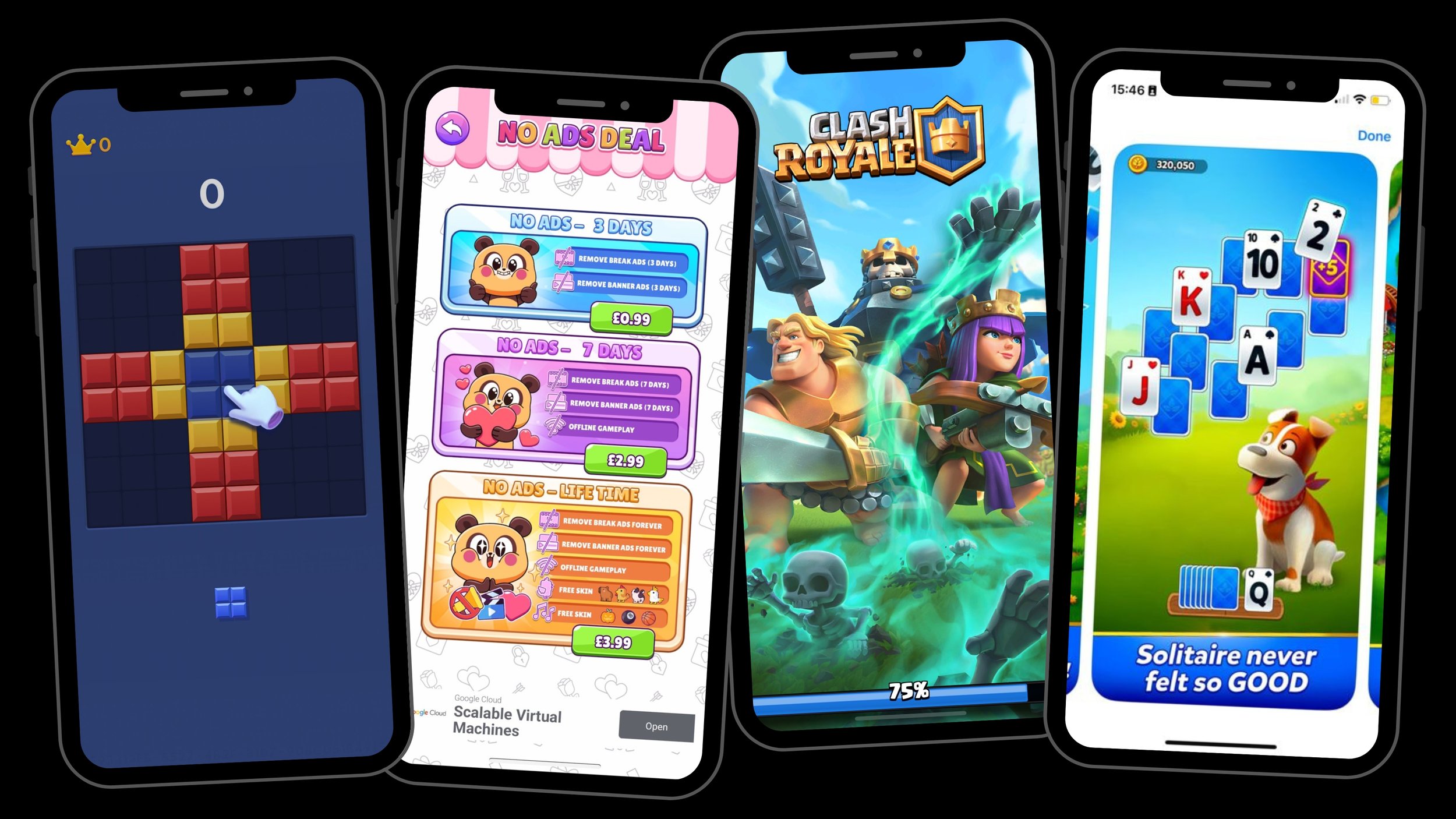
But we also witnessed the rise of ‘pay-to-win’ games – free to download but designed to encourage ongoing spending on coins, skills, or levels that offer progression or advancement, and often accompanied by in-game advertising.
Deep dive: Roblox
There are many online games and platforms we could use as an example, but one space that overwhelmingly dominates children’s digital play, particularly for younger users, is Roblox. This hugely popular online platform combines gaming with social interaction and has achieved remarkable reach – reporting an average of 82.9 million daily active users in 2024 alone.
Rather than a single game, Roblox is an open platform where anyone can create games, hangouts and experiences – though the most successful are usually supported or owned by commercial partners. Children use it not just to play games, but to talk to others in virtual social spaces, making it both a social network and a gaming platform.
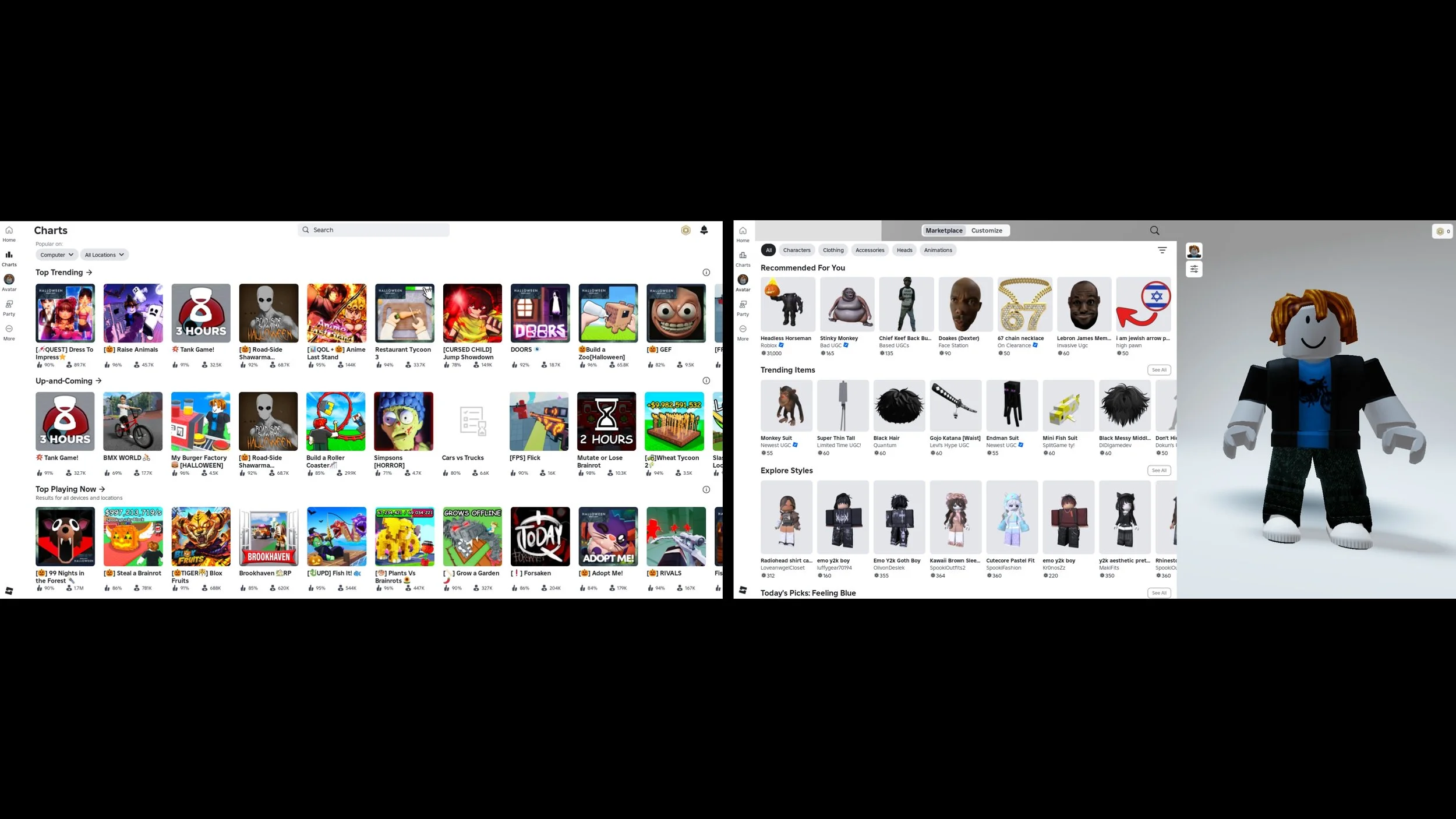
Roblox charts and marketplace
Children log in, choose from a vast menu of games, and can complete set activities to earn rewards or Robux – the platform’s in-game currency which can also be bought with real money. They can customise their avatars with outfits and accessories, many of which require Robux to access.
Avatars are blocky and anonymous, games are simplistic and fast paced, and our recent investigation into Roblox found there is no real human oversight keeping an eye on what children are doing. As a result ‘socialisation’ on the platform often descends into crude and sexual insults, missed by AI moderators; experiences and games can be accessed by children that are entirely inappropriate; and we hear from exasperated parents of children who have covertly spent large amounts of money on virtual items or had their Robux stolen by another user.
One of our Children’s Media Lives participants, Zak, 14, often spends the majority of his £20 weekly pocket money on Roblox.
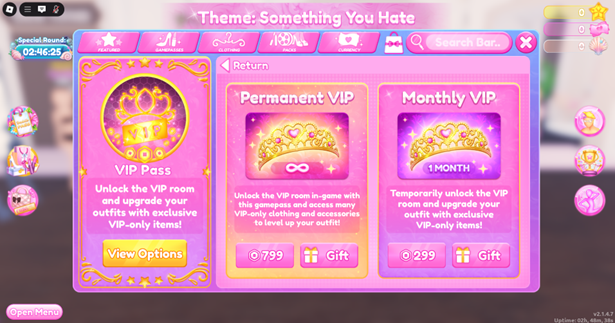
Dress To Impress
On the platform he plays the game ‘Dress to Impress’ where users are scored by other users on how well they dress their characters to a set theme. To access more outfits and styles for his character, Zak needed VIP status, purchasable with Robux. “I bought VIP a few weeks ago...I think I got the £19 one”.
If children aren’t seen to be spending on the platform this can be hugely embarrassing for them amongst their peers. We heard from children that players with the default, unpaid for avatars and outfits are seen as poor or uncool – they are “bacons” or “noobs”. Children see their avatars on Roblox as an extension of themselves, and making sure they look good has replaced social indicators like having the latest trainers at school – this is the place where children now socialise, get clout, show off and impress their friends.
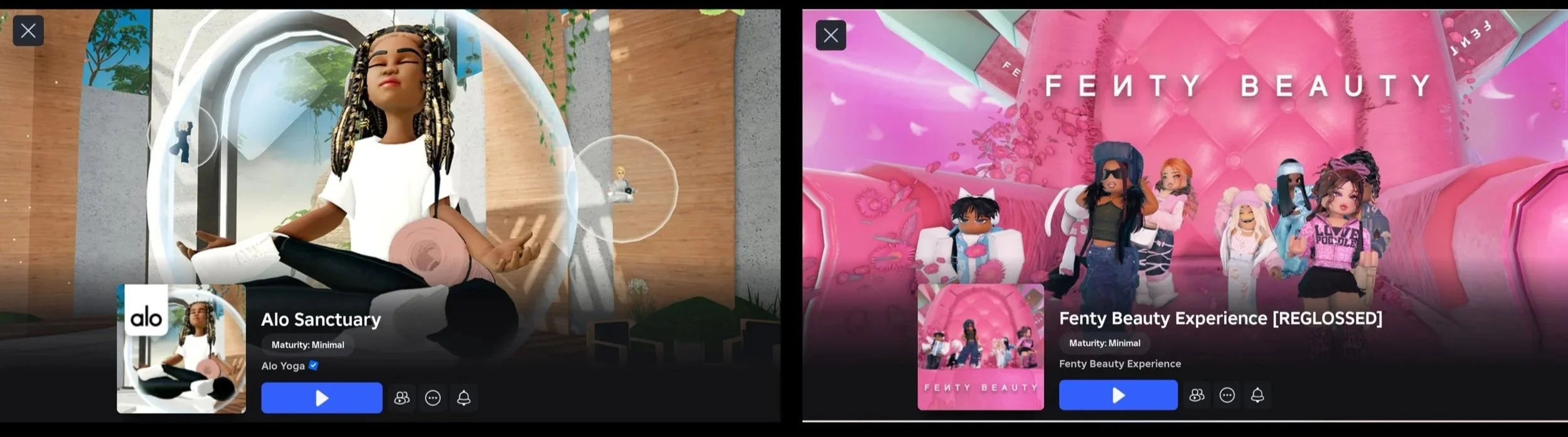
Alo Sanctuary and Fenty Beauty Experience
The design of the platform reflects this; experiences encourage users to buy and sell to get ahead. Major brands like Fenty Beauty, Gucci, Alo Yoga, and E.l.f. sponsor games, offering purchasable items, or selling real products in-game. Some have virtual stores, like IKEA, which launched “The Co-worker Game” to much fanfare last year, and initially offered paid roles for users to ‘work’ at the store. Even supposedly free games on the platform encourage spending through skins, extra lives, or cosmetic upgrades.
Who profits from children’s play?
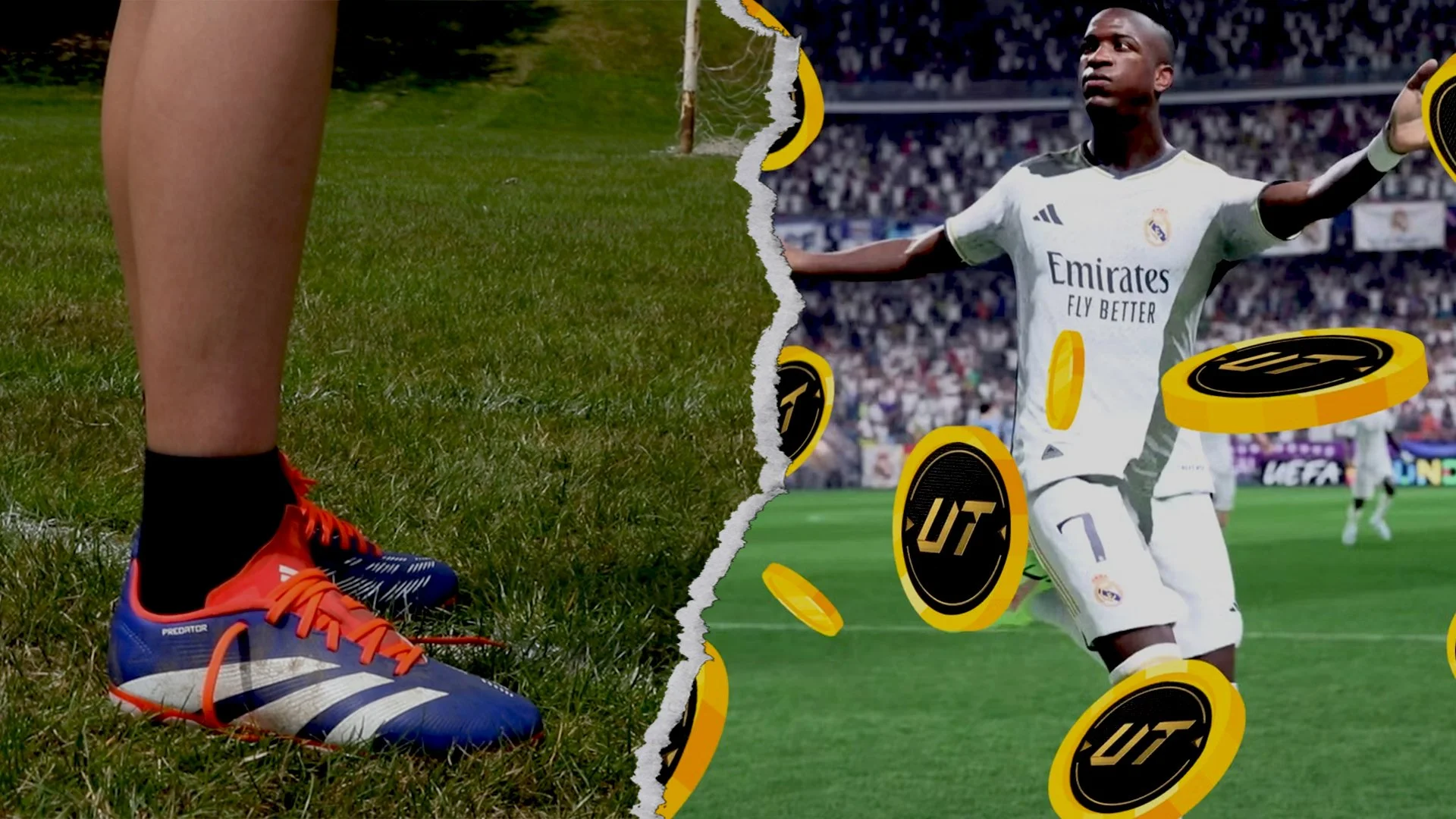
Environments like Roblox, have done all they can to engage children, and whether intentionally or not, replaced the playground. Many children are spending all of their free time playing online games, whether Roblox, Fortnite, NBA 2K or EA Sports FC (formally FIFA) at the exclusion of hobbies, outdoor play and face to face social gatherings.
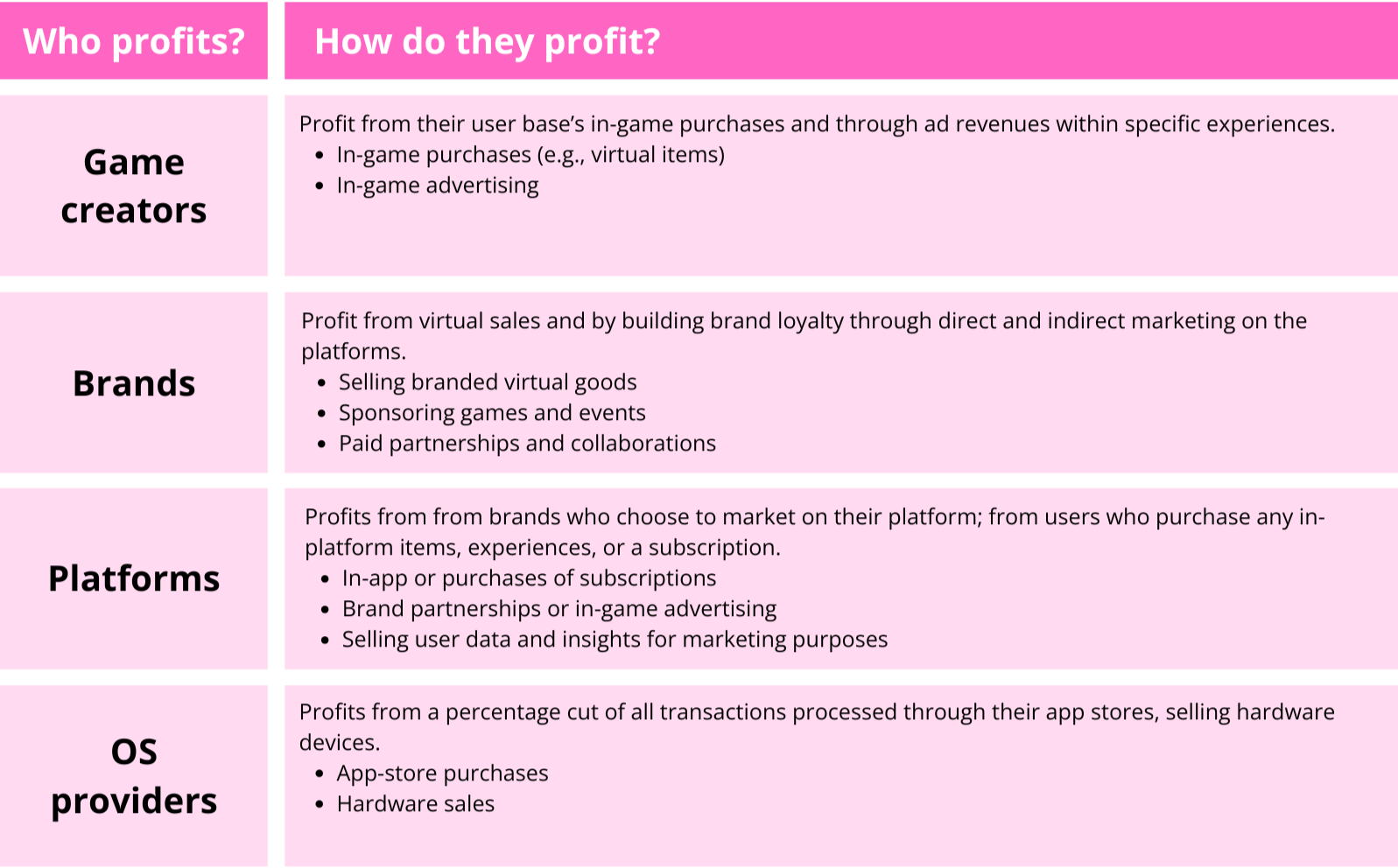
This creates an ecosystem where every layer of the system – from game creators and brands to platforms and OS providers – has a financial stake in keeping children engaged and spending, with no participant incentivised to prioritise children’s wellbeing over profit.
What might this mean for childhood?
If children are spending their formative years primarily in virtual environments rather than navigating face-to-face interactions, how will this affect their ability to read social cues, manage conflict, and build genuine relationships in the real world?
Unstructured play has historically been where children learned to innovate, problem-solve, and combat boredom. What does it mean for creativity and resilience when play becomes increasingly structured and monetised?
What opportunities for physical development are being lost as gaming replaces active play? Are children missing out on developing coordination, strength, and the physical resilience that comes from climbing, running, and exploring the real world?
When free play options are deliberately inferior and advancement requires payment rather than effort, what does this teach children about merit, persistence, and the value of working toward goals?
Learning: from mastery to metrics
The commercial reshaping of childhood doesn’t stop at leisure time. We’ve also watched it seep into classrooms and learning at home.
During the Covid-19 lockdowns, the urgent move to online learning was met with a rapid response from developers. There are now over 500,000 ‘educational’ apps available on app stores such as Apple App Store and Google Play, with apps like Kahoot and MyMaths being used by children to learn, revise or complete levels as homework tasks.
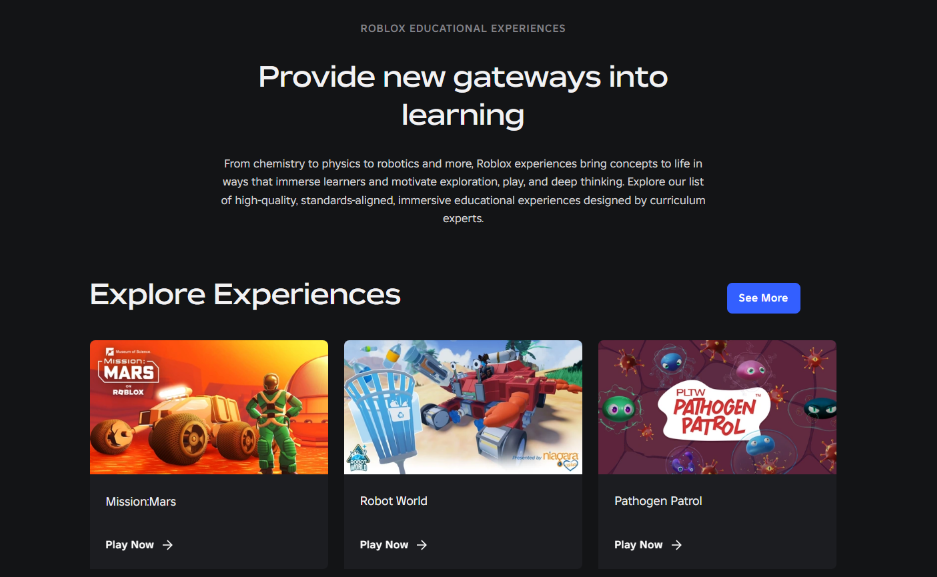
Roblox educational experiences
Children say they enjoy spending their free time on platforms like Roblox playing mini games to earn rewards, so why not replicate this model with an educational angle?
But there are costs to this approach. Design elements in games like badges, leaderboards, competitions, and points have been found to have unintended consequences. This included worsened performance, motivational issues and lack of understanding.
An example many people will be familiar with – Duolingo, one of the most popular language learning apps – uses gamification extensively: streaks, XP points, leaderboards, and virtual currency called ‘gems’. While the app is effective at building vocabulary through repetition and game-like exercises, it’s only one tool, and a limited one.
It misses what makes language learning meaningful: real conversation. There’s no one to laugh when you mispronounce something, no embarrassment when you get grammar wrong, no vulnerability in stumbling through a conversation. If you miss a day, you just lose XP points or spend ‘gems’ to repair your streak. There’s no real consequence – learning becomes about maintaining digital metrics rather than developing genuine capability.
When learning gets optimised for measurement, something crucial gets lost. Gamification encourages children to chase points or badges rather than actually exploring ideas or developing mastery.
There’s also little oversight of what actually counts as educational. A major parliamentary inquiry in 2024 found that are no quality standards these apps must meet to call themselves ‘educational’. The committee noted that many schools encourage their use, “but there is currently a poor evidence base regarding which are most effective.”
Commercial digital platforms are now a core part of school systems
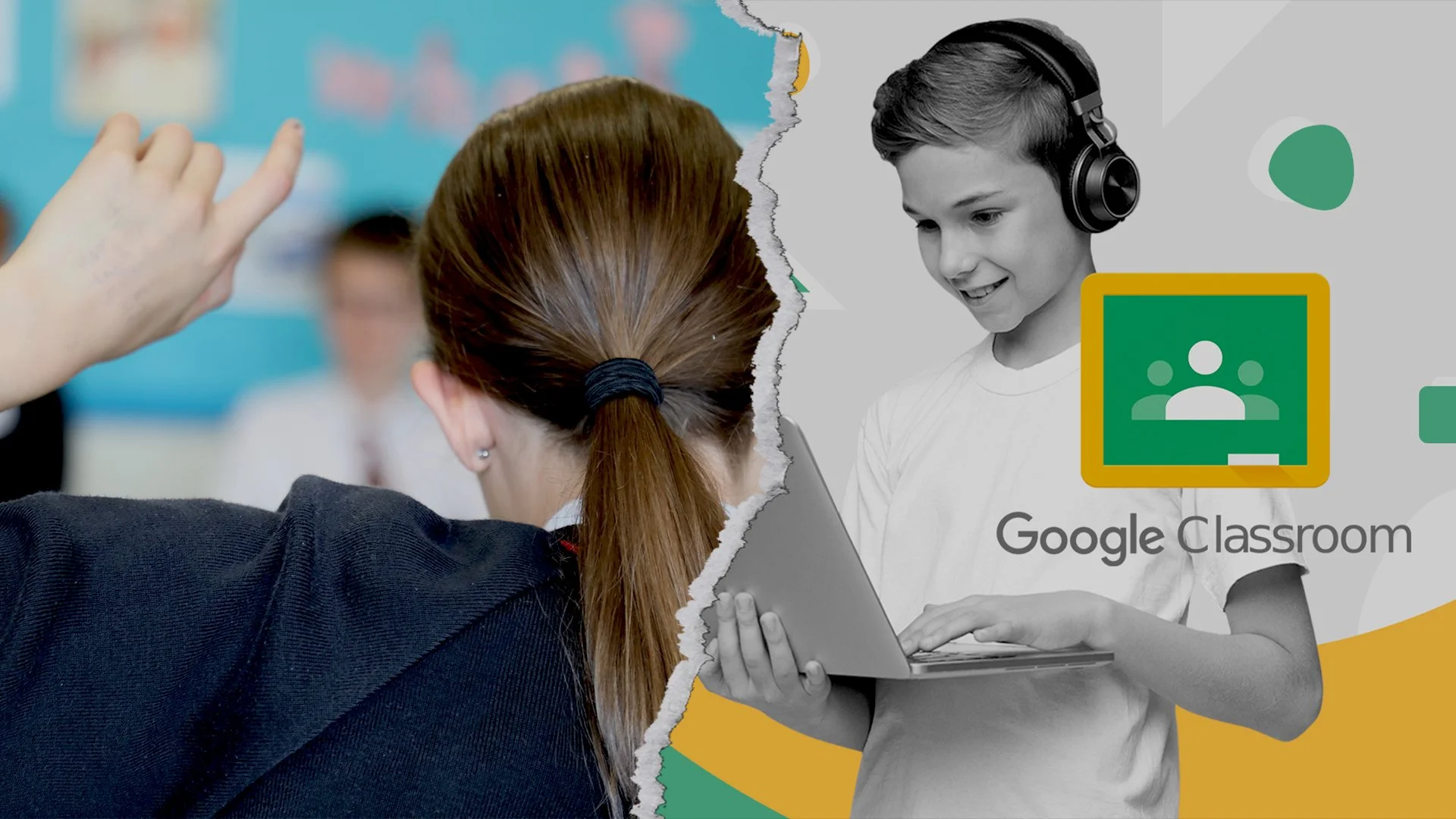
Schools aren’t just using digital platforms to set practice tasks for students. In the first month of the pandemic, the number of active users of Google Classroom – a platform of online tools for education providers – doubled to 100 million.
This figure is likely still growing. Management platforms like Google Classroom and Microsoft Teams are embedded across everything from timetables and homework to marking and teacher communication. In many schools, a single corporate platform has become the “master key” for everything from lesson planning to pastoral records.
These tools have been introduced to support teachers in carrying out administrative tasks, but in doing so they also control how learning is planned, delivered, tracked, and assessed.
Digital platforms also play into human tendencies towards ease and efficiency. Technology often promises to make our lives simpler, and we are naturally inclined to accept that offer. Tasks that once required time, effort and judgement are streamlined or automated – and in education, that convenience is hard to resist. When platforms provide instant feedback or automate marking, both teachers and students may come to prefer the speed and certainty they offer. But this efficiency can have a hidden cost: it discourages deeper engagement, patience and reflection. By making learning and teaching processes effortless, technology risks dulling the curiosity and critical thinking that genuine understanding depends on.
For these platforms to work properly they require the input of large amounts of data. This means reducing children’s progress to points or grades that enable consistent scoring and tracking over time – which lends itself to forms of learning which are more ‘gamified’.
Tasks which require creative problem solving or responses which are open to interpretation are less easy to score. Automated marking and feedback strip away the human interpretation that can nurture confidence, curiosity, and resilience. The focus shifts from understanding to hitting performance metrics.
Who profits from children’s learning?
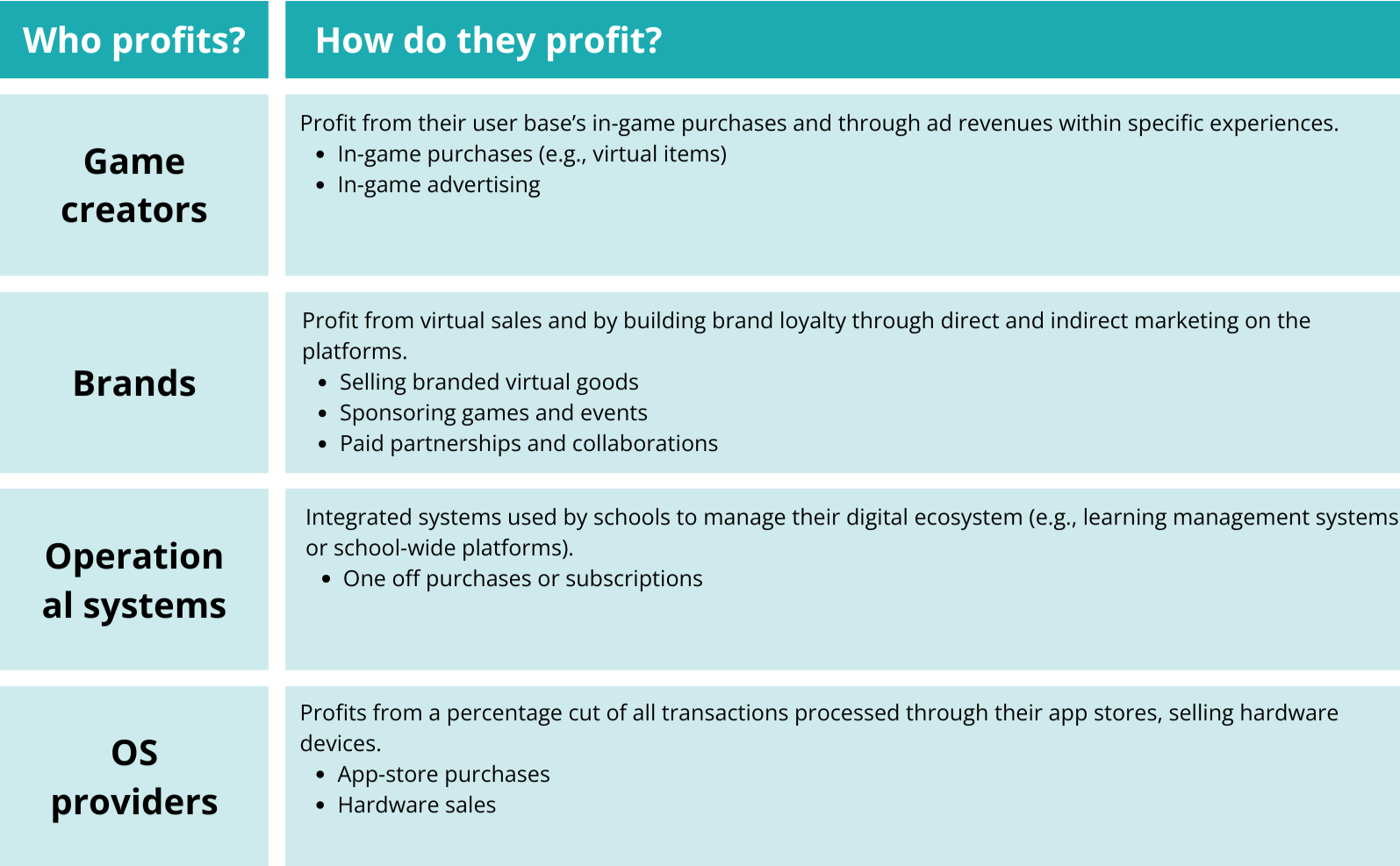
These platforms often require teachers and children to create personal accounts to gain access. Their data becomes part of the commercial ecosystem. Platforms have detailed educational profiles for each child – demographics, attendance, homework scores, behavioural notes – all of which have the potential to be monetised.
What might this mean for childhood?
Unlike traditional educational materials that schools own, children’s learning records and achievements now exist within private company systems that could disappear overnight. What happens to children’s educational progress and data if these commercial providers suddenly shut down or change their business models?
How will the vast amounts of data collected about children’s learning patterns, struggles, and abilities be used as they grow up?
When children become accustomed to receiving immediate feedback, hints, and gamified rewards for learning, how will they cope with real-world problems that require sustained effort, ambiguous thinking, and tolerance for uncertainty?
Could creativity be devalued simply because it’s harder to measure and score?
Data as the product
Across the play, entertainment and learning environments that dominate childhood, data is the primary product.
Where platforms are free to join and use, they profit from user data. Children often have little concept of this.
Every tap, swipe, and login produces data: attention spans, preferences, scroll habits, locations, as well as names, contact details, and images that children upload. Once collected, it powers personalised feeds, targeted ads, and the design of new features, creating a feedback loop: what’s shown to a child shapes what they engage with, which generates more data about their preferences, which shapes what they’re shown next – alongside ever-more precise marketing.
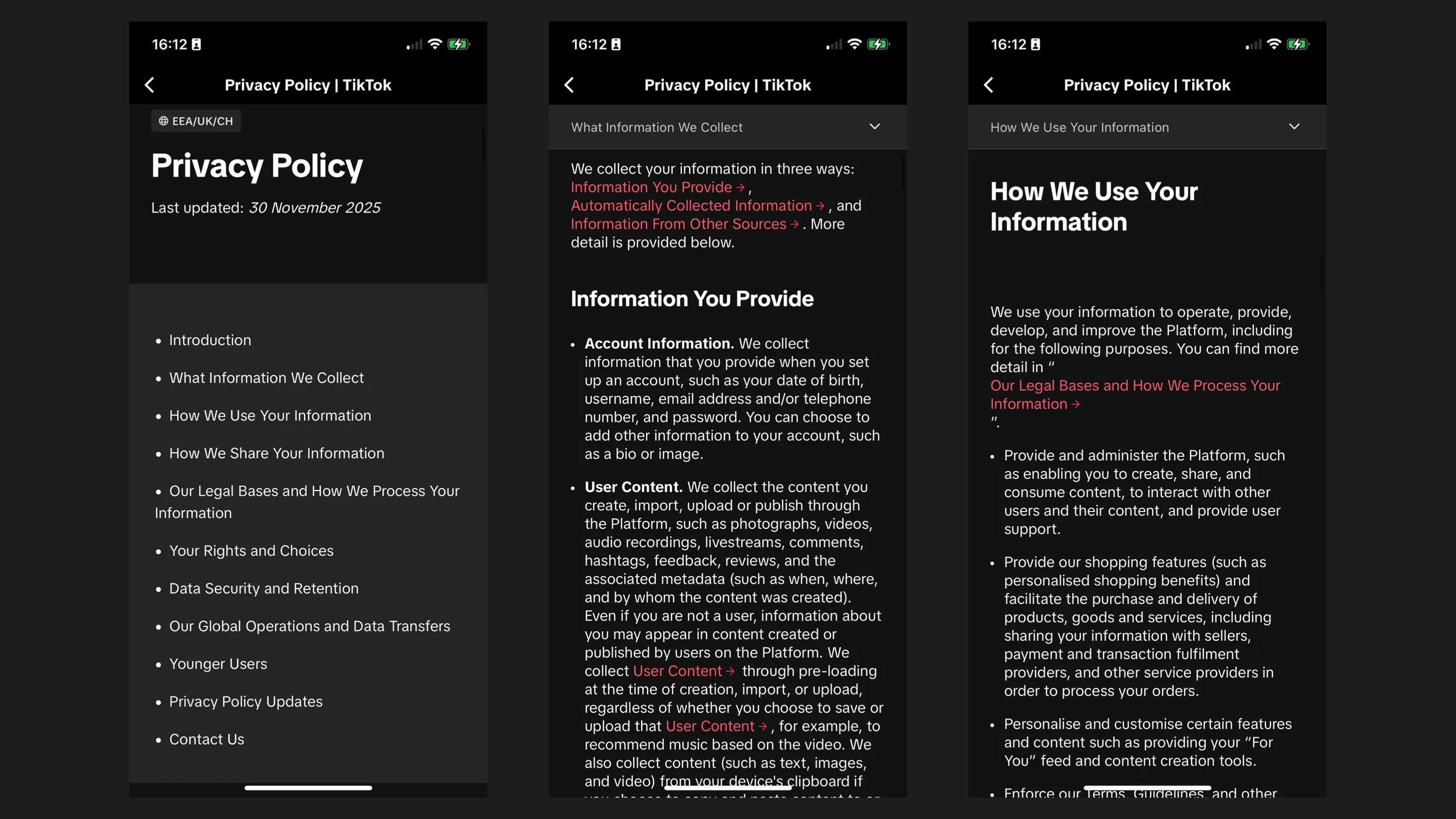
In many cases, companies know more about a child’s behaviour and interests than their parents do.
Maximising time spent consuming content to sustain this feedback loop is what platforms are designed for, not to create nurturing, safe, creative environments for children to grow up in.
By doing so a handful of businesses have manufactured environments that are integral to childhood today. They are where children spend their free time, where they chat to friends, where they pick up phrases and references to repeat at school. Exclusion from these spaces often equals social exclusion.
Platforms have monopolised childhood.
What kind of adulthood follows a commercialised childhood?
You know the old saying: it takes a village to raise a child. Villages had a vested interest in children doing well. Communities enforced shared values and provided moral guidance to ensure children were brought up according to what they believed was right. It was by no means perfect, but the role once played by villages is increasingly being filled by companies and the commercial platforms they create.
The difference is fundamental: companies aren’t driven by values that prioritise children’s wellbeing. Regulators, by design, start from the technology, focusing on preventing specific harms – removing dangerous content, ensuring fair markets – addressing what shouldn’t happen rather than what should. But there’s an absence of starting from children themselves, alongside a broader absence of vision around what kind of childhood we actually want children to have. This absence matters. Child development is one of the most established and evidence-based fields we have for understanding children’s needs - yet it’s barely present in policy conversations about technology, leaving decisions about children’s futures shaped by technical feasibility rather than developmental insight.
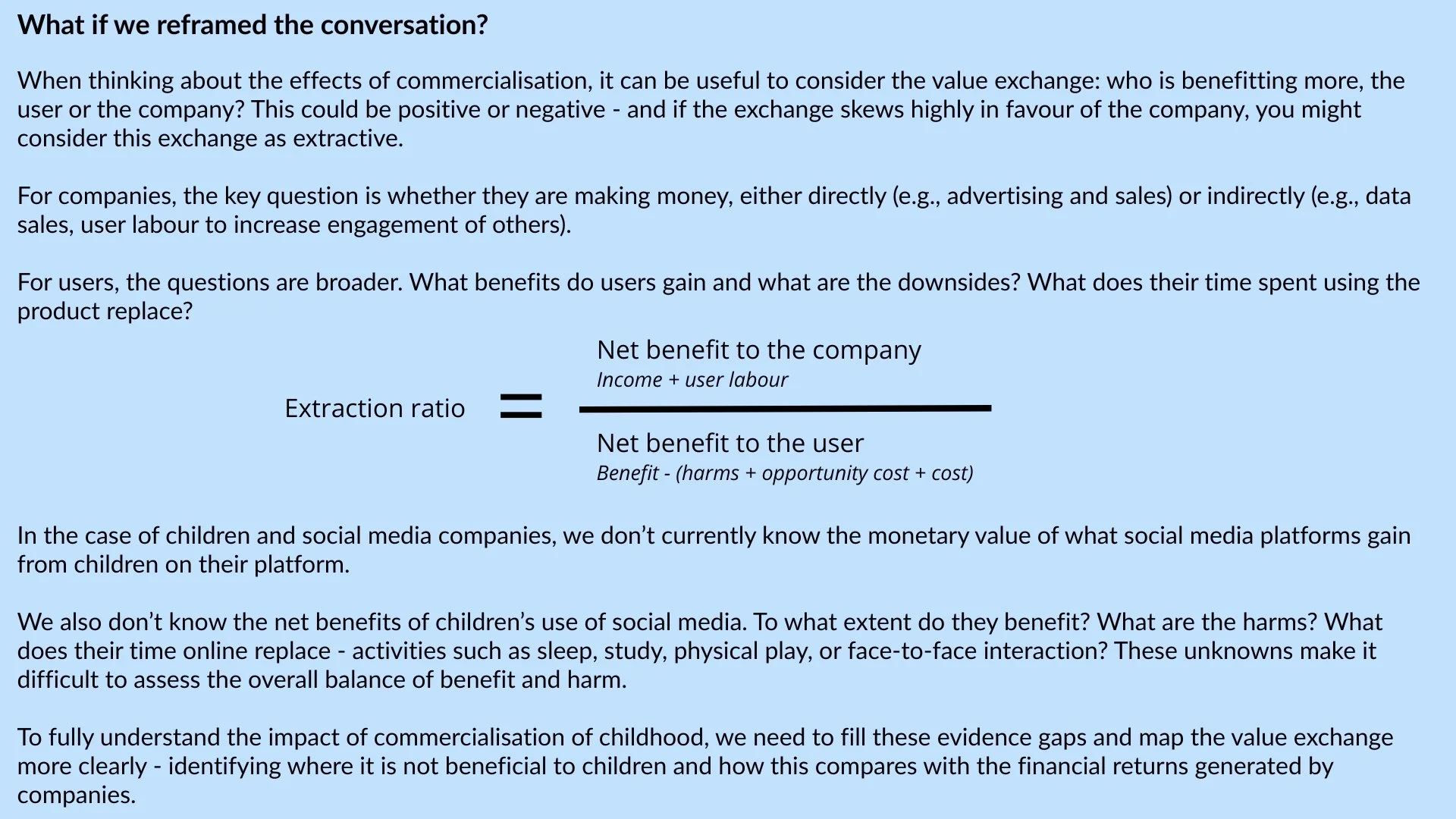
The internet is no longer simply a space you can visit and then log off from; it has become integrated into almost all aspects of life and culture. We’re watching the first generation grow up where the primary places they go to play, be entertained, to learn have been designed to capture their attention, harvest their data, or get them to spend money. Previous generations fought hard to free children from the factories and mines of the industrial age, yet we've inadvertently delivered them into new forms of commercial extraction. Unlike previous shifts in childhood – which involved active decisions, legislation, and societal discussion – this transformation has happened by default, with little scrutiny or challenge.
We’ve recently been exploring how young adults approach relationships, with some seeming to struggle with intimacy or relationship expectations. We can’t definitively attribute these challenges to their digital childhoods – but it raises questions about the impact on young people who spent their formative years in environments designed to capture attention rather than nurture development.
And this is only the beginning. The rise of AI promises even more personalised experiences – AI companions offering fake friendships, search engines delivering completely tailored results, and news feeds curated uniquely for each person. With AI's ability to learn vast amounts about individual users, we face the prospect of children inhabiting entirely artificial online worlds, with even less human oversight than today. The billions being invested in AI development by tech companies will demand returns, likely accelerating the monetisation of children's digital experiences.
Children themselves recognise they need guidance.
“Everyone leaves it to the kids, but we’re just kids we don't know, you know? So we need someone to guide us properly through it… until we’re a wee bit older.” (14/15 year old, Ofcom, Codes of Practice)
These corporations have filled a void that emerged as traditional institutions struggled to keep pace with digital transformation, treating their influence over children's development as a byproduct of their business model rather than a core responsibility. But this arrangement – allowed to emerge through our collective inaction rather than intention – forces us to confront a fundamental question: what kind of childhood do we actually want, and who should have the power to shape it?